
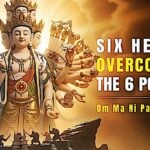
6 Avalokitesvara Heroes Overcoming 6 Poisons with 6 Syllables: Om Ma Ni Pad Me Hum: Enlightened Odyssey
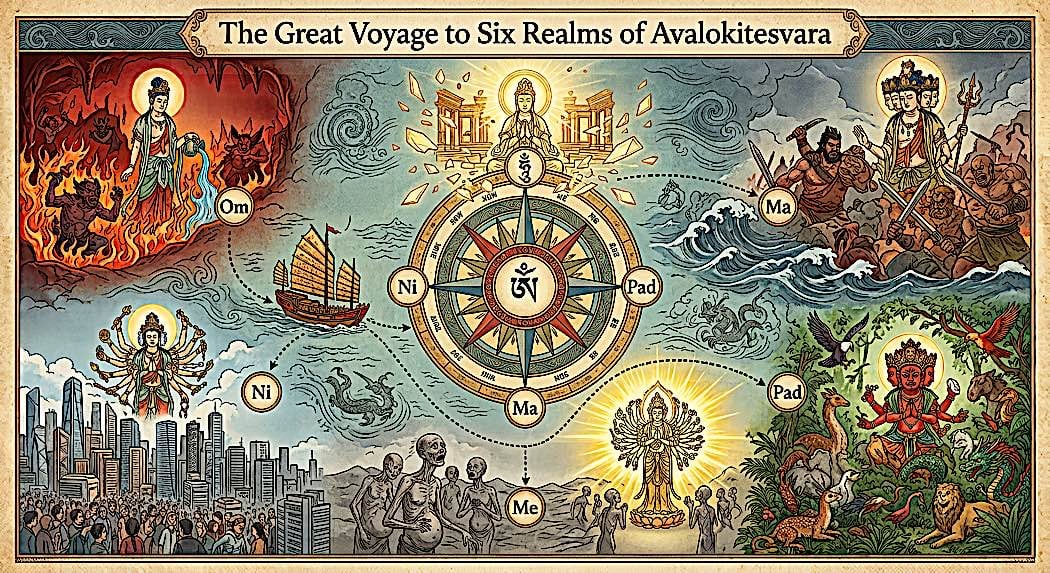
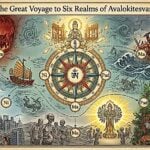
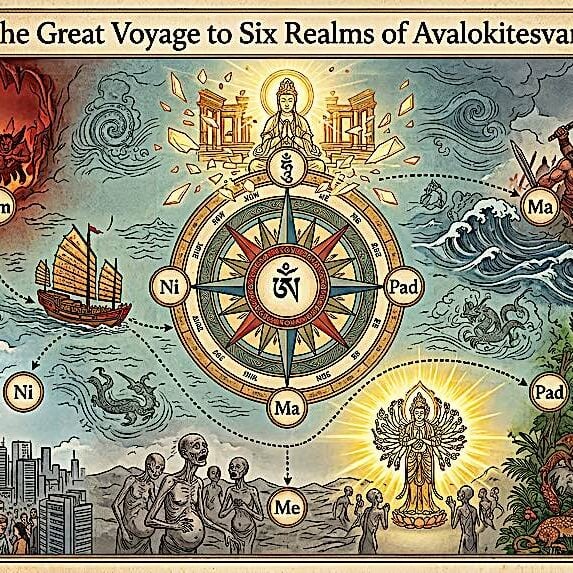
🙏 Enlightened Odyssey of Bodhisattva Hero Avalokitesvara: Adventures in the Six Poison Realms DON’T MISS THIS ODYSSEY ADVENTURE (with exciting animations or jump to chapters and scenes below if you want to visit only one of the six locations!) 🙏 🙏 🙏 🙏 🙏 🙏 And, yes, like any adventure, there is a TREASURE MAP:
☠️ The Six Poison Realms
Our Bodhisattva Captain, who sails us through the suffeirng of the six realms, pacifying the 6 Obstacles and Afflictions.
Why does Buddhism talk about poison? Because the hell realms, hungry ghosts, animals, humans, demigods, and gods aren’t just places on a map — they’re the six poisons of your own mind: anger, greed, ignorance, desire, jealousy, and pride.
And here’s the twist: you don’t need to be reborn to visit them. You live in all six every day.
NOTE: The video is a short introduction. For more details and references and all the citations referred to in this feature, see the remaining feature below.
WATCH THE VIDEO!:
Join us on an Enlightened Odyssey — a heroic voyage through the Six Poison Realms, guided by the Captain of our ship of Enlightenment, Avalokiteshvara Bodhisattva, in his six powerful forms.
- The Buddha is our Great Navigator.
- The Dharma is our Map.
- And the sacred Six Syllable Mantra — Om Mani Padme Hum — is our compass.
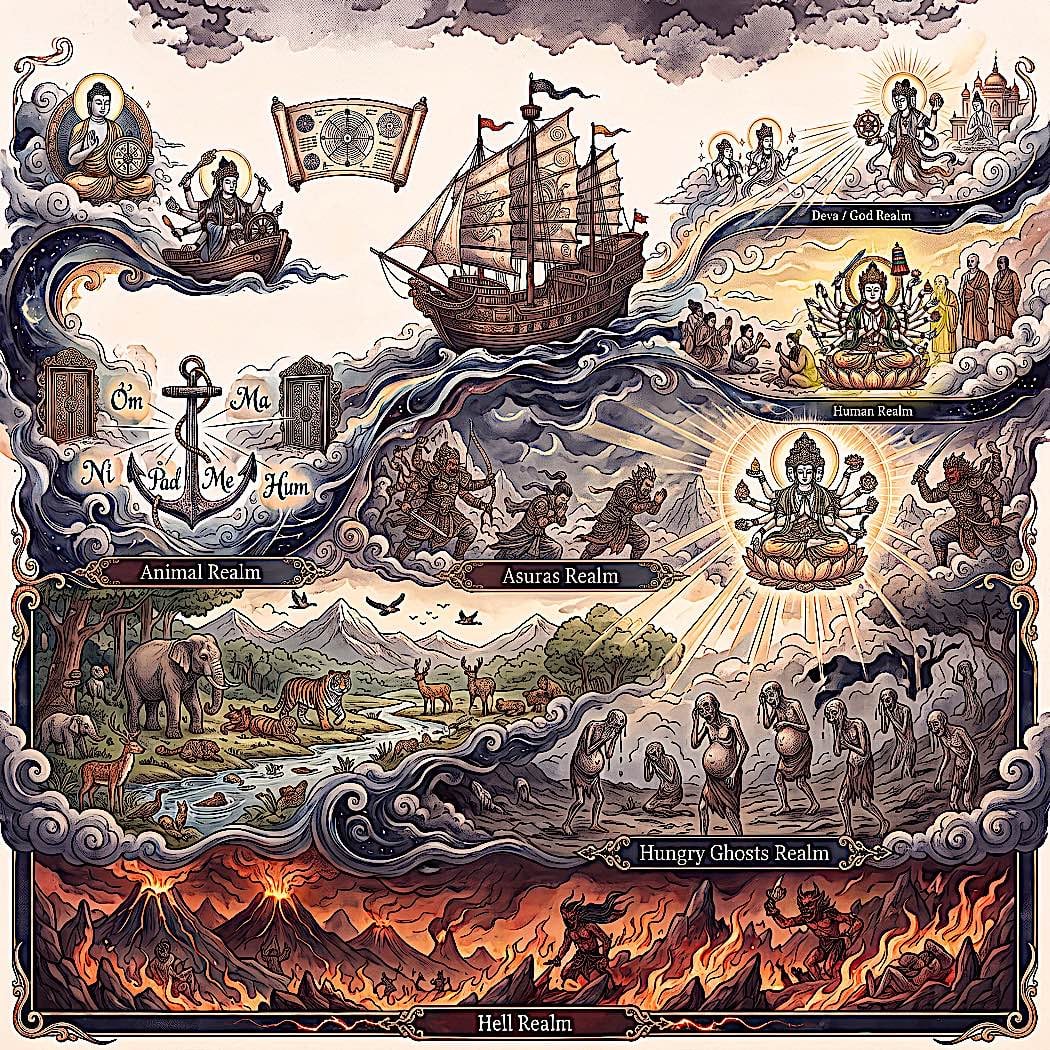
🛶 The Great Voyage: Buddha’s Map to the Far Shore
First taught by the 6th-century Tiantai patriarch Zhiyi in his Mohe Zhiguan, this ancient metaphor maps Avalokiteshvara’s six forms onto the six realms of Samsara — and onto the six poisons that keep us trapped. In Vajrayana, the same teaching is called “closing the gates.” Same truth, different maps.
One by one, we face each poison — and watch our Captain transform to pacify it:
🔴 Poison of Anger & Hate — Naraka-loka (Hell Realm)Fire, demons, and rage. Avalokiteshvara appears in his peaceful two-armed form, his serenity cooling the flames. Seed syllable: Hum.
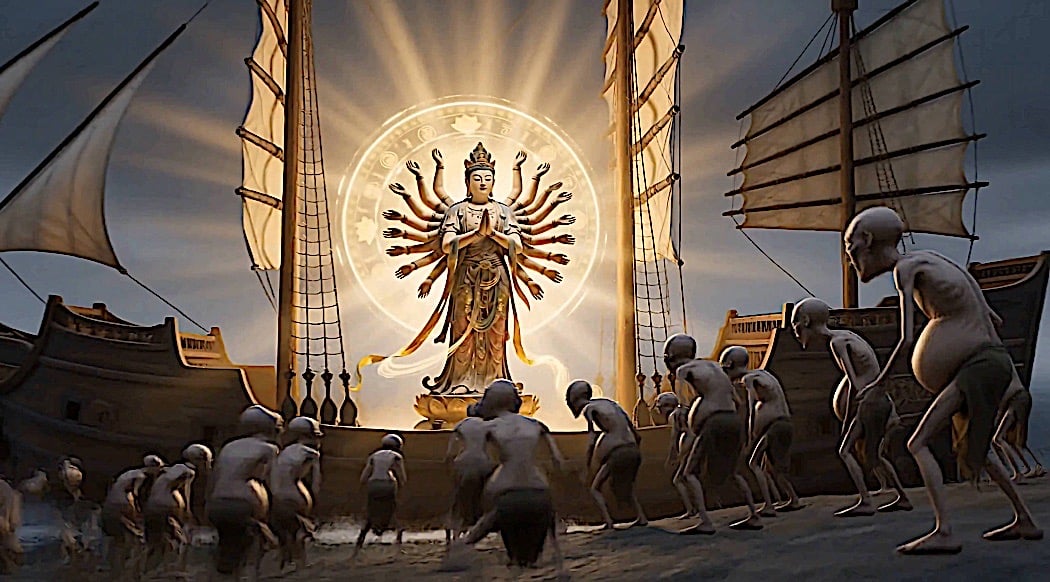
👻 Poison of Greed — Preta-loka (Hungry Ghost Realm)Never-satisfied ghosts with pot bellies and pin-mouths. Our Captain expands into his awe-inspiring 1000-Armed form, Sahasrabhuja āvalokiteśvara radiating golden light. Seed syllable: Me
6 Avalokitesvara Heroes Overcoming 6 Poisons withOm Ma Ni Pad Me Hum: Enlightened Odyssey
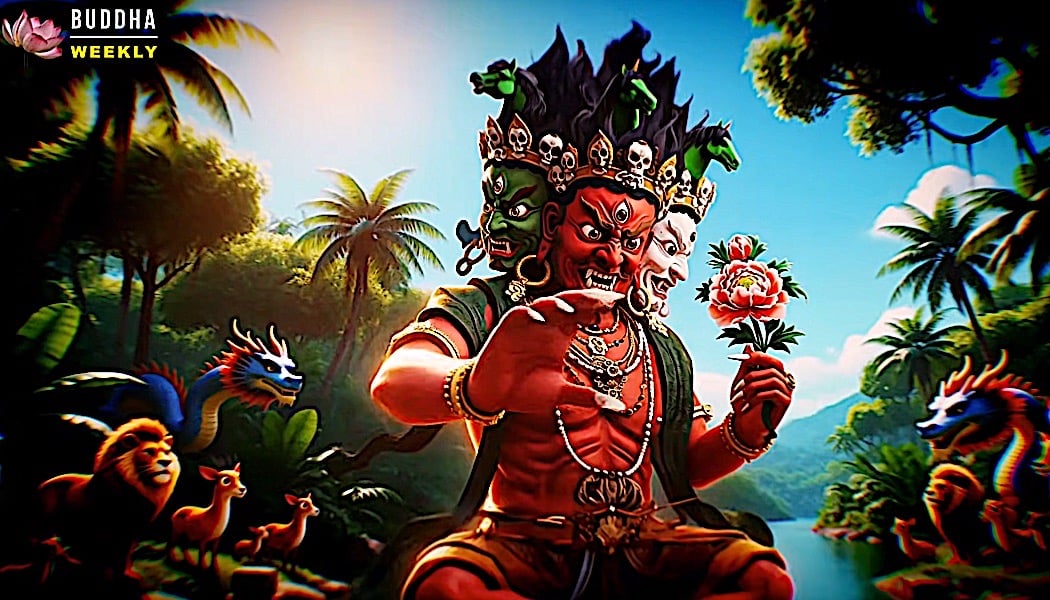
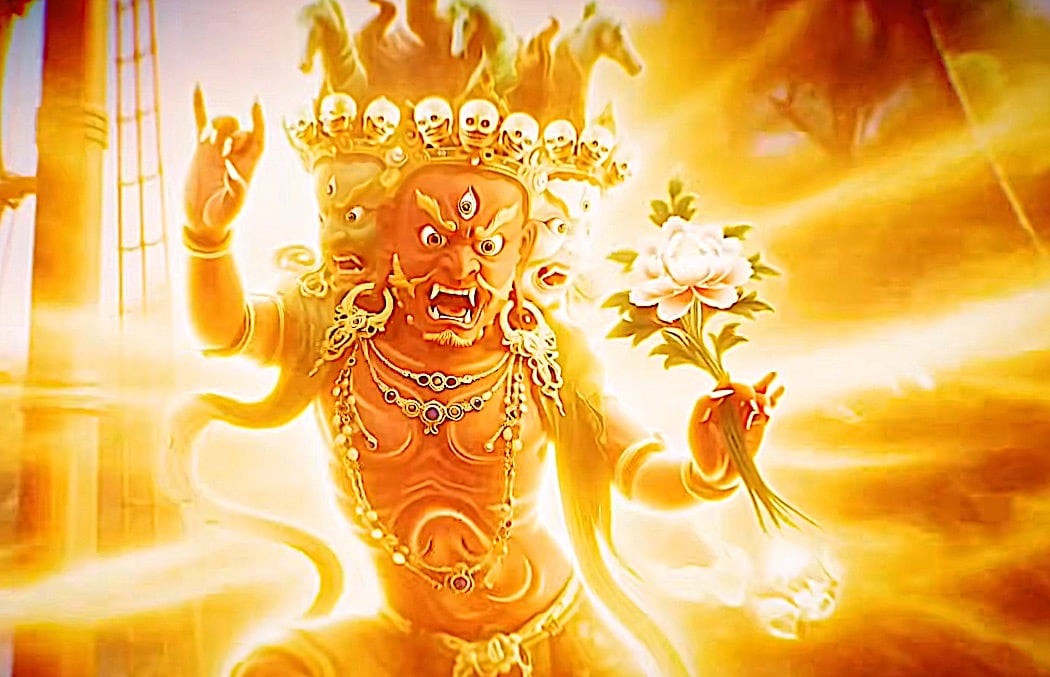
🐾 Poison of Ignorance — Triyak-loka (Animal Realm)A wild jungle where every creature devours another. Hayagrīva, Hayagrīva āvalokiteśvara, the horse-headed form, stills the beasts with his neighing, granting mirror-like wisdom. Seed syllable: Pad
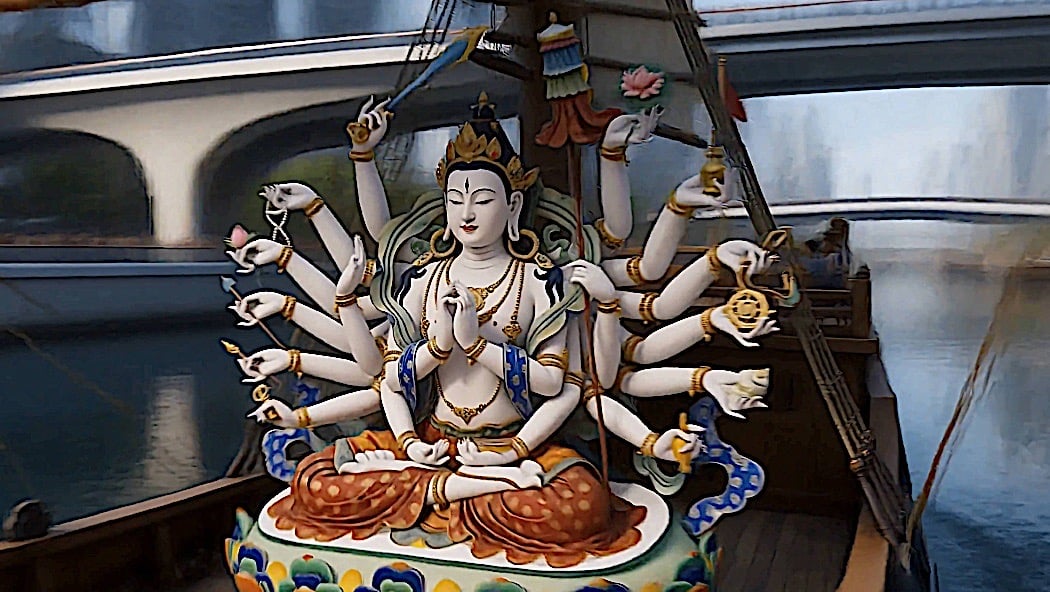
🏙️ Poison of Desire — Manushya-loka (Human Realm)Towering cities, endless cravings, no stars in the sky. The eighteen-armed Great Chundi appears, Cundī āvalokiteśvara, snatching away our attachments, granting discriminating wisdom. Seed syllable: Ni
6 Avalokitesvara Heroes Overcoming 6 Poisons withOm Ma Ni Pad Me Hum: Enlightened Odyssey
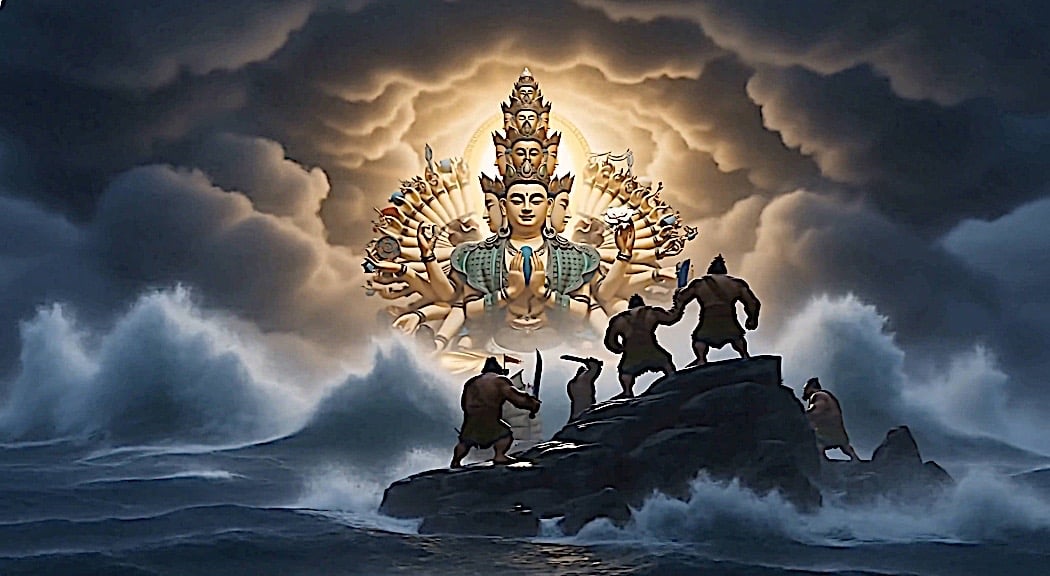
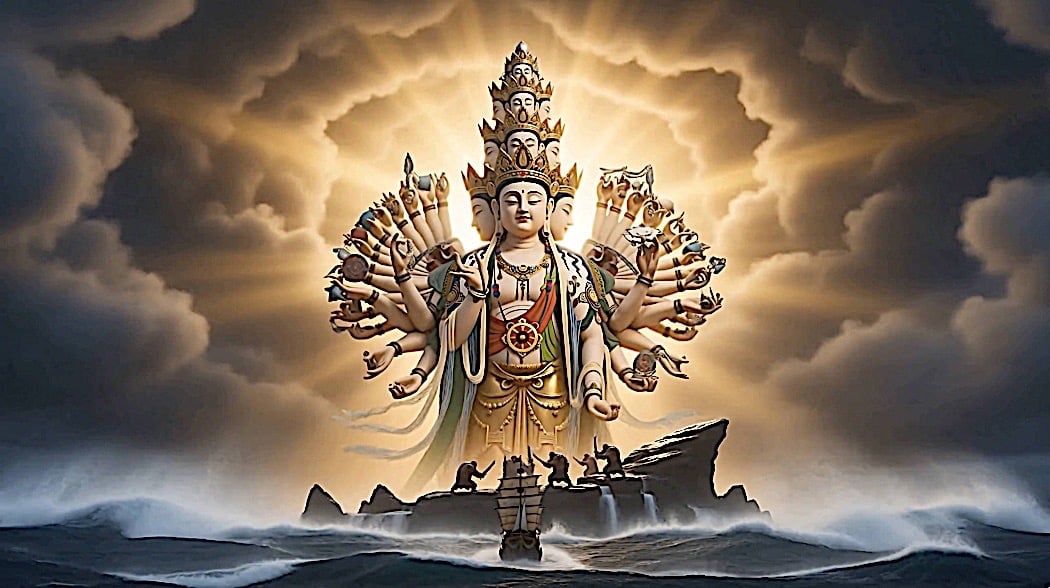
⚔️ Poison of Jealousy — Asura-loka (Demi-God Realm)Storm-tossed seas, warring giants, envy of the gods. The eleven-headed Avalokiteshvara, Ekādaśamukha āvalokiteśvara towers over the waves, calming the Asuras with golden light. Seed syllable: Ma
🌸 Poison of Pride — Deva-loka (God Realm)Divine music, jewelled trees, a beautiful unmoving dream. Chintamani Chakra Avalokiteshvara, Cintāmaṇicakra āvalokiteśvara holds the wish-fulfilling jewel — the Om itself — dissolving even divine delusion into Space-Like Wisdom. Seed syllable Om
📖 NOTE: The six seed syllables of the Om Mani Padme Hum are the syllables of each of the six Avalokitesvaras, from Deva Realm (Om) to Asura realm (Ma), to Human Realm (Ni) to Animal realm (Pad) to Hungry Ghost realm (Me) to Naraka Loka (Hum).
🌟 The Antidote Is the Journey
At the end, we return to the center — the same place we began. But now we see through the poisons. The flames have become cool water. The cravings have become compassion. And we realize: the poison was never outside us. Neither was the antidote.
Now our true journey begins — as Bodhisattvas, Captains for others still lost in the six realms.
MORE DETAILS AND CITATIONS BELOW.
📖 Chapters:
00:00 — The Six Poisons: Why Buddhism Talks About Poison
00:50 — Buddha the Great Navigator, Dharma the Map
01:18 — Avalokiteshvara: Captain of the Ship of Enlightenment
02:02 — Om Mani Padme Hum: The Six Gates, The Six Poisons
02:50 — Zhiyi’s Mohe Zhiguan & The Six Kannon Tradition
04:05 — Poison #1: Anger — Naraka-loka (Hell Realm)
06:16 — Poison #2: Greed — Preta-loka (Hungry Ghosts)
07:36 — Poison #3: Ignorance — Triyak-loka (Animal Realm)
09:01 — Poison #4: Desire — Manushya-loka (Human Realm)
10:21 — Poison #5: Jealousy — Asura-loka (Demi-God Realm)
11:23 — Poison #6: Pride — Deva-loka (God Realm)
13:43 — Return to the Center: The Antidote Was the Journey
14:08 — Becoming the Captain: The Bodhisattva’s New Odyssey
14:49 — Dedication of Merit
🙏 Support Our Spread the Dharma Mission:
buddhaweekly.com/support
patreon.com/BuddhaWeekly
🔔 Subscribe for more Buddhist teachings, visualizations, and guided journeys.
We dedicate the merit of this presentation to the benefit of all sentient beings.
odhisattva Compassion takes many forms. Famously, the 6 Forms of Avalokitesvara, the 108 Forms of Avalokitesvara. In the Heart Sutra, Avalokitesvara proclaimed “Form is Emptiness, Emptiness is Form.” In the Universal Gate Sutra we see the countless forms of Avalokitesvara, who arise to save all beings in all six realms.
The Six Avalokiteshvaras: Six Realms of Transformation and the Antidote to the Six Afflictions.
The practice of the Six Avalokiteshvaras was articulated as a core practice from the Mohe Zhiguan (Great Calming and Contemplation) by the Tiantai patriarch Zhiyi. It is universally popular in Chan, Zen, Mahayana and Esoteric Buddhism.
The Map of compassionate activity are the six Avalokitesvara’s, who present a path to accomplishment, not simply articulated wisdom.
The Six Avaloktesvara’s are only six of the 108 main forms of Compassion, but they are the most important from the point of view of activity karma and accomplishment. They are often just called the “six main” Avalokiteshvaras.
Thousand-Armed, Noble, Hayagrīva, Eleven-Faced, Cundī, and Cintāmaṇicakra with the six realms, six poisons and six afflictions. This practice, arisen from the compassionate enlightened mind, was in turn sourced from previous sutras, and practices.
The core logic is: each of the six realms has a dominant affliction (a particular emphasis of the three poisons), and each Avalokiteshvara applies a specific method to counteract that realm’s “three obstacles” (affliction, karma, and suffering). Likewise, we can be in the “human realm” but suffer from each of those afflictions and be considered to be suffering in that realm.
The Heart Mantra
Om Mani Padme Hum is the six syllable heart mantra of Avalokitesvara, directly related to the Six Avalokitesvaras, the Six Afflictions, the Six Realms, and the Six Remedies. Therefore the Heart Mantra of all Six Avalokitesvaras is Om Mani Padme Hum.
“Om” representing Cintāmaṇicakra Avalokiteśvara in the Deva Loka Realm, overcoming or “closing the door to the God Realm”of Pride with “Dharmadhatu Wisdom.”
“Ma” representing Ekādaśamukha Eleven-headed Avalokiteśvara, “closing the door of the Demigod Realm” or Asura Loka Realm and the poison of Jealousy and Hostility with “all accomplishing wisdom.”
“Ni” representing Cundī Avalokiteśvara “closes the door in the Human Realm” or Manuṣya-loka by overcoming Desire and attachment, with “discriminating wisdom.”
“Pad” representing Hayagrīva Avalokiteśvara “closes the door in the Animal Realm” or Tiryak-loka by overcoming Ignorance and Delusion with “mirror-like wisdom.”
“Me” representing great Sahasrabhuja Avalokiteśvara (Great Compassion 1000-Armed) “closes the door to the Hungry Ghost Realm” or Preta-loka by overcoming greed and posessiveness, with the “Wisdom of Equality.”
“Hum” representing Noble Avalokiteśvara “closes the door to the Hell Realm” or Naraka-loka by overcoming hatred and anger, with “Space-like primordial Dharmadatu Wisdom.”
Five Buddha Families Mandala
This aligns the Six Avalokitesvaras with the transformative practices of the Five Buddha Families. (Even though Avalokitesvara is the “Bodhisattva of the Padma Amitabha family, he emanates in all six realms and in all five purelands.)
The underlying philosophy of this correlation is that the five poisons are not destroyed, but rather transmuted into the five pristine wisdoms through the path of method and wisdom:
OM: Cintamanicakra Avalokitesvara is at the Center with Vairochana’Buddha’s Tathagatha family. The spiritual pride of the gods (and likewise humans who suffer from pride) stems from a fundamental delusion about the permanence of their bliss. By purifying this with OM, the delusion dissolves into the boundless, spacious reality of the Dharmadhatu, where everything arises and ceases naturally.
MA: Ekādaśamukha Eleven-headed Avalokiteśvara in the North with Amoghasiddhi Buddha and Tara’s Karma family. The intense envy and competitiveness of the demigods are transformed into All-Accomplishing Wisdom. This is the energy of perfect, unobstructed action that benefits all beings without jealousy or ego-driven striving.
NI: Cundī Avalokiteśvara in the West with Amitabha Buddha’s Lotus Family: The endless desire, attachment, and grasping of the human realm are purified. When grasping ceases, it becomes Discriminating Wisdom, allowing a practitioner to see the unique qualities of every phenomenon clearly without trying to possess it.
PAD Hayagrīva Avalokiteśvara in the East with Akshobhya Buddha’s Vajra Family: The mental darkness and blind instinct (ignorance) of the animal realm are struck with the immovable stability of Akshobhya. It transforms into Mirror-like Wisdom, reflecting reality exactly as it is—crisp, clear, and untainted by conceptual confusion.
ME Sahasrabhuja 1000-Armed Avalokiteśvara in the South with Ratnasambhava Buddhas Jewel Family. The insatiable hunger and greed of the pretas are purified into the Wisdom of Equality. Instead of a sense of lack or scarcity, the practitioner realizes the fundamental richness and equality of all things in the universe.
HUM Noble Avalokiteśvara is also at the Centre (with Vairocana), together with Om completing the mandala cycle: As the seed syllable of the enlightened mind, HUM functions as the anchor. It directly purifies the deepest hatred and anger of the hell realms into the absolute union of all five wisdoms. It seals the entire process, establishing the practitioner in non-dual awareness.
The Om and the Hum of the mamtra, are placed on the centre of the Buddha Family manala, representing the two extremes and also completing the cycle of this mandala. Both the extremes of Pride of God Realm and hate of the Hell Realm are transformed with the spacious Dharmadatu wisdom of the Buddha Family of Vairocana.
The Six Avalokitesvara’s in other Languages
In other languages:
- Great Mercy – Āryāvalokiteśvara (聖觀音 / 正觀音, Shèng Guānyīn / Zhèng Guānyīn; Jp. Shō-Kannon)
- Great Compassion – Sahasrabhuja (千手觀音, Qiānshǒu Guānyīn; Jp. Senju Kannon)
- Horse Head – Hayagrīva (馬頭觀音, Mǎtóu Guānyīn; Jp. Batō Kannon)
- Great Light – Ekādaśamukha (十一面觀音, Shíyīmiàn Guānyīn; Jp. Jūichimen Kannon)
- Divine Hero – Cundī (準提觀音, Zhǔntí Guānyīn; Jp. Jundei / Juntei Kannon or 准提佛母, Zhǔntí Fómǔ; Jp. Jundei / Juntei Butsumo)
- Mahābrahmā – Cintāmaṇicakra (如意輪觀音; Rúyìlún Guānyīn; Jp. Nyoirin Kannon)
Root Mantra: Great Compassion Dharani Mantra
The Root Dharani for all forms
Namo ratna-trayāya | nama āryĀvalokiteśvarāya bodhisattvāya mahāsattvāya mahākāruṇikāya sarva-bandhana-cchedana-karāya sarva-bhava-samudra-śoṣaṇa-karāya sarva-vyādhi-praśamana-karāya sarv-ety-upadrava-vināśana-karāya sarva-bhayeṣu trāṇa-karāya | tasmai namaskṛtvā imaṃ āryĀvalokiteśvara-bhāṣitaṃ Nīlakaṇṭha-nāma |
hṛdayaṃ vartayiṣyāmi sarv-ārtha-sādhakaṃ śubhaṃ |
ajeyaṃ sarva-bhutānāṃ bhava-mārga-viśodhakaṃ ||
TADYATHĀ | oṃ āloka e āloka-mati lokātikrānta ehi Hare āryĀvalokiteśvara mahābodhisattva | he bodhisattva he mahābodhisattva he virya-bodhisattva he mahākāruṇikā smara hṛdayaṃ | ehy-ehi Hare āryĀvalokiteśvara Maheśvara paramārtha-citta mahākāruṇikā | kuru-kuru karma | sādhaya-sādhaya vidyam | dehi-dehi tvaraṃ kāmam gama vihaṇgama vigama siddha-yogeśvara | dhuru-dhuru viyanta e mahā-viyanta e | dhara-dhara dharendreśvara | cala-cala vimal-āmala āryĀvalokiteśvara Jina | kṛṣṇa-jaṭā-makuṭā ‘varama prarama virama mahāsiddha-vidyādhara | bala-bala mahābala malla-malla mahāmalla cala cala Mahācala | kṛṣṇa-varṇa dīrgha-kṛṣṇa-pakṣa-nirghātana he padma-hasta | cara cara niśācareśvara kṛṣṇa-sarpa-kṛta-yajñopavīta | ehy-ehi mahāVarāha-mukha Tripura-dahan-eśvara Nārāyaṇa-balopabala-veśa-dhara | he Nīlakaṇṭha he Mahākāla halāhala-viṣa nirjita lokasya rāga-viṣa vināśana dveṣa-viṣa-vināśana moha-viṣa-viṇāśana hulu-hulu malla | hulu Hare Mahā-Padmanābha | sara-sara siri-siri suru-suru muru-muru budhya-budhya bodhaya-bodhaya bodhayā maitriya Nīlakaṇṭha | ehy-ehi vāma-sthita-Siṃha-mukha | hasa-hasa muñca-muñca mahāṭṭahāsam | ehy-ehi bho mahāsiddha-yogeśvara | bhaṇa-bhaṇa vācaṃ | sādhaya-sādhaya vidyāṃ | smara-smara taṃ bhagavantaṃ lokita-vilokitaṃ Lokeśvaram tathāgataṃ | dadāhi me darśana-kāmasya darśanam | prahlādaya manaḥ svāhā |
siddhāya svāhā | mahāsiddhāya svāhā | siddha-yogeśvarāya svāhā | Nīlakaṇṭhāya svāhā | Varāha-mukhāya svāhā | MahāNarasiṃha-mukhāya svāhā | siddha-vidyādharāya svāhā | padma-hastāya svāhā | kṛṣṇa-sarpa-kṛta-yajñopavitāya svāhā | mahā-Lakuṭadharāya svāhā | cakr-āyudhāya svāhā | śaṇkha-śabda-nibodhanāya svāhā | vāma-skandha-deśa-sthita-kṛṣṇ-ājināya svāhā | vyāghra-carma-nivasanāya svāhā | Lokeśvarāya svāhā | sarva-siddheśvaraya svāhā |
Namo bhagavate āryĀvalokiteśvarāya bodhisattvāya mahāsattvāya mahākāruṇikāya |
Siddhyantu me mantra-padāni svāhā ||
📜 Origins of the Six Forms
This grouping originates from the Mohe Zhiguan (摩訶止觀) by the Tiantai patriarch Zhiyi (538–597 CE), where six forms of Guanyin were linked to the six syllables of a dharani and the six realms of rebirth. A variant later became widely established in Japanese Esoteric Buddhism, known as the Six Kannon (六観音). The six Avalokitesvaras are also practiced widely within Vajrayana, either as a group, individually or together with the entire 108 Avalokitesvara practices, with these six repreesnting the “main forms” or the forms closely aligned to the needs and poisons of our Samsaric existance.
The six realms of Samsara, corresponding to the six Avalokiteshvara forms are in reference to the six poisons suffered by all beings of all realms. A Human can have “heedless indulgence” and be considered to be suffering in the “heavenly realms.” A human suffering from ignorance can be thought of as suffering in the animal realm. The realms represent metaphors for the common suffering of all beings: human, animal, ghost, hell, crawling, flying, two-legged, four-legged, demonic or semi-divine or heavenly deity. All are subject to the six afflictions until they attain ultimate Enlightenment.
🛠️ The “Six-Character Ritual” (Rokuji Hō) in Shingon
In Japanese Shingon (a Vajrayana lineage), the Six Kannon framework is explicitly used in a ritual called the Rokuji Hō (Six-Character Ritual). It is performed over a homa (fire ritual) altar with a triangular “subjugation” hearth, arrows, and effigies. The practice is done according to Eighteen-Rite or Vajradhātu methods, and the main deity is one of the Six Kannon—often Cundī or Amoghapāśa. This is a fully esoteric ritual technology applied to the Six Kannon structure.
TRANSCRIPT from Video:
Why is Buddha sometimes referred to as the Great Navigator? If Buddha is the Navigator, why then is Avalokiteshvara, thought of as the captain of our great ship of Enlightenment? Does this make Dharma the Map, and the Bodhisattvas the Crew in our metaphor? Or are we the crew? Come along in today’s Buddha Weekly video as we follow this map to the Far Shore, the Shore of Enlightenment. We’ll undertake this great journey by plotting our map according to the practice known as the Six Avalokiteshvara Bodhisattvas.
In this Metaphor, Buddha is the “great Navigator”, the one who guides us to the other shore, Enlightenment. The Great Navigator, Shakyamuni Buddha, didn’t just map one adventure for us. Dharma are the maps, all 84,000 discourses, and we find different maps, with varying degrees of adventure and scenery along the way, to suit people of all dispositions.
One of these adventure maps, the one we’re journeying today in this video, takes us to the six realms of Samsara, heroically guided there by the captain of our journey Avalokiteshvara Bodhisattva in his six main forms.
The coordinates on our Dharma map are known as the six syllable mantra. Om Mani Padme Hum. He will take us from the first point on our map, Om, a frightening place called Naraka-loka, the hell realms, but in the safe protection of our Captain Avalokiteshvara.
Our safe coordinates are the famous six syllable mantra: Om Mani Padme Hum — at the same time ubiquitous and known to people around the world, but also profoundly powerful and protective.
When you dive deep into the Om Mani Padme Hum of Mipham Rinpoche, you find the advanced commentaries aligning each syllable with the six different afflictions of the human condition. Or, the six realms of Samsara. Or, the six Avalokiteshvaras. These are all different ways of expressing the same truth.
In Mahayana Buddhism this is taught in the metaphor of the “great voyage” as we’ll map it out in this video. In Vajrayana the metaphor used is “closing the gates.”
These teachings were first elaborated in the 6th century CE by the Tiantai patriarch Zhiyi in his monumental work Mohe Zhigua, the Great Calming and Contemplation. In this system, he correlates six specific manifestations of Avalokiteshvara (out of the 108) with the six realms of existence in Buddhist cosmology and their corresponding mental afflictions. This became a bedrock of the Japanese Six Kannon tradition in Shingon and Tendai Buddhism, as well as core Vajrayana practices.
This video was made possible through the generosity of our donors, patrons and supporting members. Thank you to our amazing supporters.
Our map certainly allows us to go straight from one destination to the far shore of Enlightenment at our own pace, but here, we’re going to enjoy the journey to all six destinations.
Enjoy might be a very strong word in this context, since our first visit is to Naraka-loka, which is the hell realm. Okay, so we won’t stay long. This is the realm that equates to our human anger and hate, and so we see it is filled with fire and flames, moaning and groaning and demons and monsters. After all, what is our hate other than a form of demon or monster?
Our map tells us it is in the center of every other destination. So, it’s not so far away after all. It’s right here in our world. Buddha’s map — guided by our Captain of the ship Noble Avalokiteshvara gives us the practice and mantra that helps us if we suffer in this realm. You might have guessed by now, this elegant, short, perfect practice is chanting and meditating the Om Mani Padme Hum.
Do you suffer from excessive anger or hate, even if it’s apparently righteous. The practice of Noble Avalokiteshvara, here is in none other than his principal form. His seed syllable is Hum.
In some traditions He or She, since he can appear as both, is visualized standing and 2 armed. In some traditions he is seated on a lotus, or with four or six arms. Usually he has Amitabha Buddha on his crown. But this is a peaceful form to overcome hate and anger with kindness and compassion.
His serenity is what you need to cool the fires of hate. His compassion and loving kindness overcomes the hate. Of course, his most famous mantra is the entire six syllable mantra Om Mani Padme Hum, also called the Great Bright Mantra or the Root of all Mantras or the Six Gates Mantra.
Did you enjoy the view in Naraka-loka? Probably you enjoyed it more after the cooling meditation with Avalokiteshvara, when you saw, as we did, the flames hiss and sputter to cool, peaceful waters as we continued our journey, mapped by the Buddha, to next adventure. We now feel calm, ready to face any obstacle now that anger and hate is pacified.
After the hell realms we travel South to visit the always loud and needy realm of the Hungry Ghosts, called Preta-Loka. Here, as we beach the ship, we see the moaning, greedy, never satisfied hungry ghosts, who reflect our own worst nature. But we’re not shocked by this vision of the pot-bellied hungry ghosts, but more by our captain Avalokiteshvara. He suddenly grows and expands with glowing light, transforms from that loving Noble Avalokiteshvara who pacified hell, into his awesome, and enormous 1000-Armed form. What a sight!
He arises over all, reaching out, but with kindness, with 1000-arms, glowing with light, to help all of us with our greed and our possessiveness. The grey world of the Pretas, the hungry ghosts, suddenly warms and transforms with golden light. His seed syllable is the Me but we hear the crew singing Om Mani Padme Hum. And suddenly all we feel is serene equity. We want everyone to be happy, not only ourselves.
Finally, we leave behind this now glowing golden world for our next destination in the East.
The next shore we arrive at is Triyak-loka, the animal realm, green and wild, a jungle full of animals and cries and birds and reptiles and two-legged and four-legged and eight-legged and two-winged creatures. We even find creatures we thought of as fantasies. There are dragons, nagas, giant serpents. The sound is overwhelming and wild and hungry. Everyone here wants to eat the other.
And, suddenly, the jungle is stilled by the great neighing of a horse. Horse heads have emerged from Avalokiteshvara’s head, which is now transformed with enlightened fury. The sound of these horses neighing makes every animal and beast quiet, stilling every drooling mouth and every snarling beast, and every screaming bird.
This is our lord and captain Avalokiteshvara as Hayagriva, whose seed syllable is Pad. Against his Enlightened power and wrath no beast dares to stir. And, suddenly, in that terrible sound, the animals and beasts realize something. They realize what they have been fighting for was illusory. The ignorance falls away, and they receive mirror-like wisdom, the still and quiet reflective aftermath of Enlightened wrath.
And, we sail on now, with more confidence, until we arrive eventually, in the noisiest and busiest and prettiest realm in the west. We are in none other than Manushya-loka, the human realm, where all desires and attachments have free rein, and here the sun is always setting and glorious. But something is wrong, despite all the luxury and the towering skyscrapers. It is too much of everything. Every object and attachment is meant to be possessed. The cities tower over all. The noise is endless. The night sky has no stars to see, due to the bright city lights.
Now, our Captain transforms into the Great Chundi Avalokiteshvara with eighteen great arms, shining with light. All these humans trapped in desire look upon her form. It seems that their desires are snatched away by one of her hands. No one cares, because nothing is as beautiful as Chundi. Her seed syllable is the Ni in the Om Mani Padme Hum. With eyes fixed her magnificent form, we start to understand the illusion of our beautiful towering cities. We develop discriminating wisdom, overcoming our endless cravings and lust.
Sadly, we leave for our next destination in the North. The oceans arise in storms, in these northern latitudes. As we journey, the sea is almost a typhoon. And we look back at our captain who now towers over all. He has eleven heads! The eyes and faces are looking out in all directions over the stormy sea. And, then we see why the storm is so violent. In the western land of Asura-loka great towering giants and demi gods are warring with each other. They are jealous of what the others have. They are jealous of the people in other realms, such as the Deva-loka realm. They are the cause of the storms.
The Om Mani Padme Hum mantra calms the water, and light goes out from the heart of our eleven-headed captain, and all the fighting Asuras pause, astonished and staring at this towering champion in their midst. His seed syllable Ma is golden. And the sun rises on a calm ocean.
We sail on now to one more realm. Our captain Avalokiteshvara, arising in all these forms and aspects has calmed all of these great afflictions: the anger and hate in the hell realms, the endless greed in the hungry ghost realm, the ignorance of the animal realm, the excessive desires of the human realm, and even the thundering jealousy of the Asura realm. But our last stop before the final shore is the most dangerous of all.
We can sense it by the divine music playing. The water has become cloud-like. The trees are bearing jewelled fruit. Everything is beautiful but wispy and dream-like. There is no hunger, hate, or hostility here in the divine Deva – Loka, the realm of the god-like. In our own human nature, this is when we are content because we are so proud of everything. We were so successful. For now, we’re so handsome or pretty. We are wealthy. We need nothing. We care about nothing, including others.
And with a sudden start, we, the astonished crew, realize we have journeyed back to the center of the world. Wasn’t this the hell realm the last time we were here? Now, instead of flames it is song, and bliss and dream-like beauty. Nothing moves. It is a beautiful unmoving postcard.
We, the curious crew, look at our captain who has transformed into a goddess more beautiful than any God in this astonishing realm. She is Chintamani Chakra Avalokiteshvara. In one hand she holds a shining jewel, none other than the wish-fulfilling jewel of Dharma. All eyes are on the jewel, which is not other than the Om in the Om Mani Padme Hum Mantra. And even the Gods feel their final delusions dissolving away into the spacious reality of Space-Like Wisdom, the Dharmadatu.
And here we are back at the center. This is where we started. But now, the center is transformed. And, we realize, with Buddha’s map, and Avalokiteshvara in his six forms as our captain, that we arrived at the other shore. And, we realize we are in the same place we began, but now we see through the illusions and cravings and attachments.
Now, our actual journey begins. Now, we ourselves take on this role as Captain for others. We have realized that even though our suffering has stopped, there are countless others in need of saving. We set out on a new heroic journey as Bodhisattvas.
We dedicate the merit of this presentation to the benefit of all sentient beings.
Foundational & Scriptural Sources
1. Saint Louis Art Museum — Seated Bodhisattva Avalokiteśvara (Guanyin)
https://www.slam.org/collection/objects/59/#main
Concise museum reference listing all six forms and their corresponding realms.
2. Ars Orientalis — Six Guanyin (Chinese) in Mohe Zhiguan
https://archive.org/download/arsorientalis36372009univ/arsorientalis36372009univ.pdf
Academic article tracing the Chinese origins of the Six Kannon system, with citations to the Mohe Zhiguan and historical records from Japan .
3. Oxford Academic — Reconstructing Six Kannon from the Tenth to the Twelfth Centuries
https://academic.oup.com/hawaii-scholarship-online/book/30555/chapter-abstract/257960714
Scholarly chapter on how Tendai and Shingon monks adopted the Six Guanyin framework from Chinese texts and established it as a Japanese lineage
Mantra & Practice Texts (Vajrayana Cross-Over)
4. Lotsawa House — Visualization and Recitation of the Six-Syllable Mantra by Mipham Rinpoche
https://www.lotsawahouse.org/tibetan-masters/mipham/six-syllable-avalokiteshvara
Complete free translation of a classic Nyingma sadhana for the six-syllable mantra, with visualization instructions .
5. Nara National Museum — Nyoirin Kannon (Cintāmaṇicakra)
https://www.narahaku.go.jp/english/collection/p-944-0.html
Museum entry confirming that the six arms of Cintāmaṇicakra symbolize the bodhisattva’s power to rescue beings from each of the Six Realms .
Official Dalai Lama Teachings (Vajrayana Context)
6. Office of His Holiness the Dalai Lama — Avalokiteshvara Empowerment (2022)
https://www.dalailama.com/news/2022/avalokiteshvara-empowerment/
His Holiness explicitly states the empowerment belongs to the Action Tantras (Kriya Tantras) and advises reciting the six-syllable mantra 10,000 times .
7. Office of His Holiness the Dalai Lama — Permission and Empowerment of Avalokiteshvara (2015)
https://kr.dalailama.com/news/2015/permission-and-empowerment-of-avalokiteshvara-the-stages-of-meditation-and-the-three-essential-moment
Detailed teaching on Vajrayana practice, including the significance of the vajra and bell, deity yoga, and the role of emptiness in tantric practice .
Academic & Iconographic Sources
8. MDPI Religions Journal — The Cintāmani Motif in Buddhist Art
https://susy.mdpi.com/user/review/displayFile/53993264/yEHftg4G?file=author-coverletter&report=41636897
Peer-reviewed article on the cintāmaṇi jewel’s role in Buddhist iconography and its association with Cintāmaṇicakra, including the “thought-jewel” etymology .
9. Foguangshan Buddhist Arts — Mogao Cave 14: Cintamanicakra Avalokitesvara Sutra Illustration
http://arts.fgs.org.tw/en/keyword_all_search_detail.php?arg=ShZKD7hUwQZsKb1rN1nS9EZfqB%2F%2FeUYHwTCYhE0k4xzhG3yXQlusP03LAx2dxaEsocqjvFiQLw
Detailed iconographic breakdown of the six arms and their functions in the Tang dynasty painting, including the prayer beads “for liberating beings in the animal realm” .
10. Nanzan Institute for Religion and Culture — Review: Accounts and Images of Six Kannon in Japan
https://nirc.nanzan-u.ac.jp/nfile/4684
Academic review discussing how the Six Kannon were associated with saving beings in the six realms, aiding women’s salvation, and protecting sutras .
#Buddhism #Avalokiteshvara #OmManiPadmeHum #SixRealms #SixPoisons #Kleshas #Bodhisattva #BuddhaWeekly #Enlightenment #Mahayana #Vajrayana #Guanyin #Kannon #Dharma #Meditation #Compassion #Samsara #EnlightenedOdyssey
More articles by this author
6 Avalokitesvara Heroes Overcoming 6 Poisons with 6 Syllables: Om Ma Ni Pad Me Hum: Enlightened Odyssey
Śrīmahādevī Dharani 吉祥天女 Shri Devi Mantra: Great Auspicious Goddess (Official Music Video): Abundance
Search
Latest Features
Please support the "Spread the Dharma" mission as one of our heroic Dharma Supporting Members, or with a one-time donation.
Please Help Support the “Spread the Dharma” Mission!
Be a part of the noble mission as a supporting member or a patron, or a volunteer contributor of content.
The power of Dharma to help sentient beings, in part, lies in ensuring access to Buddha’s precious Dharma — the mission of Buddha Weekly. We can’t do it without you!
A non-profit association since 2007, Buddha Weekly published many feature articles, videos, and, podcasts. Please consider supporting the mission to preserve and “Spread the Dharma." Your support as either a patron or a supporting member helps defray the high costs of producing quality Dharma content. Thank you! Learn more here, or become one of our super karma heroes on Patreon.
Lee Kane
Author | Buddha Weekly
Lee Kane is the editor of Buddha Weekly, since 2007. His main focuses as a writer are mindfulness techniques, meditation, Dharma and Sutra commentaries, Buddhist practices, international perspectives and traditions, Vajrayana, Mahayana, Zen. He also covers various events.
Lee also contributes as a writer to various other online magazines and blogs.