


Taking Refuge in the Three Jewels: The Complete Companion Guide to Awakening, Vows, and Daily Renewal with video
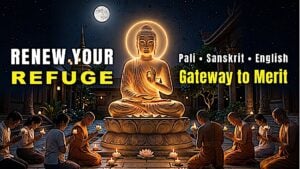
Taking Refuge: Buddhism’s Most Important Practice — With Pali, Sanskrit & English Chants. VIDEO is FOLLOWED by an In-Depth Guide on Taking Refuge
🙏The Gateway of Merit: Why Taking Refuge in the Three Jewels Matters Most
🙏Why Light Offerings & Taking Refuge Are Buddhism’s Most Powerful Practice
🙏Renew Your Refuge & Precepts on Buddha Days — 10 Million times Merit (Full Chant)
VIDEO:
Taking Refuge in the Three Jewels is considered the most important — and most powerful — practice in all of Buddhism. In this 20-minute video, we explore why Refuge is the “Gateway of Merit,” why light offerings appear in nearly every Buddhist ritual, and what practice to do on special merit Buddha Days. Then we recite the full Refuge and Precepts ceremony together in Pali, Sanskrit, and English.
In this video:
- Why Taking Refuge is the foundation of every Buddhist tradition — Theravada, Mahayana, and Vajrayana
- The three mechanisms of merit: intention (Bodhichitta), karma (activity), and devotion
- Why offerings of light are the most symbolic Refuge offering
- How merit multiplies 10 million times (up to 100 million) on major Buddha Days and extra merit days (full moon, first quarter, new moon)
- The story of Angulimala: purifying even the heaviest karma through Refuge
- A simple step-by-step guide to renewing Refuge at home: confession, prostration, chanting, and dedication
- Full chants in Pali, Sanskrit, and English — chant along with subtitles!
Whether you’re new to Buddhism or renewing a daily practice, this video is a complete Refuge ceremony you can follow at home. As Dilgo Khyentse Rinpoche said, “Devotion is the essence of the path.”
⏱️ Timecodes:
Why Refuge is Buddhism’s most important practice
The three mechanisms of merit & why we offer light
Buddha Days & multiplied merit
06:48 Making an Offering
07:48 Special Merit on Major Buddha Days
08:24 Dilgo Khyentse Rinpoche “Devotion is essence…”
09:18 Refuge Purifies even the Heaviest Negative Karma (Story of Angulimala)
10:14 Step-by-step: how to renew Refuge at home
11:07 How to do Prostrations
12:52 Pali recitation
14:14 Sanskrit recitation
15:38 English recitation
17:03 Dedication of merit
🙏 May whatever merit we have accumulated through taking Refuge and celebrating the Buddha Dharma be dedicated to the long life of all compassionate teachers, the complete elimination of illness, war, and suffering across the world, and the swift enlightenment of every single sentient being.
- DHARMA CALENDAR on BUDDHA WEEKLY (Multi Tradition): https://buddhaweekly.com/dharma-calendar/
- FULL GUIDE TO TAKING REFUGE (Comprehensive) on Buddha Weekly: https://buddhaweekly.com/taking-refuge/
- BUDDHA DAYS PLAYLIST on BUDDHA WEEKLY YOUTUBE (Special Buddha Days Practices): https://www.youtube.com/playlist?list=PL8d71VyWOwkF5pp05T3PkCQWE1xYHdX0k
- BEAUTIFULLY CHANTED BUDDHA DAYS PRACTICES IN PALI and SANSKRIT on @3GemsBand : https://www.youtube.com/playlist?list=PLXseTAxtdIkdJSIp4jhJEodKuXuVjYXrI
🔔 Subscribe to Buddha Weekly for more Dharma teachings, guided practices, and multi-tradition Buddhist content.
📅 Visit https://buddhaweekly.com/dharma-calendar/ for our multi-tradition Dharma calendar of Buddha Days and merit days.
TRANSCRIPT OF VIDEO with CHANTING WORDS
(More Detailed Guide below the Transcript)
Why is Taking Formal Refuge in the Three Jewels considered the most important practice in Buddhism? Why is the “light offering” also considered a vital Refuge Offering? Why do you almost always see offerings of candles or butter lamps in Buddhist rituals — and even in almost every one of Buddha Weekly’s videos? What practice should we do on special merit Buddha Days?
We’ll answer these quesions and more in this short video and then recite the most important merit practice of all: Refuge and Precepts. Here we’ll recite in Pali, Sanskrit and English. May all beings benefit.
At least four times a year we celebrate special merit Buddha Days. Regardless of tradition, we all celebrate Buddha’s Birth, Enlightenment, and Paranirvana and his various displays of wisdom and compassion. We do this with joy and faith, not a sense of duty. This is also why we keep a multi-tradition Dharma calendar on the Buddha Weekly website. Marking the dates, and honouring them, is not just a symbol. It creates vast merit for you when you practice on these days.
What is the mechanism of merit? There are three.
The first is intention. The intention to benefit all sentient beings creates vast merit. This is Bodhichitta.
The second is karma. By that we mean activity. The activity is symbolized through your effort to make offerings or reciting. Here, on Buddha Days — and any day we wish to accumulate virtuous merit — we take refuge in the Three Jewels, renew our lay precepts, creating positive activity merit, and dedicate the merit.
The third aspect is devotion and faith, the true engine of results. We don’t offer devotion because we think Buddha needs praise, or asks for anything. We offer devotion because we are grateful for the help we know we will receive.
We show it with our offerings. We show it by taking time to read and study the teachings. The main symbol of this is offerings of light. There are actually eight sensory offerings, offerings of sight, smell, taste and sound. The most important of these are light and sound, since it is by light we can see and read the Dharma teachings of buddha, and by sound that we can hear the Dharma teachings.
In Dharma teachings, you’ll often hear the phrase from your teachers, that this sutta, sutra, mantra or Paritta has benefits on hearing and benefits on seeing. Benefits on seeing means “seeing and reading the words of the Dharma, such as Sutras, teachings, a Dharma video, or a written mantra.
The same mantra or Sutta or Paritta also has benefits on speaking and hearing. This is why we speak the words out loud, or listen to them from our teacher.
Honouring special dates is a practice across every tradition and is universally marked in all traditions by Taking Refuge in the Three Jewels and Offering of Light.
Taking Refuge is the one essential practice: fundamental, universal, and vastly powerful. It is also incredibly simple to perform, and very concise. The practice not only renews our commitment and faith, it also increases our merit, provides us with sanctuary and unshakable protection, and ensures our future Enlightenment.
And the good news? Although it is a short, daily practice, taking formal Refuge and offering light has “skies of merit” according to Lama Zopa Rinpoche, with merit multiplied 10 million times on Buddha Days according to Vinaya text commentary. There are also extra merit days on Lunar phases: full moon, first quarter and new moon in particular.
The number of special merit days may vary by lineage, but the principle remains the same. We celebrate Buddha’s birth, enlightenment, paranirvana, special displays of compassion and wisdom in his life on Earth, and — most importantly — we celebrate the Teachings of the Buddha and the Sangha or the community.
How do we do this? There’s no mystical formula, despite it’s vast merit. You can state it in Pali, Sanskrit, Tibetan or your own language. The key is to say it out loud as your declaration of devotion, sanctuary and renewal. You can play this video, marking the timecode where your language begins, and play it, with subtitles on, while chanting along. This way you accrue the benefits of seeing, hearing and chanting.
The most symbolic physical act, aside from chanting, is making an offering. Usually this is light, symbolizing that Buddha’s Wisdom was a light of compassion and wisdom for our world. It honours the light that allows us to see the Dharma.
Light is a symbol of the illuminating wisdom of Buddha, Dharma and Sangha. If you go to a temple, you may light a butter lamp. You don’t’ have to use candles or lamps if it’s a fire risk. Any light will do, including watching a video of someone lighting the candles or butter lamps.
This is the reason you see scenes of people lighting candles or praying in front of butter lamps and candles in almost every one of our devotional videos.
Canonical teachings explain that on major Buddha Days, the spiritual power of our practice is exponentially magnified—multiplying the merit of every virtuous action ten millionfold, and up to one hundred million times.
Whether you are renewing your commitments on one of the major annual Buddha days, or on the monthly Extra merit practice dates on full moons, or just doing your daily morning meditation, taking Refuge is not merely a formality or introduction.
As the great master Dilgo Khyentse Rinpoche declared, “Devotion is the essence of the path.” Taking Refuge is the front door to the entire Buddha Dharma—the foundation upon which every realization, every vow, and all peace rests.
No matter which tradition you practice—Theravada, Mahayana, or Vajrayana—taking Refuge in the Three Jewels is our common home. It is the defining practice that unites every lineage of Buddhism across the globe in joy, compassion and wisdom.
By taking Refuge, we step out of isolation. We join a 2,500-year-old lineage of wisdom and a living global community of loving Dharma friends.
The canonical texts record that formal Refuge possesses the extraordinary capacity to purify even the heaviest negative karma.
The most famous example of this from Sutra, was the history of the serial killer Angulimala, who had killed 999 people. When he Took Refuge and his Precepts, he purified his mind through sincere Refuge and achieved arhatship in that very life.
When we renew our Refuge on Buddha Days, we are actively clearing past karmic obstacles, shielding ourselves from lower realms of suffering, and planting the direct seeds for full Enlightenment.
How do we formally renew our Refuge on a Buddha Day or in our daily practice at home? Here is a simple, beautiful step-by-step guide you can follow today. While it is wonderful to do this in a formal environment with your teacher, if you are not able to do so, on any Buddha Day, or any day you practice, you can create vast merit with this simple formula.
Most Refuge ceremonies start with silent confession to yourself. Just say, quietly, or whisper or just think of your negative acts in the last day, week or month and then say, sincerely, “I regret and will refrain in future from this negative act.” Your confession is also your offering.
To show devotion, make prostrations.
This is showing your faith and devotion, but it can be as simple as touching your folded hands to your forehead, throat, and heart, three times. If you are physically able, you can prostrate to the floor on your knees to show truly deep and touching devotion. If you have a physical injury or any discomfort you can prostrate from a seated position, or just bow from your waist — or whatever you can to show faith and devotion.
Here, we are prostrating to the Three Jewels as we visualize them.
Prostrations subdue pride, express reverence, and purify physical negative karma. Prostration combines the physical karma, and the devotion we mentioned among the three requirements of Refuge.
Now you recite the Supreme formula of Refuge, the ultimate protection, in your preferred language. Check the time codes for the start times of the Pali, Sanskrit and English versions, turn on subtitles (and change to your language translation if available), then chant along. Traditionally we recite three times.
The structure is simple. We begin with homage to the Three Jewels. Then, we Take formal Refuge three times. Finally, we make the five vows or precepts of a lay person. If you are a monastic you will have eight. You are reaffirming the most important teachings. Finally, the merit is dedicated for the benefit of all beings.
Let’s begin in Holy Pali.
Namo tassa bhagavato arahato sammāsambuddhassa.
Buddhaṃ saraṇaṃ gacchāmi.
Dhammaṃ saraṇaṃ gacchāmi.
Saṅghaṃ saraṇaṃ gacchāmi.
Dutiyampi Buddhaṃ saraṇaṃ gacchāmi.
Dutiyampi Dhammaṃ saraṇaṃ gacchāmi.
Dutiyampi Saṅghaṃ saraṇaṃ gacchāmi.
Tatiyampi Buddhaṃ saraṇaṃ gacchāmi.
Tatiyampi Dhammaṃ saraṇaṃ gacchāmi.
Tatiyampi Saṅghaṃ saraṇaṃ gacchāmi.
Pāṇātipātā veramaṇī sikkhāpadaṃ samādiyāmi.
Adinnādānā veramaṇī sikkhāpadaṃ samādiyāmi.
Kāmesu micchācārā veramaṇī sikkhāpadaṃ samādiyāmi.
Musāvādā veramaṇī sikkhāpadaṃ samādiyāmi.
Surāmeraya-majja-pamādaṭṭhānā veramaṇī sikkhāpadaṃ samādiyāmi.
Iminā puññena, sabba-sattānaṃ hitāya, Buddha-bhūmiṃ pāpuṇeyyaṃ.
Next, let’s chant in Sacred Sanskrit.
Namo bhagavate arhate samyaksaṃbuddhāya.
Buddhaṃ śaraṇaṃ gacchāmi.
Dharmaṃ śaraṇaṃ gacchāmi.
Saṅghaṃ śaraṇaṃ gacchāmi.
Dvitīyampi Buddhaṃ śaraṇaṃ gacchāmi.
Dvitīyampi Dharmaṃ śaraṇaṃ gacchāmi.
Dvitīyampi Saṅghaṃ śaraṇaṃ gacchāmi.
Tṛtīyampi Buddhaṃ śaraṇaṃ gacchāmi.
Tṛtīyampi Dharmaṃ śaraṇaṃ gacchāmi.
Tṛtīyampi Saṅghaṃ śaraṇaṃ gacchāmi.
Prāṇātipātāt prativiratiṃ śikṣāpadaṃ samādade.
Adattādānāt prativiratiṃ śikṣāpadaṃ samādade.
Kāmamithyācārāt prativiratiṃ śikṣāpadaṃ samādade.
Mṛṣāvādāt prativiratiṃ śikṣāpadaṃ samādade.
Surā-maireya-madya-pramāda-sthānāt prativiratiṃ śikṣāpadaṃ samādade.
Anena puṇyena, sarva-sattvānāṃ hitāya, buddhatvaṃ prāpnuyām.
In English, or in your own preferred language
Homage to the Blessed One, the Worthy One, the Perfectly Enlightened One.
I take refuge in the Buddha.
I take refuge in the Dharma.
I take refuge in the Sangha.
For the second time, I take refuge in the Buddha.
For the second time, I take refuge in the Dharma.
For the second time, I take refuge in the Sangha.
For the third time, I take refuge in the Buddha.
For the third time, I take refuge in the Dharma.
For the third time, I take refuge in the Sangha.
I undertake the training rule to refrain from taking life.
I undertake the training rule to refrain from taking what is not given.
I undertake the training rule to refrain from sexual misconduct.
I undertake the training rule to refrain from false speech.
I undertake the training rule to refrain from intoxicants that cause heedlessness.
By this merit, for the benefit of all sentient beings, may I attain Buddhahood.
As we complete this formal renewal of Refuge let us take a moment to deeply rejoice in our extraordinary good fortune.
Out of billions of beings, we have met the precious Dharma, we have recognized the shelter of the Three Jewels, and we have the freedom to practice!
Let us now dedicate all the vast merit generated by this practice today:
“May whatever merit we have accumulated through taking Refuge and celebrating the Buddha Dharma be dedicated to the long life of all compassionate teachers, the complete elimination of illness, war, and suffering across the world, and the swift enlightenment of every single sentient being.”
Thank you for renewing your vows today. May your Refuge be an unshakeable sanctuary of peace, joy, and wisdom.
Island of Refuge: Buddha, Dharma and Sangha: Our Modern Protection from All Fear, Stress, Danger, and Obstacles
Introduction: The Island Within and the Sanctuary Without
We all face busy, modern, and increasingly stressful lives, emotional burnout, and relentless worldly noise.
We seek shelter from anxiety, grief, and confusion, often turning to temporary comforts that leave us feeling even more drained. In the Buddhist commentaries, this is often referred to as “Taking Refuge in the Wrong Things.” We take refuge in pleasure, entertainment, addictions and other temporary distractions from our suffering.
Buddha taught, instead, to seek a more permanent relief from Suffering. We seek refuge in the Enlightened Teacher, the Enlightened Teachings and the Supporting Community. These are our true safe refuge from all obstacles and dangers.
The Permanent Solution
Over twenty-five centuries ago, Siddhartha Gautama—the historical Shakyamuni Buddha—taught a permanent solution to human suffering.
Before passing into Mahaparinirvana, the Buddha offered his final, comforting instruction to his disciples: to make an island of oneself, to seek no external refuge other than the truth, and to anchor the heart in the Three Jewels—the Buddha, the Dharma, and the Sangha.
Taking Refuge in the Three Jewels (Triratna in Sanskrit, Tiratana in Pali) is not a passive ritual or a dogmatic pledge of allegiance. It is an active, joyful, and revolutionary commitment to personal awakening and universal compassion. As the great master Chögyam Trungpa Rinpoche observed, taking Refuge in the Buddha, the Dharma, and the Sangha is far more than a simple ritual—by taking the Refuge vow, we commit ourselves directly to ultimate freedom and awaken from Samsara’s confusion.
Whether practiced in the quiet solitude of a morning meditation room or celebrated collectively during great holy festivals like Lhabab Duchen and full moons, renewing formal Refuge is the beating heart of Buddhist living. This feature serves as an exhaustive companion guide for actual practicing Buddhists and earnest seekers, exploring why Refuge is essential, how it protects the mind, how it unites all Buddhist lineages, and how to practice it step-by-step in modern daily life.
What is Buddhist Refuge? The Essential Gateway to the Path
In Buddhist philosophy, entering the spiritual path is not defined by external appearances, wearing traditional robes, shaving one’s head, or memorizing vast libraries of scriptures.
As Kyabje Lama Zopa Rinpoche taught during his Kopan Meditation Course lectures, a person can memorize all hundreds of volumes of the Tengyur, maintain an elaborate home filled with antique statues and thangkas, and debate complex philosophical tenets flawlessly—yet if there is no Refuge held sincerely within the mind, that person remains an “outer being” (pahiraka).
Conversely, the moment a practitioner generates a genuine, heartfelt reliance on the Three Jewels to escape the cycle of suffering, they become an “inner being” (buddhist).
Lama Zopa’s lable “inner Buddhist” isn’t an elitist term, but rather a recognition of our genuine path is internal practice and transformation. It is not marked by shaving our head and looking peaceful and sitting in the lotus position. It’s marked by our inner peace and state.
This state is defined by turning away from ego-driven attachments and turning toward enlightened wisdom, ethical discipline, and spiritual community. Our precious posessions aren’t the statue on the altar and our mala — but rather what they represent to us internally: Buddha, Dharma and Sangha.
Why Every Practice Begins with Refuge
Regardless of tradition, and regardless of our level of understanding, without exception we start with Refuge in the Three Jewels. Without it, at least without an intrinsic understanding of it, we are not practicing as Buddhists.
And, regardless of complexity of our practice, wehther basic breath mindfulness and sutra chanting, or inner body mandala advanced Vajrayana yogas — they, all begin with Taking Refuge. For this reason we tend to take it for granted. After all, we say it a dozen times a day. But, each time we say it, we purify our mindstream and renew our safe refuge in the Enlightened Buddha, Dharma and Sangha.
In The Excellent Path to Enlightenment, Dilgo Khyentse Rinpoche declared that devotion is the very essence of the path.
Kyabje Garchen Rinpoche similarly emphasized that the single most important source of blessings is uncontrived devotion to the Three Jewels.
Great Sakya and Gelug teachers emphasize that Refuge forms the indispensable foundation for all subsequent vows, including the Pratimoksha lay precepts, the Bodhisattva vows of universal compassion, and Tantric commitments.
If one attempts to engage in advanced meditations without the foundation of Refuge, masters warn that the practice is like snow falling on a warm road—it looks impressive for a brief moment, but melts away without leaving any lasting spiritual transformation. Refuge provides the roots; ethics, meditation, and wisdom are the branches and fruit that flourish from those roots.
Finding a Safe Enlightened Refuge: Overcoming False Refuges
Recognizing Worldly Addictions and Distractions,
Human beings are inherently refuge-seeking creatures. In one way of thinking, this is addiction. Extending the metaphor, Refuge in the Buddha Dharma and Sangha are Safe Refuge. “So called” refuge in material things, such as in pleasures, alcohol, social media, escaping stress in a movie, — these are just “temporary safety and illusory security — these are excapes rather than safe refuge.
When confronted with emotional pain, stress, existential dread, or interpersonal conflict, the instinct is to seek shelter or escape. Safe shelter is genuine protection. Escape is illusory and passing. Short-term escape if fine, if it’s not meant to be our reliable harbor. For safe harbor from a genuine storm, we need permanent shelter.
As noted Buddhist psychologist and teacher Rob Preece observes, modern people are extraordinarily adept at taking refuge in the wrong things.
When stressed or suffering, people routinely take refuge in food, alcohol, recreational drugs, compulsive shopping, television, social media, careerism, or codependent relationships. While these worldly diversions may offer temporary distraction or numbing relief, they cannot remove the root causes of suffering. In fact, relying on impermanent, volatile objects for ultimate security inevitably breeds deeper anxiety, disappointment, and addiction when those false refuges inevitably collapse.
The Dalai Lama’s Ditch Metaphor: Seeking True Liberation
Explaining why worldly objects and ordinary beings cannot serve as ultimate protection, His Holiness the XIV Dalai Lama offered a vivid illustration:
“If you fall deep into a muddy ditch, it is senseless to ask a fellow prisoner trapped in the same ditch to pull you out. You must call upon someone who is standing firmly outside the ditch, possessing both the strength and the rope necessary to rescue you.”
Ordinary worldly deities, wealthy individuals, or external pleasures are themselves trapped in the ditch of Samsara, bound by delusion, karma, and impermanence. We are certainly in community with them, and can seek to help each other out of the ditch, but for true help, we reach for the Enlightened hand of help.
Only the Three Jewels—the Awakened Buddha who stands outside Samsara, the Dharma teachings that act as the rescue rope, and the Sangha who assist in pulling us up—possess the flawless capability to protect living beings from all dangers and fears.
3 Views of the Triple Gem: One Truth
Three Levels of Sanctuary: The Three Metaphors
The Metaphor of Healing: Doctor, Medicine, and Nurse
Consistently in Buddhist literature, including teachings by Kyabje Lama Zopa Rinpoche and many other teachers, the most popular 3 Gems metaphor is the medical theme:
The Buddha is the Supreme Doctor: Having fully diagnosed the universal disease of human suffering (Dukkha) and eradicated its root causes (Karma and Kleshas), the Buddha presents the cure.
The Dharma is the Medicine: The actual teachings, the Suttas, Sutras, Parittas and Other Scriptures and Commentaries, are the potent medicine that cures spiritual sickness when integrated into daily life.
The Sangha is the Nurse/Caregiver: The community of monastics, realized practitioners, and Dharma companions provide the supportive environment, encouragement, and proper support required to ensure the patient completes the treatment.
BUDDHA –> Supreme Physician (Diagnoses Suffering & Offers the Cure)
DHARMA –> Potent Medicine (Actual Teachings & Practice Realizations)
SANGHA –> Dedicated Nurses (Supportive Community Guiding Recovery)
Outer Refuge: The Historical Buddha, Sacred Scriptures, and Monastic Sangha
As explained by Lama Thubten Yeshe in his Kopan teachings, Refuge is understood progressively across three developmental tiers: Outer, Inner, and Secret.
Outer Buddha: The historical Shakyamuni Buddha, along with all enlightened Buddhas of the three times and ten directions, who demonstrated complete liberation and gave us the teachings.
Outer Dharma: The sacred scriptures, Suttas Sutras, commentaries, and verbal teachings that reveal the Four Noble Truths and the Eightfold Path.
Outer Sangha: The ordained monastic community (Bhikkhus and Bhikkhunis) and noble Arya beings who preserve and transmit the unbroken lineage of teachings.
Inner Refuge: Awakening Your Inherent Buddha Nature and Future Enlightenment
As practitioners mature, they realize that external teachers point toward an internal reality. Inner Refuge shifts the focus inward:
Inner Buddha: Your own inherent Buddha Nature (Tathagatagarbha) and the future state of complete enlightenment that you will inevitably achieve.
Inner Dharma: The realization of transcendental wisdom, non-self, and compassion generated directly within your own mindstream.
Inner Sangha: The unity of your own purified mindstream with the qualities of awakening, eliminating reliance on external validation.
As Chan Master Sheng-Yen highlighted, taking inner Refuge transforms negative mindstates directly: taking Refuge in the Buddha transforms anger into boundless compassion; taking Refuge in the Dharma transforms delusion into luminous wisdom; and taking Refuge in the Sangha transforms selfish desire into open-hearted generosity.
Secret Refuge: Harnessing Subtle Energy and Non-Dual Wisdom
In the advanced Vajrayana tradition, secret Refuge involves recognizing that one’s subtle nervous system (nadis, pranas, bindus) is pervaded by blissful daka and dakini energy. By unifying Great Bliss (Mahasukha) with the realization of emptiness (Shunyata), secret Refuge utilizes the mind-body energy resources as the direct vehicle to achieve swift, non-dual liberation.
4. The Extraordinary Benefits and Spiritual Protection of Refuge Vows
Purifying Aeons of Karma: The Lessons of Angulimala and King Magyeda
One of the most extraordinary qualities of Refuge is its capacity to completely purify even the heaviest, most heinous negative karmas. Canonical sources highlight two famous historical examples:
Angulimala: The infamous serial killer who slew 999 people and wore a garland of their fingers. Upon meeting Shakyamuni Buddha, Angulimala generated deep, sincere Refuge, adopted ethical discipline, and completely purified his past misdeeds, ultimately attaining Arhatship in that very lifetime.
King Magyeda (Ajatasattu): King Magyeda committed one of the five cardinal sins of immediate retribution (anantarika-karma) by murdering his own father, King Bimbisara (an Aryan practitioner). Although destined for immediate rebirth in the lowest hell realm (Avici), his encounter with the Buddha and intense generation of heartfelt Refuge purified the immediate heavy karmic weight, granting him protection from hell and placing him firmly on the path to liberation.
Furthermore, teachings record the account of a monastic who broke all 253 fundamental ordination vows. Through years of intensive, devoted Refuge practice and purification, he completely cleansed his karmic obscurations, demonstrating his purity by walking unharmed across a treacherous, deep river.
Venerable Zasep Tulku Rinpoche on Broken Commitments: “Just Pick Up Where You Left Off”
Practitioners often experience periods of spiritual stagnation, stress, or broken commitments, leading to guilt and discouragement. Addressing this common struggle, Venerable Acharya Zasep Tulku Rinpoche offers comforting and practical guidance:
“Do not think your practice is no longer worth the effort just because you have broken your commitments; do not abandon your commitments and daily practice; just pick up where you left off. My kind teacher, the most holy Tara Tulku Rinpoche said: ‘If you forget to eat breakfast, you don’t give up there and then. The next day, you go ahead and eat breakfast. Simple.'”
Rinpoche reassures lay practitioners that minor setbacks or broken vows simply require them to return to the basics, perform purification practices like Vajrasattva mantras or 35 Buddhas prostrations, and continue their spiritual journey without guilt.
Key Benefit
Seeing Our Own Buddha Nature grounded in ultimate truth.
Prerequisite for All Vows
Establishes the necessary foundation for lay precepts, Bodhisattva vows, and Tantric commitments.
Complete Karma Purification
Cleanses aeons of negative karma, as demonstrated by Angulimala and King Magyeda.
Protection from Lower Rebirths
Guards the mindstream at death, preventing rebirth in hell, hungry ghost, or animal realms.
Protection from Dangers & Fear
Acts as an ultimate shield against non-human obstacles, hostility, and fear (Maha Samaya Sutta).
Continuous 24/7 Merit Engine
Generates unbroken spiritual merit day and night, even while sleeping or unconscious.
Swift Attainment of Goals
Pacifies obstacles, fulfills virtuous wishes, and smoothly leads to full Buddhahood.
The 24/7 Merit Engine: How Vows Accumulate Merit Day and Night
A fundamental teaching emphasized by Kyabje Lama Zopa Rinpoche is the radical difference between performing virtuous acts spontaneously versus performing them under the commitment of formal vows (Samaya).
If an individual makes a lifelong vow to abstain from killing or stealing, that vow creates an ongoing “merit engine.” Because the practitioner is actively upholding the vow every second of the day—whether they are working, walking on a beach, eating, resting, or fast asleep in a deep coma—they accumulate continuous, positive merit 24 hours a day, 7 days a week.
[ LIFELONG REFUGE & LAY VOWS ]
│
├─► WAKING HOURS : Mindful practice & ethical non-harming (Continuous Merit)
├─► SLEEPING TIME : Vows remain actively held in mindstream (Continuous Merit)
└─► ILLNESS/COMA : Vow protection persists unbroken (Continuous Merit)
│
▼
[ 24/7 UNINTERRUPTED STREAM OF POSITIVE KARMA ]
Lama Zopa humorously remarked that even if a person who has taken lay or monastic vows does nothing all day except eat, sleep, and go to the bathroom, they still generate far more spiritual merit every hour than a non-vowed person performing massive, worldly charitable acts. The formal commitment transforms ordinary life into an uninterrupted stream of positive karmic momentum.
Protection from Fear, Danger, and Lower Rebirths
In ancient scriptures like the Maha Samaya Sutta (The Great Meeting Sutra) and the Dhajagga Sutta (The Banner Sutta), the Buddha declared that those who go to the Buddha, Dharma, and Sangha for Refuge will not go to the planes of woe (lower rebirths). Upon discarding their physical bodies at death, those who die remembering the Three Jewels, chanting a sacred mantra, or remembering a devoted monastic teacher are immediately protected from falling into lower realms, taking rebirth in heavenly or auspicious human realms instead.
Furthermore, as demonstrated in the Maha Samaya Sutta, when Mara’s evil forces and armies assailed the assembly of 500 Arhats in the Kapilavatthu forest, the practitioners remained unshakeable, peaceful, and utterly victorious purely through the protective power of their unbroken Refuge.
5. One Dharma, Many Lineages: The Universal Core of All Traditions
While Buddhism evolved over centuries into vibrant regional traditions and lineages, Taking Refuge in the Three Jewels remains the single universal thread that unites every school without exception.
Lineage
Primary Focus & Emphasis
Traditional Liturgical Expression
Theravada (Elder School)
Historical Buddha, Pali Suttas, Monastic Sangha, Lay Precepts
“Buddham saranam gacchami, Dhammam saranam gacchami, Sangham saranam gacchami”
Mahayana (East Asian / Zen)
Bodhichitta, Interbeing, Universal Compassion, Buddha Nature
“Namo Buddhaya, Namo Dharmaya, Namo Sanghaya”
Vajrayana (Tibetan / Esoteric)
Guru Lineage, Yidams, Dakinis, Subtle Energies, Secret Refuge
“Namo Gurubhya, Namo Buddhaya, Namo Dharmaya, Namo Sanghaya”
Plum Village (Engaged Buddhism)
Mindfulness, Interbeing, Collective Sangha Energy, Island Within
“I take refuge in the island within myself…”
Theravada: The Refuge in Dhamma and Purity of Moral Precepts
In the Theravada tradition of Sri Lanka, Thailand, Myanmar, Cambodia, and Laos, Refuge is expressed through daily Pali chanting (Tisarana). Focus is placed on the historical Shakyamuni Buddha as the supreme human master, the Pali Canon (Sutta, Vinaya, Abhidhamma) as the unexcelled guide, and the monastic Sangha as the sacred field of merit. Theravadins emphasize taking the Five Lay Precepts (Pancha Sila) alongside Refuge as a concrete training in non-harming (Ahimsa).
Mahayana: Bodhichitta, Universal Compassion, and Interbeing
In Mahayana traditions (Ch’an, Zen, Pure Land, Nichiren, Korean Seon), Refuge is intrinsically linked with Bodhichitta—the altruistic resolve to achieve full awakening to liberate all living beings. Taking Refuge includes dedicating all accumulated merits to others. The practice emphasizes realizing that all sentient beings possess Buddha Nature and that individual happiness is inseparable from collective well-being (Interbeing).
Vajrayana: The Sacred Guru, Yidam, and Dakini Refuges
In Tibetan Buddhism (Nyingma, Kagyu, Sakya, Gelug), Refuge is expanded to include the “Four Refuges” or “Outer, Inner, and Secret Refuges.” Because the living teacher (Guru or Lama) directly transmits the unbroken lineage of Buddha’s wisdom to the student, Vajrayana practitioners recite: “Namo Gurubhya, Namo Buddhaya, Namo Dharmaya, Namo Sanghaya.” Here, the Guru embodies the Buddha, the Yidam (meditation deity) embodies the Dharma, and the Dakinis and Protectors embody the Sangha.
Zen & Plum Village: Touching Buddha Nature in the Present Moment
In Zen and the Plum Village tradition founded by Venerable Thich Nhat Hanh, Sister Chan Duc explains that taking Refuge means returning to the “island of self.” By coming home to conscious breathing and mindful walking, practitioners touch their inherent awakened nature (Buddha), accept the natural law of conditioned genesis and interbeing (Dharma), and lean on the collective harmony of the spiritual community (Sangha).
6. How to Take Formal Refuge: Ceremonies, Liturgy, and Lay Guidelines
The Formal Refuge Ceremony Step-by-Step
While daily Refuge can be practiced privately at home, entering the formal Buddhist path involves participating in a Refuge Ceremony conducted by a qualified lineage teacher (Lopen or Guru). As outlined by Lama Zopa Rinpoche, the traditional ceremony unfolds through distinct, sacred stages:
Purification & Preparation: The candidate cleanses their body, cleans their home altar, and makes physical offerings (flowers, incense, butter lamps, clear water).
Prostrations: The candidate performs three full or partial prostrations to the living Buddha field and to the presiding teacher.
Generating Motivation: The candidate generates deep gratitude for their precious human rebirth, recognizes the sufferings of Samsara, and resolves to seek liberation for the benefit of all sentient beings.
Recitation of Vows: Kneeling with palms joined (Anjali mudra), the candidate repeats the formal Refuge prayer three times after the teacher, clearly reciting their name and stating their intention to take Refuge from this moment until achieving complete enlightenment.
Receiving Lay Precepts (Upasika): On the foundation of Refuge, the candidate chooses to adopt one, two, three, four, or all five lay precepts (abstaining from killing, stealing, sexual misconduct, false speech, and intoxicants).
Receiving a Refuge Name & Cut of Hair: In many traditions, the teacher clips a small lock of hair (symbolizing severing worldly ties) and bestows a spiritual Refuge Name.
Dedication of Merit: The ceremony closes with joyous prayers dedicating all accumulated spiritual energy to global peace and universal liberation.
PALI (Theravada):
“Buddham saranam gacchami. Dhammam saranam gacchami. Sangham saranam gacchami.”
SANSKRIT:
“Namo Buddhaya. Namo Dharmaya. Namo Sanghaya.”
TIBETAN (Mahayana / Tantra):
“Sangye chö dang tsog kyi chog nam la / Jang chub bar du dag ni kyab su chi.”
ENGLISH (Standard):
“I take refuge in the Buddha, the Awakened Teacher.
I take refuge in the Dharma, the Truth and the Path.
I take refuge in the Sangha, the Spiritual Community.
Until I reach Enlightenment for the benefit of all living beings.”
The Refuge Precepts: Three Things to Adopt and Three Things to Abandon
Upon taking formal Refuge, scriptures specify six fundamental behavioral guidelines divided into three abandonments and three adoptations:
Aspect
What to Abandon
What to Adopt & Practice
Regarding Buddha
Relying on worldly deities, material objects, or false teachers as ultimate salvation.
Deep respect for all Buddha images, statues, thangkas, and art (never placing them on the floor).
Regarding Dharma
Causing harm, violence, or distress to living beings (Ahimsa / Non-harming).
Deep respect for all Dharma texts and scriptures (never placing them on the floor or stepping over them).
Regarding Sangha
Associating with negative influences who encourage non-virtuous behavior or cynicism.
Deep respect for monastics, spiritual teachers, and fellow Sangha members, seeing them as companions.
7. Renewing Refuge on Buddha Days, Full Moons, and Lhabab Duchen 2026
The Power of Holy Days and Karmic Acceleration
In Buddhist cosmology and calendar traditions (lunisolar calendars), major annual holy dates associated with key milestones in Shakyamuni Buddha’s life act as immense spiritual amplifiers. On these sacred dates—such as Vesak / Saga Dawa (Buddha’s Birth, Enlightenment, Parinirvana), Choekhor Duchen (First Turning of the Wheel of Dharma), Magha Puja (Sangha Day), and Lhabab Duchen—the collective focus of the global Sangha creates an extraordinary environment for practice.
Lhabab Duchen 2026: The Day of Ten Million Multiplied Merits
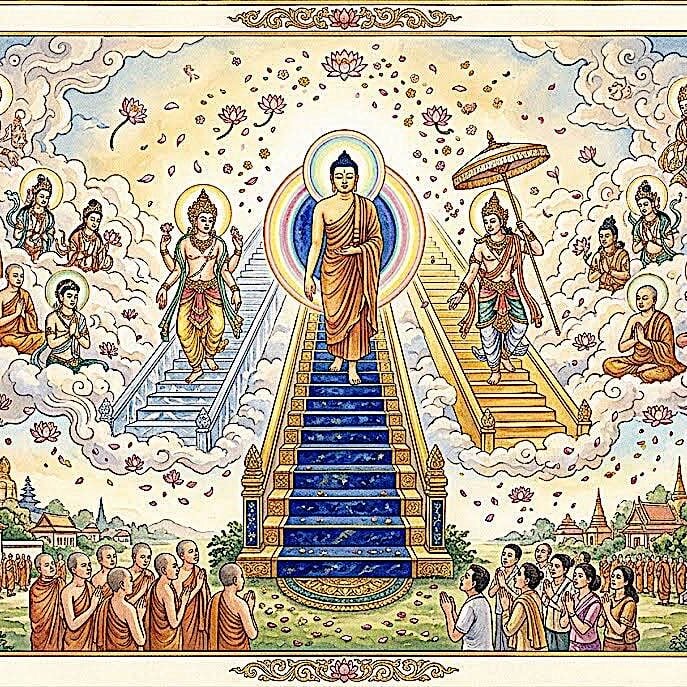
On Sunday, November 1, 2026 (marking the 22nd day of the ninth Tibetan lunar month), Buddhists worldwide will celebrate Lhabab Duchen, the sacred festival commemorating Buddha’s historic descent from the Trayastrimsa Heaven back to Earth at Samkashya.
According to canonical Vinaya texts such as the Treasure of Quotations and Logic, any virtuous or non-virtuous karmic action performed on Lhabab Duchen is multiplied ten million times (and up to 100,000,000 times). Because karmic consequences expand so exponentially, lay practitioners take extreme care to guard their speech, actions, and thoughts while enthusiastically renewing their Refuge vows.
Lama Zopa Rinpoche’s Eight Essential Practices for Buddha Days
To maximize the spiritual potential of holy days like Lhabab Duchen, Kyabje Lama Zopa Rinpoche recommended Eight Essential Virtuous Practices:
Reciting Sacred Sutras: Chanting the Heart Sutra, Diamond Cutter Sutra, Sutra of Golden Light, or Sutra Remembering the Three Jewels.
Making Offerings to the Sangha: Offering food, robes, medicine, or financial support to ordained monastics and Dharma publishing efforts.
Cultivating Bodhichitta & Reciting The King of Prayers: Chanting Samantabhadra’s Aspiration to align the mind with Bodhisattva activities.
Practicing Generosity (Dana): Assisting the poor, feeding animals, or providing emotional comfort and support to those in distress.
Taking the Eight Mahayana Precepts (Sojong): Upholding eight strict vows for 24 hours (from dawn to dawn).
Making Sensory and Altar Offerings: Adorning home altars with fresh water bowls, flowers, incense, tormas, and light offerings (butter lamps or candles).
Engaging in Wisdom Study: Reading Dharma books, studying emptiness, listening to qualified teachers, or copying sutra verses by hand.
Prostrations and Refuge Recitation: Performing physical prostrations while chanting Namo Buddhaya, Namo Dharmaya, Namo Sanghaya.
Taking the Eight Mahayana Precepts (Sojong) for Lay Practitioners
While devout lay Buddhists try to maintain the Five Lay Precepts daily, on major holy days and full moons they frequently adopt the Eight Mahayana Precepts for a 24-hour period (from dawn on the holy day until dawn the next morning). This allows lay practitioners to experience the pure, unburdened discipline of monastic life.
I undertake to abstain from killing or harming any living being.
I undertake to abstain from taking what is not given (stealing).
I undertake to abstain from all sexual activity (complete celibacy for 24 hours).
I undertake to abstain from false, harsh, or divisive speech.
I undertake to abstain from all intoxicants (alcohol, drugs, heedlessness).
I undertake to abstain from eating after midday (taking food only before noon).
I undertake to abstain from singing, dancing, entertainment, perfume, and cosmetics.
I undertake to abstain from sitting on high/luxurious beds and oversleeping.
8. Practical Home Checklist: A Daily and Monthly Routine for Lay Buddhists
Morning and Evening Home Practices
You do not need to reside in a monastery or travel to distant pilgrimage sites to maintain a powerful, transformative Refuge practice. A dedicated lay practitioner can establish a sacred rhythm at home through simple daily habits:
Morning Routine (5-10 minutes):
Wake up, wash face, and approach your home altar space.
Refresh seven clean water offering bowls (an antidote to attachment taught by Lama Zopa) and light an incense stick or candle.
Perform three physical prostrations with palms joined, touching forehead, throat, and heart.
Recite the formal Refuge prayer three times in English, Pali, Sanskrit, or Tibetan.
Set a conscious daily intention: “Today, I will practice non-harming, cultivate kindness, and keep the Three Jewels at the center of my mind.”
Evening Routine (5 minutes):
Approach your altar, perform three physical prostrations, and clean/empty the water bowls.
Briefly reflect on your day with honesty, acknowledging any missteps or moments of anger.
Recite the Shakyamuni Buddha Mantra (Om Muni Muni Mahamuni Shakyamuni Svaha) or Vajrasattva Mantra to purify daily misdeeds.
Formally dedicate all spiritual merit generated throughout the day to global peace and the enlightenment of all living beings.
Taking Refuge in the Three Jewels is not an event that happens once in a temple and is forgotten. It is a living, breathing, moment-by-moment journey. Every time you choose patience over anger, truth over deception, generosity over hoarding, and compassion over indifference, you actively renew your Refuge.
As we look forward to holy occasions like Lhabab Duchen on Sunday, November 1, 2026, let us remember that the ultimate Refuge is built within our own minds. Guided by the supreme teacher Shakyamuni Buddha, nourished by the potent medicine of the Dharma, and supported by the loving warmth of the global Sangha, we become unshakeable sanctuaries of peace, clarity, and healing for a world in need.
May all beings be free from suffering and the causes of suffering. May all beings enjoy happiness and the causes of happiness. May all beings realize the ultimate protection of the Three Jewels.
9. Source References & Selected Bibliography
This comprehensive feature guide is grounded in and synthesized from canonical Buddhist scriptures, editorial archives, and authoritative lineage teachings from Buddha Weekly, Lama Yeshe Wisdom Archive, Plum Village, and Lion’s Roar:
- Espada, Jason (2022). The Profound Practice of Taking Refuge: The Foundation of Buddhist Liberation, Faith, Devotion, and Protection. Buddha Weekly.
- Lama Thubten Yeshe (1980/2021). Three Ways of Taking Refuge: Outer, Inner, and Secret. Lama Yeshe Wisdom Archive.
- Lama Thubten Zopa Rinpoche (1974/2020). Day 9: Refuge in the Triple Gem, The Importance of Taking Vows, and the Refuge Ceremony (Kopan Course). Lama Yeshe Wisdom Archive.
- Lama Thubten Yeshe & Lama Thubten Zopa Rinpoche (2020). The Benefits of Refuge and the Definition of an Inner Being. Lama Yeshe Wisdom Archive.
- Sister Chan Duc (2021). Taking Refuge in the Three Jewels: Returning to the Island of Self. Plum Village Dharma Talks.
- Zasep Tulku Rinpoche, Ven. Acharya (2023). Ngondro Foundation Practices Series (Part 2): Teachings on the Truth of Suffering, the Importance of Taking Refuge, and Guided Shakyamuni Buddha Visualization. Buddha Weekly.
- Buddha Weekly Editorial Team (2026). Descending Light: Celebrating Lhabab Duchen 2026 — The Day of Ten Million Multiplied Merits: Buddha’s Descent From Heaven. Buddha Weekly.
- Buddha Weekly Editorial Team (2023). Refuge is the Ultimate Protection from Dangers: The Maha Samaya Sutta — The Great Meeting Sutra. Buddha Weekly.
- Buddha Weekly Editorial Team (2023). Buddha Dharma Practice Reboot? With Refuge and Bodhichitta, You Are Not Alone — Methods to Supercharge Your Enthusiasm for Buddhist Practice. Buddha Weekly.
- Buddha Weekly Editorial Team (2022). Devotion to the Three Jewels: Essence of Buddha Dharma; The Most Important Practice. Buddha Weekly.
- Buddha Weekly Editorial Team (2022). The Dalai Lama and Eight Other Teachers Explain How to Avoid Taking Refuge in the Wrong Things and Overcome Obstacles. Buddha Weekly.
- Buddha Weekly Editorial Team (2024). Celebrating the Supreme Assembly, the Sangha: Magha Puja Day and Fourfold Assembly Day. Buddha Weekly.
- Buddha Weekly Editorial Team (2023). How Your Spirituality and Buddhist Refuge Can Impact Your Health — A Buddhist Approach to Healthy Faith. Buddha Weekly.
- Buddha Weekly Editorial Team (2022). The Forgotten Practice of Simple Devotion to the Three Jewels: Buddha, Dharma, and Sangha, or Teacher, Yidam, and Dakini. Buddha Weekly.
- Buddha Weekly Media (2021). Life of Gautama Buddha in 5 Minutes: A Timeline of Enlightenment Celebrating Shakyamuni Buddha. Buddha Weekly Video Series.
- Buddha Weekly Practice Series (2023). Video Practice: Shakyamuni Buddha Sadhana: Purify Aeons of Karma (12-Minute Daily Practice). Buddha Weekly.
More articles by this author

GURU RINPOCHE DAY! Ganachakra (Community Offering Day) or Tsog (Tsok) 10th Lunar Day: Extra Merit Day Celebrating Compassionate Method
Taking Refuge in the Three Jewels: The Complete Companion Guide to Awakening, Vows, and Daily Renewal with video
Descending Light: Celebrating Lhabab Duchen 2026 — The Day of Ten Million Multiplied Merits: Buddha’s Descent From Heaven

Buddhist Dharma Dates: clearing the confusion on the 3 plus 1 calendars: Lunisolar, Lunar and Solar and — Which do You Celebrate
Search
Latest Features

Please support the "Spread the Dharma" mission as one of our heroic Dharma Supporting Members, or with a one-time donation.
Please Help Support the “Spread the Dharma” Mission!
Be a part of the noble mission as a supporting member or a patron, or a volunteer contributor of content.
The power of Dharma to help sentient beings, in part, lies in ensuring access to Buddha’s precious Dharma — the mission of Buddha Weekly. We can’t do it without you!
A non-profit association since 2007, Buddha Weekly published many feature articles, videos, and, podcasts. Please consider supporting the mission to preserve and “Spread the Dharma." Your support as either a patron or a supporting member helps defray the high costs of producing quality Dharma content. Thank you! Learn more here, or become one of our super karma heroes on Patreon.
Lee Kane
Author | Buddha Weekly
Lee Kane is the editor of Buddha Weekly, since 2007. His main focuses as a writer are mindfulness techniques, meditation, Dharma and Sutra commentaries, Buddhist practices, international perspectives and traditions, Vajrayana, Mahayana, Zen. He also covers various events.
Lee also contributes as a writer to various other online magazines and blogs.