
7 Buddhas Blessings and 4 Heavenly Kings Protection: Ātānātiya Suttaṁ (Pali Paritta) – SONG, VIDEO and FULL SUTTA
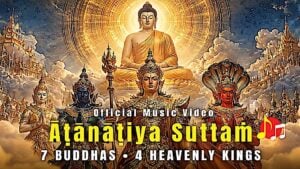
🙏 Greetings, Dhamma friends! We are deeply honored to share with you our new Paritta Blessing Music Video of the profoundly important Āṭānāṭiya Suttaṁ.
NOTE: BELOW you’ll find not only our song tribute, and the full lyrics, but also reference to the full Sutta, which is considerably longer than we can perform in a song. In the Mahamevnawa Pali Paritta chanting book, the full Sutta is 24 pages in length (Pages 129-153). Since the Sutta is quite long, the song is somewhat abbreviated, although, of course we’ve kept all of the Seven Buddhas Praises and the blessings and protective verses of the 4 Heavenly Kings. For the full Sutta in English see below.
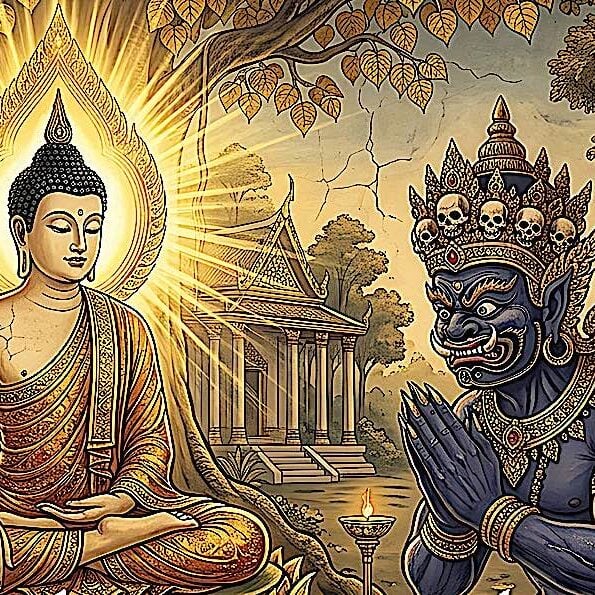
🙏🙏🙏 7 Buddhas Praises and 4 Heavenly Kings 3Gems Band Performs one of our band favorites, the ancient Pali Sutta of Blessings and Protection, chanted with heavenly harmony. 🙏🙏🙏
Video:
✨ Pali LYRICS BELOW with translation in Brackets, or turn on subtitles to chant along!
💫 Benefits (from Sutta)
Blessings of the 7 Buddhas and Protection of the 4 Heavenly Kings.💫
🙏🙏🙏 I. Homage to the Buddhas
Vipassissa namatthu – Cakkhumantassa sirīmato
Homage to Vipassi, possessed of the eye of Dhamma and glory.
Sikhissapi namatthu – Sabbabhūtānukampino
Homage to Sikhi, compassionate towards all beings.
Vessabhussa namatthu – Nahātakassa tapassino
Homage to Vessabhu, free from all defilements, of great energy.
Namatthu Kakusandhassa – Mārasenāpamaddino
Homage to Kakusandha, conqueror of Māra’s army.
Koṇāgamanassa namatthu – Brāhmaṇassa vusīmato
Homage to Koṇāgamana, who completed the holy life.
Kassapassa namatthu – Vippamuttassa sabbadhi
Homage to Kassapa, fully freed from all defilements.
Aṅgīrasassa namatthu – Sakyaputtassa sirīmato
Homage to Angīrasa, son of the Sākyans, full of radiance,
Yo imaṁ dhammaṁ adesi – Sabbadukkhāpanūdanaṁ
Who proclaimed this Dhamma that dispels all suffering.
II. The Four Directions
East — Dhataraṭṭha
Yato uggacchatī sūriyo – Ādicco maṇḍalī mahā
From where the resplendent sun, the great circle, rises—
Ito sā purimā disā – Iti naṁ ācikkhati jano
From here that is the eastern direction, so the people declare.
Yaṁ disaṁ abhipāleti – Mahārājā yasassi so
That direction is watched over by a glorious Great King—
Gandhabbānaṁ ādhipati – Dhataraṭṭho’ti nāma so
Master of the gandhabbas, Dhataraṭṭha by name.
Refrain:
Te cāpi Buddhaṁ disvāna – Buddhaṁ ādiccabandhunaṁ
They too, having seen the Buddha, kinsman of the sun,
Dūrato’va namassanti – Mahantaṁ vītasāradaṁ
Worship from afar the mighty one, free from fear:
Namo te purisājañña – Namo te purisuttama
“Homage to you, excellent one! Homage to you, Supreme One!”
South — Virūḷha
Ito sā dakkhiṇā dīsā – Iti naṁ ācikkhati jano
From here that is the southern direction, so the people declare.
Yaṁ disaṁ abhipāleti – Mahārājā yasassiso
That direction is watched over by a glorious Great King—
Kumbhaṇḍānaṁ ādhipati – Virūḷho iti nāmaso
Master of the kumbhaṇḍas, Virūḷha by name.
Refrain:
Te cāpi Buddhaṁ disvāna – Buddhaṁ ādiccabandhunaṁ
They too, having seen the Buddha, kinsman of the sun,
Dūrato’va namassanti – Mahantaṁ vītasāradaṁ
Worship from afar the mighty one, free from fear:
Namo te purisājañña – Namo te purisuttama
“Homage to you, excellent one! Homage to you, Supreme One!”
West — Virūpakkha
Yattha coggacchati suriyo – Ādicco maṇḍalī mahā
Where the resplendent sun, the great circle, sets—
Ito sā pacchimā disā – Iti naṁ ācikkhati jano
From here that is the western direction, so the people declare.
Yaṁ disaṁ abhipāleti – Mahārājā yasassiso
That direction is watched over by a glorious Great King—
Nāgānaṁ ca ādhipati – Virūpakkho iti nāma so
Master of the nāgas, Virūpakkha by name.
Refrain:
Te cāpi Buddhaṁ disvāna – Buddhaṁ ādiccabandhunaṁ
They too, having seen the Buddha, kinsman of the sun,
Dūrato’va namassanti – Mahantaṁ vītasāradaṁ
Worship from afar the mighty one, free from fear:
Namo te purisājañña – Namo te purisuttama
“Homage to you, excellent one! Homage to you, Supreme One!”
North — Kuvera
Yena uttarakurū rammā – Mahāneru Sudassano
Where delightful Uttarakuru is, and beautiful Mount Meru—
Ito sā uttarā disā – Iti naṁ ācikkhatī jano
From here that is the northern direction, so the people declare.
Yaṁ disaṁ abhipāleti – Mahārājā yasassiso
That direction is watched over by a glorious Great King—
Yakkhānaṁ ādhipati – Kuvero iti nāmaso
Master of the yakkhas, Kuvera by name.
Refrain:
Te cāpi Buddhaṁ disvāna – Buddhaṁ ādiccabandhunaṁ
They too, having seen the Buddha, kinsman of the sun,
Dūrato’va namassanti – Mahantaṁ vītasāradaṁ
Worship from afar the mighty one, free from fear:
Namo te purisājañña – Namo te purisuttama
“Homage to you, excellent one! Homage to you, Supreme One!”
Protection:
Ete c’aññe ca rājāno
(Whatever kings there may be)
Mahesakkhā yasassino
(Of great authority and power)
Sabbe va namas-seyyanti
(All of them indeed bow down)
Buddhaṁ ādiccabandhunaṁ
(To the Buddha, kinsman of the Solar dynasty)
Sabbe devā namas-seyyanti
(All the gods bow down)
Buddhaṁ ādiccabandhunaṁ!
(To the Buddha, kinsman of the Solar dynasty)
III. Closing Dedication
Kusalena samekkhasi – Amanussā’pi taṁ vandanti
With the power of goodness look upon this: even non-human beings worship you.
Sutaṁ netaṁ abhiṇhaso – Tasmā evaṁ vademase
We have heard this repeatedly; therefore we speak thus:
Jinaṁ vandatha Gotamaṁ – Jinaṁ vandāma Gotamaṁ
“Worship the Victor, Gotama! We worship the Victor, Gotama!”
Vijjācaraṇasampannaṁ – Buddhaṁ vandāma Gotamaṁ
“We worship the Buddha Gotama, endowed with knowledge and virtue.”
This is our ongoing Pali Paritta Series.
FULL SUTTA in English DN 32
1. The First Recitation Section
So I have heard. This discourse bears similarities to the Mahāsamayasutta (DN 20). Thematically, that discourse is about the devotion of the deities, whereas this is about protection for the mendicants. | I believe this is only place in whole canon that lists the bhāṇavāra at the start. At one time the Buddha was staying near Rājagaha, on the Vulture’s Peak Mountain. Then, late at night, the four great kings—with large armies of spirits, centaurs, gnomes, and dragons—set guards, troops, and wards at the four quarters and then, lighting up the entire Vulture’s Peak with their beauty, went up to the Buddha, bowed, and sat down to one side. Before sitting down to one side, some spirits bowed, some exchanged greetings and polite conversation, some held up their cupped palms toward the Buddha, some announced their name and clan, while some kept silent.
Seated to one side, the Great King Vessavaṇa said to the Buddha, Here Kuvera is called Vessavaṇa, which our text below explains as being derived from the name of his city. “Sir, some high spirits have confidence in the Buddha, some do not. Some middling spirits have confidence in the Buddha, some do not. Some low spirits have confidence in the Buddha, some do not. But mostly the spirits don’t have confidence in the Buddha. Why is that? Because the Buddha teaches them to refrain from killing living creatures, stealing, lying, sexual misconduct, and consuming intoxicants of beer, wine, and liquor. But mostly they don’t refrain from such things. They don’t like that or approve of it.
Sir, there are disciples of the Buddha who frequent remote lodgings in the wilderness and the forest that are quiet and still, far from the madding crowd, remote from human settlements, and fit for retreat. There dwell high spirits who have no confidence in the Buddha’s dispensation. To give them confidence, may the Buddha please learn the Āṭānāṭiya protection for the guarding, protection, safety, and comfort of the monks, nuns, laymen, and laywomen.” The Buddha consented with silence.
Then, knowing that the Buddha had consented, on that occasion Great King Vessavaṇa recited the Āṭānāṭiya protection. “Protection” is rakkhā, which is a synonym of paritta.
“Hail Vipassī, For these verses, I lean heavily on the translation by Ānandajoti, The Āṭānāṭiya Discourse. They are commonly recited in Theravada countries today. The recital begins with the seven Buddhas, for which see DN 14.the glorious Clear-eyed One!Hail Sikhī,sympathetic for all beings!
Hail Vessabhū,cleansed and fervent!Hail Kakusandha,crusher of Māra’s army!
Hail Koṇāgamana,the brahmin who has lived the life!Hail Kassapa,everywhere free!
Hail Aṅgīrasa, Aṅgīras was one of the Vedic sages and the Aṅgīrasas are his descendants. They were priestly poets who assisted Indra in freeing the cows from the Vala cave, thus ushering in the dawn. Aṅgīras is regarded as the pravara or revered ancestor of the Gotama clan. Both names are associated with light: aṅgīrasa shares a root and is often synonymous with agni (“fire”), while gotama means “light dispelling dark”.the glorious Sakyan!He taught this Dhammathat casts aside all suffering.
Those in the world who are quenched,truly discerning,not backbiters; such peoplebeing great of heart and intrepid,
revere that Gotama;he who is helpful to gods and humans,accomplished in knowledge and conduct,great of heart and intrepid.
Where rises the sun—Here begins a series of verses dedicated to the divinities in each of the four quarters, proceeding in the standard way: east, south, west, north.Aditi’s child, the great orb—with whose risingnight’s umbra also ends,and of whom, when sun has risen,it is said to be the day—
there is a deep lake,an ocean of flowing waters.That’s how they understand that lake there, This is according to the commentary (taṁ rahadaṁ tattha evaṁ jānanti).as an ocean of flowing waters.
From here that is the eastern quarter,so the people say.That quarter is wardedby a great king, glorious,
the lord of the centaurs;his name is Dhataraṭṭha.He delights in song and dance,honored by the centaurs.
And he has many mighty sonsall of one name, so I’ve heard.Eighty, and ten, and one—all of them named Indra.
After seeing the Awakened One,the Buddha, Kinsman of the Sun,they revere him from afar,the one great of heart and intrepid.
Homage to you, O thoroughbred!Homage to you, supreme among men!You examine us skillfully; This relates back to the basic problem facing the yakkhas: shame. They know what they do is wrong, but they like it and hence feel shame when hearing the Dhamma. But the Buddha treats them with respect, without shaming or bias, and thus is able to lead them to the good. The commentary implicitly connects this line with DN 30:2.1.2, where the Buddha “examines” (samekkhati) the population for their individual and shared traits.the non-humans bow to you.We’ve been asked many a time,‘Do you bow to Gotama the victor?’
And so we ought to declare:‘We bow to Gotama the victor,accomplished in knowledge and conduct!We bow to Gotama the awakened!’
It’s where the departed go, they say, The south has the shortest and least auspicious description. To the extent that it relates to physical geography, this echoes the perception of northerners at the time that the south of India lay outside the “civilized” realms (āryāvarta).who are backbiters and calumniators,killers and hunters,bandits and cheats.
From here that is the southern quarter,so the people say.That quarter is wardedby a great king, glorious,
the lord of the gnomes;his name is Virūḷha.He delights in song and dance,honored by the gnomes.
And he has many mighty sonsall of one name, so I’ve heard.Eighty, and ten, and one—all of them named Indra.
After seeing the Awakened One,the Buddha, Kinsman of the Sun,they revere him from afar,the one great of heart and intrepid.
Homage to you, O thoroughbred!Homage to you, supreme among men!You examine us skillfully;the non-humans bow to you.We’ve been asked many a time,‘Do you bow to Gotama the victor?’
And so we ought to declare:‘We bow to Gotama the victor,accomplished in knowledge and conduct!We bow to Gotama the awakened!’
Where sets the sun—The description of the west mirrors the east.Aditi’s child, the great orb—with whose settingthe day also ends;and of whom, when sun has set,it is said to be night’s umbra—
there is a deep lake in that place,an ocean of flowing waters.That’s how they understand that lake there,as an ocean of flowing waters.
From here that is the western quarter,so the people say.That quarter is wardedby a great king, glorious,
the lord of the dragons;his name is Virūpakkha.He delights in song and dance,honored by the dragons.
And he has many mighty sonsall of one name, so I’ve heard.Eighty, and ten, and one—all of them named Indra.
After seeing the Awakened One,the Buddha, Kinsman of the Sun,they revere him from afar,the one great of heart and intrepid.
Homage to you, O thoroughbred!Homage to you, supreme among men!You examine us skillfully;the non-humans bow to you.We’ve been asked many a time,‘Do you bow to Gotama the victor?’
And so we ought to declare:‘We bow to Gotama the victor,accomplished in knowledge and conduct!We bow to Gotama the awakened!’
Where the lovely land north of Kuru is, The description of the north is by far the most elaborate. | The “land north of Kuru” (uttarakuru) is mentioned in Sanskrit and Greek literature, where it sometimes appears as an actual country and other times as a place of fantasy. Attempts to locate it in a specific region in or beyond the Himalayas have proven inconclusive.and the beautiful Mount Meru, Meru is another place that appears sometimes as a physical mountain and other times purely mystical. As home of the gods (Snp 3.11:4.3), its peak is accessible only by psychic powers (Thig 14.1:19.3, MN 50:30.1). It is the center of the world in Buddhist, Hindu, and Jain cosmologies. Today it is sometimes identified with Mount Kailash. See discussion of Sineru at SN 13.11:1.2.humans born thereare unselfish, without possessions. This agrees with the description at AN 9.21:1.3.
They do not sow the seed,nor do they draw the plough.The rice eaten by people They live in a kinder state of nature, which we selfish humans have lost (DN 27:16.1).ripens in untilled soil,
free of powder or husk, pure,fragrant, with only the rice-grain.After cooking in a tandoor oven, Tuṇḍikīre is explained by the commentary as “firestone”. In the notes to his translation, Walshe suggests a relation with tandoor, which has been found as far back as the Indus Valley Civilization, a millennium before the Buddha.they enjoy eating that food.
Having prepared a cow with hooves uncloven, Cloven and uncloven was an important classification of animals in the Dharmaśāstras.they’re drawn about from place to place.Having prepared a beast with hooves uncloven,they’re drawn about from place to place.
Having prepared a woman-drawn carriage, The commentary says they were mostly carried on the backs of pregnant women(!). But the verb anuyanti indicates, rather, that they were “drawn along after”, which suggests a rickshaw.they’re drawn about from place to place.Having prepared a man-drawn carriage,they’re drawn about from place to place.
Having prepared a girl-drawn carriage,they’re drawn about from place to place.Having prepared a boy-drawn carriage,they’re drawn about from place to place.
Having ascended their vehicle,that king’s servantstour about in every quarter,
provided with heavenly vehiclesof elephant and of horse.And there are palaces and palanquinsfor that great and glorious king.
And he has cities, too,well-built in the sky:Āṭānāṭā, Kusināṭā, Parakusināṭā, The discourse is named after the first of these cities. The name is hard to explain, but all the names in this series have the element nāṭa, which is probably the name of the people. One meaning of nāṭa is “dance”, and one of the unique features of this discourse is that each of the Four Great Kings is said to delight in song and dance. There is a long history of dancing divinities in India, and images of dancers go back as far as the Indus Valley Civilization. If we take nāṭa in the sense “the people of the dance”, kusināṭā would therefore be “dancers of the grass” after the kusa grass essential to the Vedic rites of kingship. Parakusināṭā is the “further dancers of the grass”, and parakusiṭanāṭā is probably a variation on that. Nāṭapuriyā is the “citadel of the dancers”. Each of these associates the people of the dance with the idea of protection or authority, agreeing with the context, where the cities are said to belong to a great king. Thus the prefix āṭā- probably stems from tāṇa (“shelter, refuge”; the same root as paritta), in the sense of the “refuge of the dancers”.Nāṭapuriyā, and Parakusiṭanāṭā. Adopt the reading nāṭapuriyā found in Sinhalese-script manuscripts against the Mahāsaṅgīti’s nāṭasuriyā.
To the north is Kapīvanta, “Abounding in monkeys”.and Janogha lies beyond. “Flood of folk”.And there’s Navanavutiya, Ambara-ambaravatiya, Navanavutiya is “the city of the ninety-nine” i.e. three times thirty-three. | Ambara is “sky”.and the royal capital named Āḷakamandā. Also encountered at DN 17:1.3.8 and DN 16:5.18.5. Alakā is the capital of Kuvera in Sanskrit sources.
The Great King Kuvera, dear sir,has a capital named Visāṇā, The city Visāṇa is not encountered elsewhere, but it means “horn”, possibly reinforcing the importance of “song and dance”.which is why the great kingis called ‘Vessavaṇa’.
Searching, they shine: The commentary explains “searching” (paccesanto) as investigating the meaning of the teachings. It takes pakāsenti as “explain”: the spirits of the nation explain the teaching to spirits who are gatekeepers, who then explain it to the king. The terms below are the names of these spirits. However, pakāsenti also means “shine”, and the names below seem to be associated with solar or celestial phenomena. I think the phrase is a poetic description of the celestial bodies that shine as they search across the sky. This verse is especially obscure, and any explanation is speculative, but below I offer an analysis under the assumption that the names depict shining celestial bodies.Tatolā, Tattalā, Tatotalā, Resolve tatola as tato + la (= Sanskrit las, to shine or glitter): “one who glitters from afar”, i.e. a star that shines across the distant skies. | Tattala would then have tatta in the sense “heated”, i.e. “one who glitters from heat” (unless it is a misreading from tattha, yielding “one who glitters from there”). | Tatotala is a reduplicated form, “one who glitters from farther”.Ojasi, Tejasi, Tatojasi, Take oja in the sense “lustre”—attested in Sanskrit but not otherwise in Pali—rather than the more familiar “nutritive essence” (MN 36:27.5), yielding “lustrous one”. | Tejasi means “brilliant one” (used of the sun at Praśna Upaniṣad 5.5). | Tatojasi means “one whose lustre shines from afar”.Sūra, Rājā, Ariṭṭha, and Nemi. These are a set of associated solar names. Ariṭṭha and Nemi appear compounded in Sanskrit, Ariṣṭanemi, which evokes the powerful chariot of a conqueror (“indestructible rim”, Rig Veda 1.89.6, 1.180.10, 3.53.17, 10.178.1). It was the name of the 22nd Jain tīrthaṅkara, and in Brahmanical texts of several figures, including a dragon (Mahābhārata 1.59.39a, 1114.62a, etc.) and an Asura king (Bhāgavatapurāṇa 8.6.31, 8.10.10). Along with the divine steed Tārkṣya, he is associated with Garuḍa, and was probably originally an epithet for the unstoppable wheel of the Sun, Sūra. This line, then, while a simple list of four names in Pali, appears to be a fragmented memory of a Vedic conception which might be translated: “King Sun, (the wheel) of indestructible rim”.
There is a lake there too named Dharaṇī, Dharaṇī the “bearer” is also a pregnant woman or Mother Earth.whence the clouds rain forth,and the rains disperse.There is a hall there too named Sālavatī, Sāla means “hall” or “sal tree”, but the commentary says it was surrounded by creepers of that name.
where the spirits frequent.There the trees are ever in fruit,with many different flocks of birds.Peacocks and herons call out there,and the sweet cuckoos too.
One bird cries out ‘Live, live!’,another ‘Lift up your heart!’There are cocks and kookaburras, Kuḷīrakā appears to be the name of a crab-eating bird (kuḷīra). In honor of my native country, I name it after the kookaburra, which eats crabs and is renowned for its cry.and in the wood the woodpeckers. In Ja 547:426.2 we find koṭṭhā pokkharasātakā, where the koṭṭha is evidently a woodpecker. Satapatta can mean woodpecker or lotus (or crane or peacock), and perhaps there is an association here, the “hundred-leaved [bird] of the lotus pond”.
The parrots and mynah cry out there,and the ‘little stick-boy’ birds.Kuvera’s pond of rushesis lovely all the time.
From here that is the northern quarter,so the people say.That quarter is wardedby a great king, glorious,
the lord of spirits;his name is Kuvera.He delights in song and dance,honored by the spirits.
And he has many mighty sonsall of one name, so I’ve heard.Eighty, and ten, and one—all of them named Indra.
After seeing the Awakened One,the Buddha, Kinsman of the Sun,they revere him from afar,the one great of heart and intrepid.
Homage to you, O thoroughbred!Homage to you, supreme among men!You examine us skillfully;the non-humans bow to you.We’ve been asked many a time,‘Do you bow to Gotama the victor?’
And so we ought to declare:‘We bow to Gotama the victor,accomplished in knowledge and conduct!We bow to Gotama the awakened!’
This, good fellow, is the Āṭānāṭiya protection for the guarding, protection, safety, and comfort of the monks, nuns, laymen, and laywomen.
The monks, nuns, laymen, and laywomen should learn this Āṭānāṭiya protection well and completely memorize it. If anyone who does so is approached while walking, standing, sitting, or lying down by any non-human being with malicious intent—including males, females, boys, girls, chief ministers, councillors, and servants among the spirits, centaurs, gnomes, and dragons—that non-human will receive no homage or respect in any village or town. And they will receive no ground or dwelling in my capital of Ālakamandā. Nor will they get to go to the conference of the spirits. In addition, the non-humans would not give or take them in marriage. They’d heap personal abuse on them, drop an empty bowl on their head, and even split their head into seven pieces!
For there are, good fellow, non-humans who are fierce, cruel, and violent. They don’t obey the Great Kings or their men or their men’s men. They’re said to be rebelling against the Great Kings. They’re just like the bandits in the king of Magadha’s realm who don’t obey the king, his men, or his men’s men, and are said to be rebelling against the king.
If any non-human being with malicious intent—including males, females, boys, girls, ministers, councillors, and servants among the spirits, centaurs, gnomes, and dragons—approaches a monk, nun, layman, or laywoman while walking, standing, sitting, or lying down, one ought to yell, cry, and scream to the spirits, great spirits, generals, great generals: ‘This spirit’s got me! This spirit’s entered me! This spirit’s annoying me! This spirit’s harassing me! This spirit’s hurting me! This spirit’s harming me! This spirit won’t let me go!’
To what spirits, great spirits, generals, great generals?
‘Indra, Soma, and Varuṇa, For these gods, see my comment on DN 13:25.2. Here I will comment on the names not discussed elsewhere, especially in DN 20.Bhāradvāja, the Progenitor, This is presumably Bharadvāja Bārhaspatya, the rishi ancestor of the Bhāradvāja clan, many members of which are encountered in the suttas. It is unusual to find him listed along with the primary Vedic gods. The Bhāradvāja verses are mostly collected in the sixth book of the Rig Veda, where they show a special devotion to the god Pūṣan. See also note on SN 7.1:1.2.Candana and Kāmaseṭṭha,Kinnughaṇḍu and Nighaṇḍu,
Panāda and Opamañña,and Mātali, the god’s equerry.Cittasena the centaur,and the kings Nala and Janesabha,
Sātāgira, Hemavata,Puṇṇaka, Karatiya, and Guḷa; These deities appear nowhere else. Puṇṇaka is “full”, guḷa is “lump”, and karatiya is unclear (“bean-like”?).Sivaka and Mucalinda, The yakkha Sivaka (“blissful, auspicious”) helped Anāthapiṇḍika visit the Buddha (SN 10.8:1.12); he is possibly to be identified with Shiva. | The dragon king Mucalinda sheltered the Buddha after his awakening (Ud 2.1:2.2).Vessāmitta, Yugandhara, Yugandhara is the tutelary deity of the mountain of that name.
Gopāla, Suppagedha, Gopāla is “cowherd”, an epithet of both Krishna and Shiva. | Suppagedha (or supparodha) is obscure.Hiri, Netti, and Mandiya; “Shame”, “conduit” (or “craving”), and “stupidity” seem like odd companions.Pañcālacaṇḍa, Āḷavaka, A saying by Pañcālacaṇḍa at SN 2.7 is quoted by Udāyī and explained by Ānanda at AN 9.42. He would appear to be the fierce (caṇḍa) protector of the Pañcāla clan, but a Pañcālacanda appears as a brahmin teacher (Aitereya Āraṇyaka 3.1.6, Śāṅkhāyana Āraṇyaka 7.19, Gopatha Brāhmaṇa 1.1.27n). | Āḷavaka is the tutelary deity of Āḷavī (SN 10.12, Snp 1.10).Pajjunna, Sumana, Sumukha, Pajjuna is Parjanya, the Vedic god of rain, especially the thunderstorm. His daughters appear in SN 1.39 and SN 1.40. | Sumana is “Happyheart”, sumukha is “Fairface”.Dadhimukha, Maṇi, Māṇivara, Dīgha, Dadhimukha is “Milkface”, and in the Mahābhārata is a name of a dragon. | Maṇi is “gem”. | Māṇivara is “fine gem”, although the commentary takes this as two names. | Dīgha is identified by the commentary with Dīgha Parajana of MN 31:21.1.together with Serīsaka.’ Serīsaka means “of sirīsa wood”, perhaps the tutelary deity of a forest.
This, good fellow, is the Āṭānāṭiya protection for the guarding, protection, safety, and comfort of the monks, nuns, laymen, and laywomen. Well, now, good fellow, I must go. I have many duties, and much to do.”
“Please, Great Kings, go at your convenience.”
Then the four great kings got up from their seats, bowed and respectfully circled the Buddha, keeping him on their right side, before vanishing right there. And before the other spirits present vanished, some bowed and respectfully circled the Buddha, keeping him on their right side, some exchanged greetings and polite conversation, some held up their cupped palms toward the Buddha, some announced their name and clan, while some kept silent.
The first recitation section is complete.
2. The Second Recitation Section
Then, when the night had passed, the Buddha told the mendicants all that had happened, repeating all the verses spoken. Then he added:
“Mendicants, learn the Āṭānāṭiya protection! Memorize the Āṭānāṭiya protection! Remember the Āṭānāṭiya protection! The Āṭānāṭiya protection is beneficial, and is for the guarding, protection, safety, and comfort of the monks, nuns, laymen, and laywomen.”
That is what the Buddha said. Satisfied, the mendicants approved what the Buddha said.
SOURCES
-
Source Mahamevnawa Paritta Chanting Book, Page 123 FOR the Pali (with English Translation) we strongly recommend this wonderful book for your daily practices. It has all the dailly practice Parittas.
- Publisher : Mahamegha Books
- Publication date : July 15 2015
- Language : English and Pali
- Print length : 184 pages
- ISBN-10 : 9556870644
- ISBN-13 : 978-9556870640
- English translation Āṭānāṭiyasutta—Bhikkhu Sujato from SUTTA CENTRAL>>
More articles by this author
Search
Latest Features


Please support the "Spread the Dharma" mission as one of our heroic Dharma Supporting Members, or with a one-time donation.
Please Help Support the “Spread the Dharma” Mission!
Be a part of the noble mission as a supporting member or a patron, or a volunteer contributor of content.
The power of Dharma to help sentient beings, in part, lies in ensuring access to Buddha’s precious Dharma — the mission of Buddha Weekly. We can’t do it without you!
A non-profit association since 2007, Buddha Weekly published many feature articles, videos, and, podcasts. Please consider supporting the mission to preserve and “Spread the Dharma." Your support as either a patron or a supporting member helps defray the high costs of producing quality Dharma content. Thank you! Learn more here, or become one of our super karma heroes on Patreon.
Lee Kane
Author | Buddha Weekly
Lee Kane is the editor of Buddha Weekly, since 2007. His main focuses as a writer are mindfulness techniques, meditation, Dharma and Sutra commentaries, Buddhist practices, international perspectives and traditions, Vajrayana, Mahayana, Zen. He also covers various events.
Lee also contributes as a writer to various other online magazines and blogs.