


7-minute Buddhist Practices, 7 Step Puja, 7 Purifications, 7 Accomplishing Merits
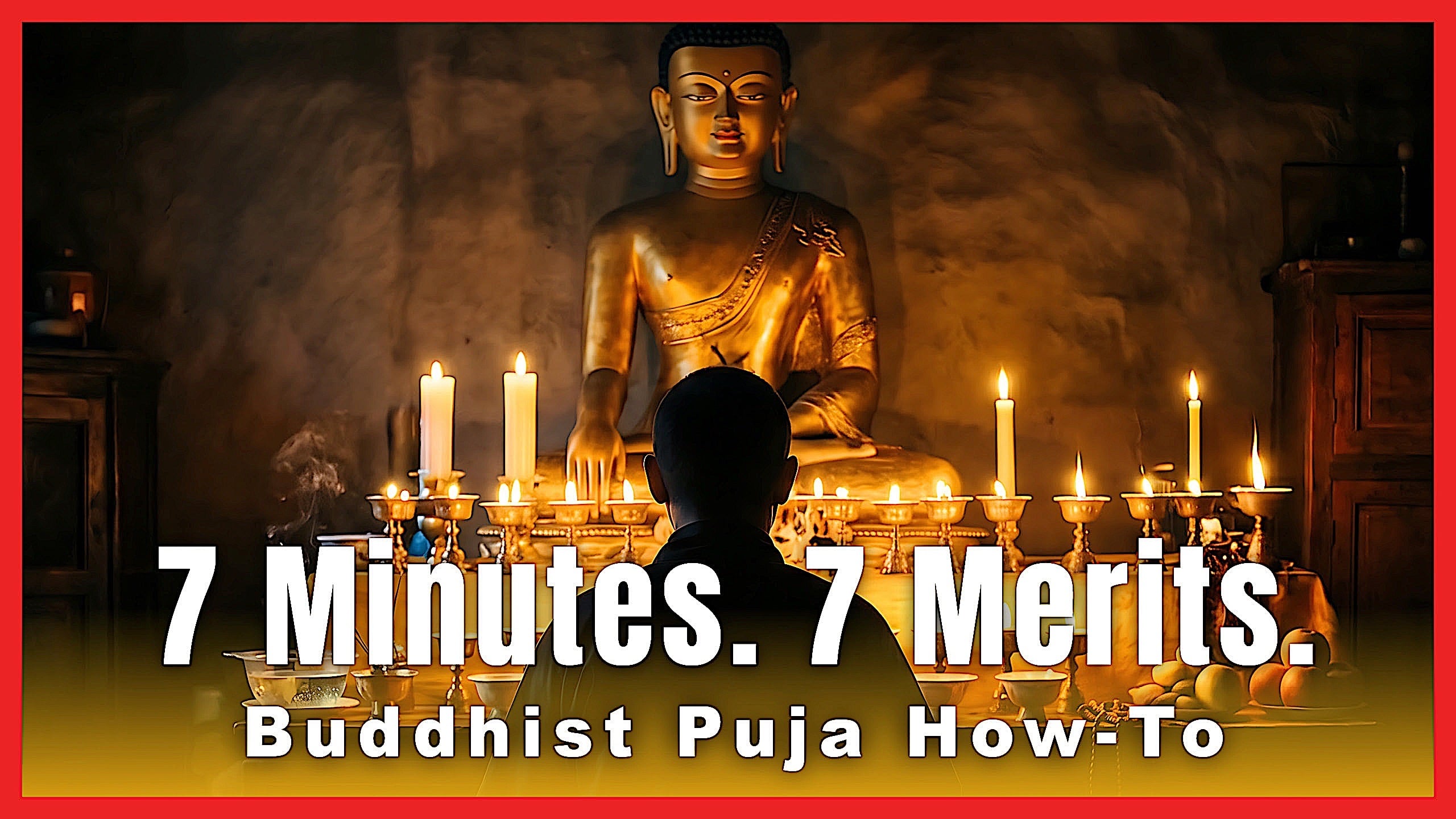
Have you ever wondered how to create a simple, short daily Buddhist practice that anyone can do in only 7 minutes? How can this simple 7-minute Puja practice create merit and purify daily, even if you do not have a teacher? What are the steps to starting, or rebooting, a daily Buddhist practice? What exactly is a Puja, and how does it differ from advanced sadhana practices?
Video:
Welcome back to Buddha Weekly! Today we are answering all of these questions as we walk through a simple, 7-minute daily Puja, a devotional practice to purify your mind, cultivate profound respect, and generate merit.
How can you respectfully perform a full practice daily in only a few minutes? Check out our popular playlist of very concise daily practices. You’ll find a 6 minute Akshobhya Buddha practice with mantras. A 7-Minute Tara Puja. A 9-Minute Ratnasambhava Buddha practice. A 12-Minute Shakyamuni Buddha purification puja, and many others. You’ll also find, in that list short Pujas for the Magnetizing Deities of the Lotus family, Vajrapani, 5 Buddhas Karma Repair, 8 Bodhisattvas, and many, many more.
And the King of all Pujas is the King of Prayers, the aspiration of Samantabhadra, which we have in Sanskrit, also linked. Bookmark the links for daily practice.
These short Pujas are linked at the information icon, and used as an example in this video. We also have PDFs of most of these practices on BuddhaWeekly.com under downloads.
So, what is the difference between a daily puja and a more involved Sadhana yoga you might receive from a teacher? Pujas are called merit-accumulation and supplication practices. When we need to purify our negativities and karma, or we need to create merit so that we feel qualified to make requests for siddhis and wishes, we perform Pujas. And, of course, we do it out of reverence and devotion to the Buddha, Dharma and Sangha.
🔗 Links to all practices mentioned (click the info icon or check below):
✅ Concise Daily Practices Playlist (Amitabha, Tara, Guru Rinpoche, Medicine Buddha, Vajrasattva & more) https://www.youtube.com/playlist?list=PL8d71VyWOwkH5KFhKs3Xt51x0ZJwDTfrp
✅ 7-Minute Tara Puja https://www.youtube.com/watch?v=RgbHrXKTyDE
✅ 12-Minute Shakyamuni Purification https://www.youtube.com/watch?v=bYeMrCVI7ZU&t
✅ 9-Minute Ratnasambhava with Dharani https://www.youtube.com/watch?v=vGFnLmSkWhs
✅ King of Prayers – Aspiration of Samantabhadra (Sanskrit) https://www.youtube.com/watch?v=BhWpGOK_5KA&t
✅ Short Puja Playlist: https://www.youtube.com/playlist?list=PL8d71VyWOwkHBrD3Xk7gUMD0acHe4xDAx
📥 Free PDFs available at BuddhaWeekly.com → Downloads https://buddhaweekly.com/pdfs-downloads/ 📥 Free Altar Pictures available at BuddhaWeekly.com → Dharma Art Galleries: https://buddhaweekly.com/dharma-art-galleries/
Puja and these short practices, with or without a teacher’s guidance are called ‘Frontal Generation.’ That’s just a jargon term for visualizing the enlightened beings in front of you, or placing an altar and image in front of you, with offerings.
It is completely open to everyone and requires no special empowerments for any Enlightened Deity or Buddha.
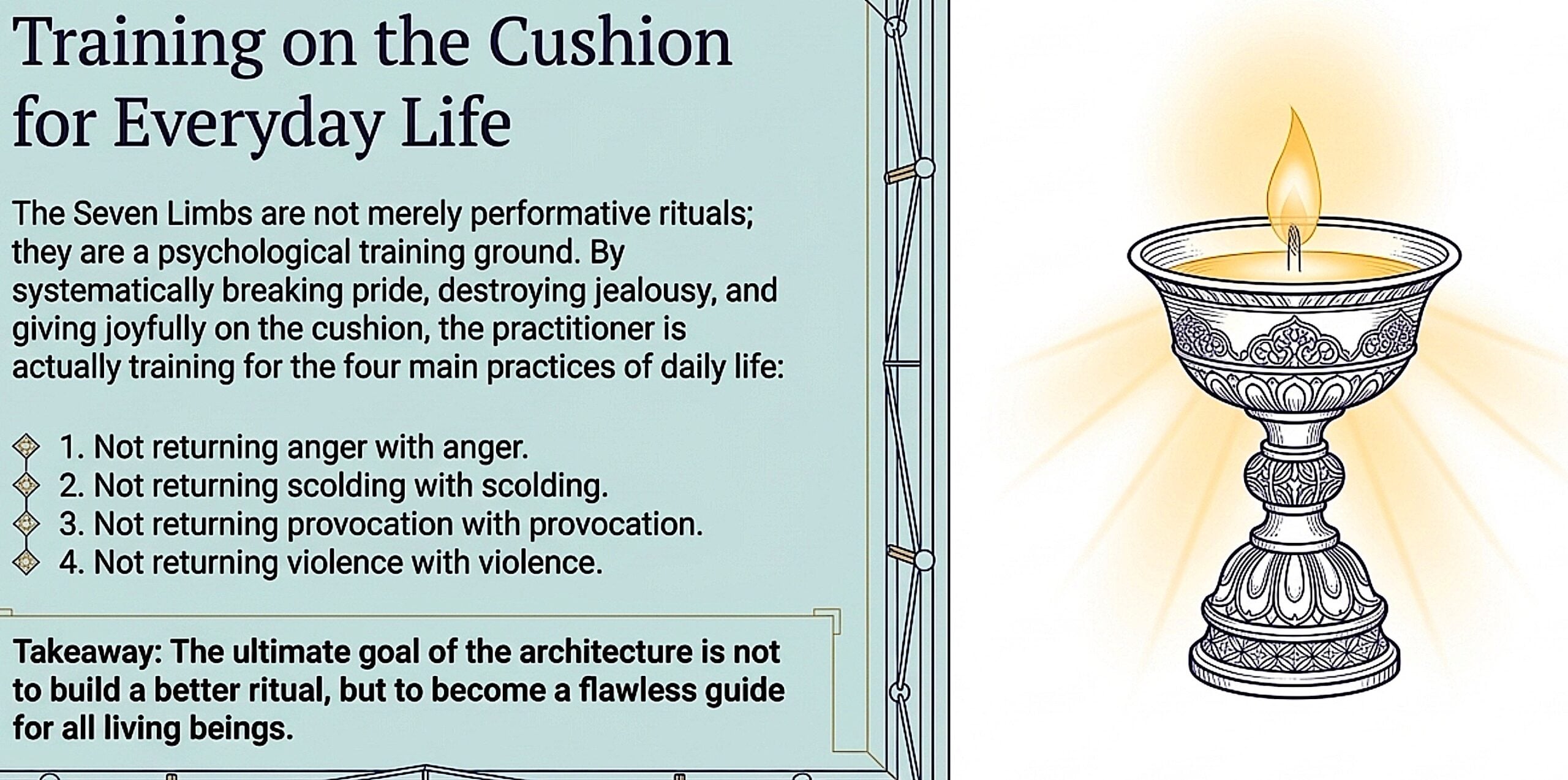
As the great Tibetan master Lama Zopa Rinpoche explained, ‘The seven factors of the seven-limb practice are like seven vital parts of a car, plane or other vehicle that enable it to function and take passengers to the places they wish to go’. He called it the basic practice for achieving realizations and enlightenment.
Sadhana and teacher-sanctioned yogas are generally more involved. They still start with Puja and merit-accumulation and what are called “the preliminaries” but they move into long meditations where we might meditate either on generating ourselves as our Yidam, or on a body mandala, or on longer involved practices that do require teacher training.
It’s not a mystical hoo-hoo thing. Empowerment and Initiation is not about magical blessings and secrets. It’s about receiving the necessary guidance for more involved practices. In other words, anyone may practice pujas, or the 7 Limbs of Practice as they are formally called.
Short on time? You can just play it on your phone with headphones and close your eyes and practice in your head while you commute to work on a bus or train. Or on a lunch break at work the same way. You don’t need a fancy altar and formal set up to do daily reverence. What matters is mind and intention.
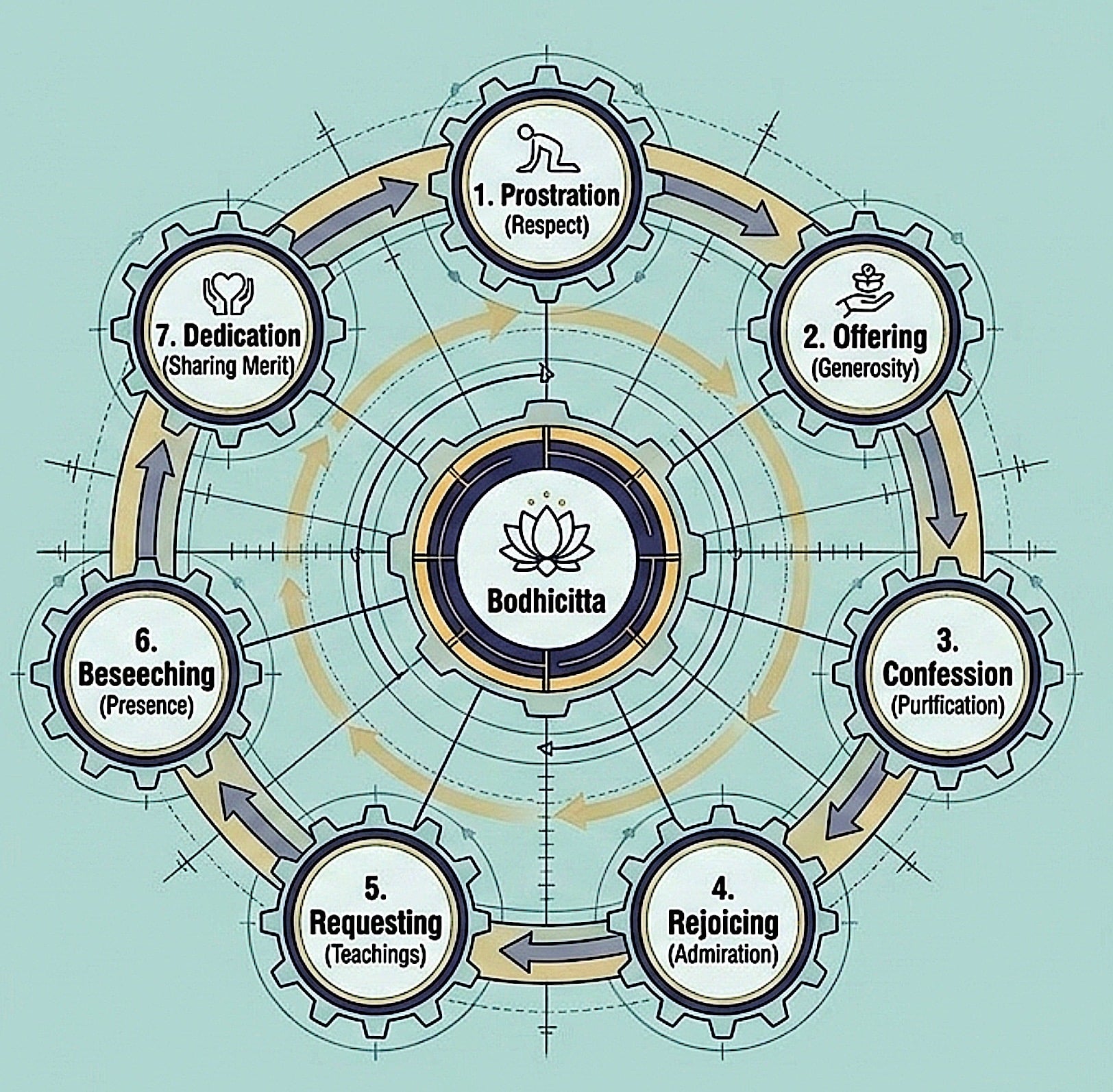
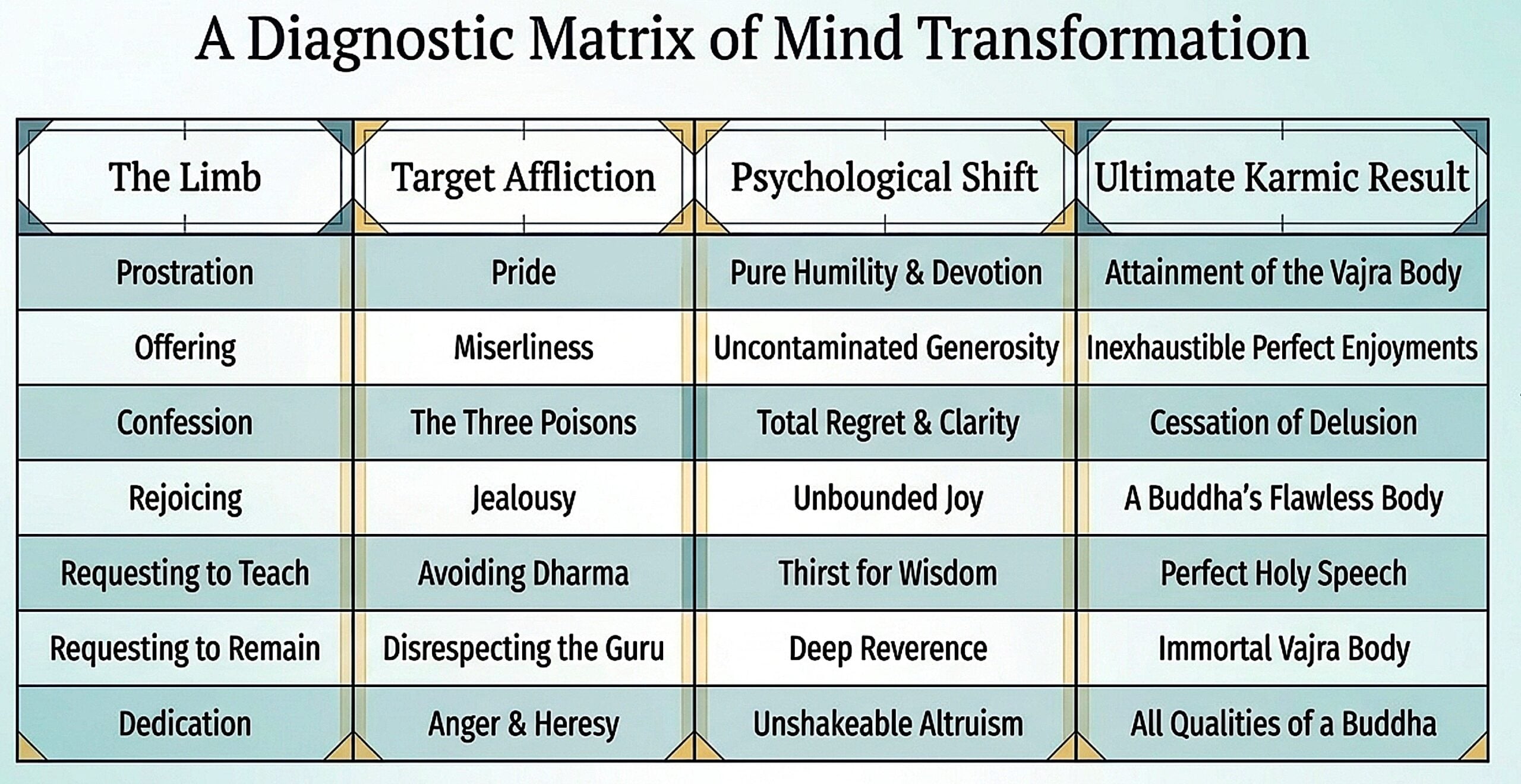
Despite the 7-Minute concise format, each of these seven steps purifies one poison or obstacle. Here’s a quick walk through. After listening to our explanation, we suggest you play any one of those concise practices linked in that playlist of short practices to see how they match up.
So, let’s break down the Seven Limbs of Practice, step-by-step.
Number 1 is Refuge and Prostration, which is the Antidote to Pride, self clinging and ego. We begin by making physical or mental prostrations to cultivate humility. Don’t worry if you can’t prostrate, either because you’re in a public place or physically unable. You can do the prostrations mentally, by closing your eyes and imagining yourself prostrating to the Three Jewels. As you do, you can recite this classic verse: ‘To all the buddhas, the lions of the human race. I prostrate in homage; Devotion fills my body, speech and mind’ or the equivalent line from your Puja. As you do this you are also taking refuge, which you can state more formally at the beginning by saying
“I take Refuge in the Three Jewels, Buddha, Dharma and Sangha until I attain Enlightenment for the benefit of all sentient beings.”
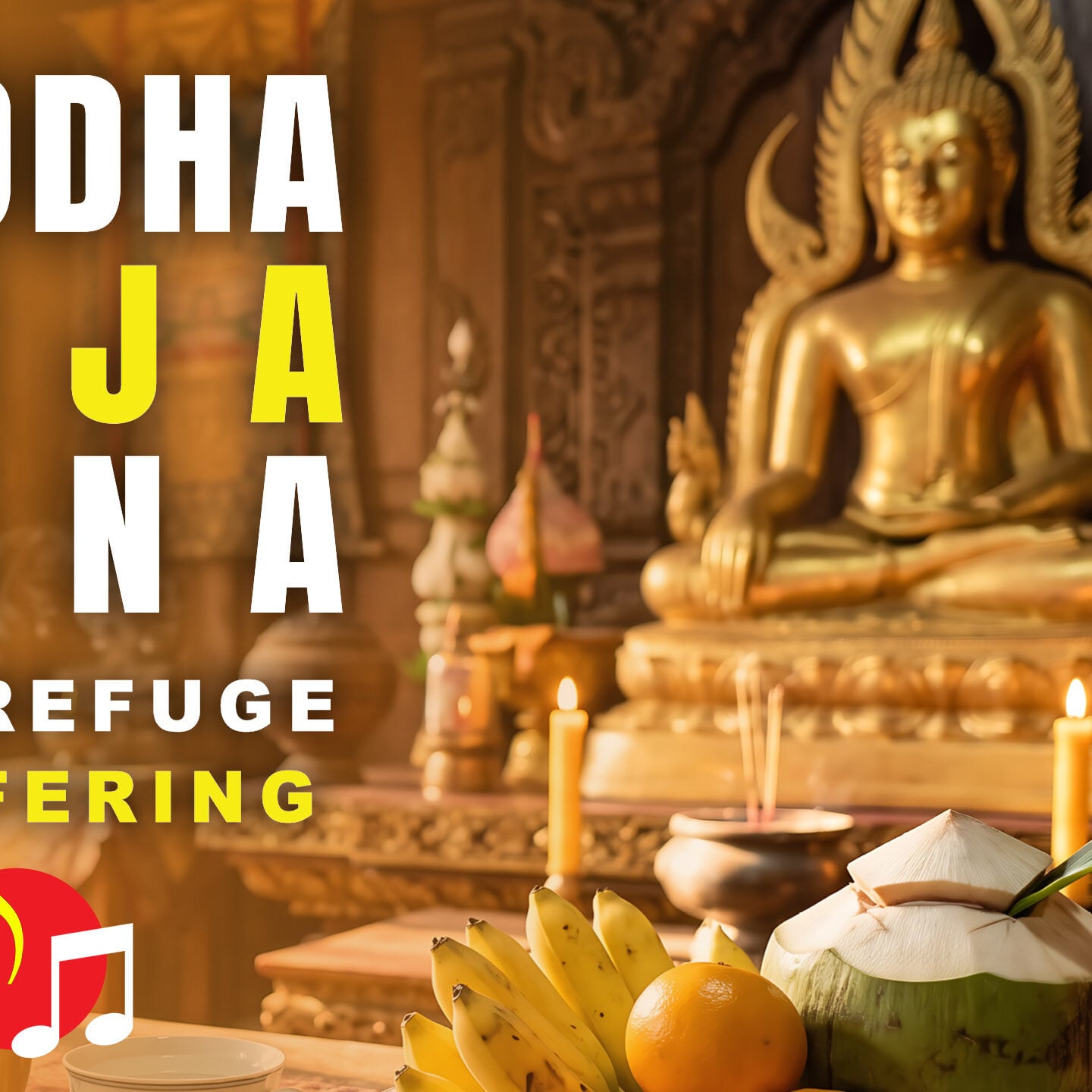
Number 2 is Offering , which is the Antidote to greed. To show this, we make offerings to overcome our greed. You can offer real items on an altar, like water or light, or vegetarian fruit and food, or simply imagine them. You can also offer your good deeds, by saying “I offer all my good deeds this day to the Three Jewels for the benefit of all sentient beings.” If you’re doing physical offerings you normally place 8 bowls of clean water, or the 8 sensory offerings of water for drinking, water for washing, flowers, incense, light or candles, perfume, food and sound, music or mantra.
You can recite: ‘To all the Buddhas, Dharma and Sangha, I make offerings: Of the loveliest flowers, of beautiful garlands… The brightest lamps and finest incense’.
Number 3 is Confession, which is the Antidote to all the negative karma we’ve created through anger, hate, greed, ignorance, attachment, lust, and jealousy or envy. By confessing silently to our Yidam or the Three jewels, we purify our negative karma by honestly regretting our past mistakes driven by attachment, anger, and ignorance. We do this silently, because we know the Buddhas are everywhere, including mind and heart.
We could say something like: “Whatever negative acts I have committed, I confess sincerely. Before you, I confess and purify each and every one’.
Number 4: Rejoicing is The Antidote to Jealousy or envy. The fourth limb combats jealousy by feeling pure joy for the good deeds of others. The great sage Lama Tsongkhapa said that ‘among all virtues, rejoicing is the best’ because it is the easiest way to create infinite merit.
You might say: ‘With a heart full of delight, I rejoice at all the merits Of buddhas and bodhisattvas And every living being’.
Number 5 is requesting to Turn the Dharma Wheel, which is The Antidote to Ignorance Even if we don’t yet have a teacher, we see the written Dharma as our teacher, and the living presence of the Enlightened Buddhas, Bodhisattvas, Yidams, and the Merit Field. We ask the enlightened beings to continually teach the Dharma to combat the darkness of ignorance.
We request them to: ‘Turn the unsurpassable wheel of Dharma’.
Number 6 is requesting to Remain. Here we ask our Buddhas, Bodhisattvas, Yidams, spiritual teachers and the Sangha not to pass away, so they may continue to guide us.
In Puja we might say, ‘Remain, for aeons as many as the atoms in this world, And bring well-being and happiness to all living beings’.
Before we move on to the final step, the dedication of merit, it is ideal to chant mantras now as a sound offering. You can chant these musically or recite as speech. We have separate videos on mantras, and how they work, linked at the information icon. Mantras accumulate merit through their virtuous sound. Ideally, chant in the original language of Buddhas mantra teachings, which is primarily Sanskrit. If you’re chanting the older Parittas these will be in Pali. If you have a teacher who is Tibetan, you might be given Tibetan phonetics. You should always follow your teacher’s guidance on this. To symbolize the activity of all of the 7 limbs visualize blessing light going out from the Buddha’s heart to all beings in the universe as you chant your mantras. This light then enters your own heart, blessing you as well.
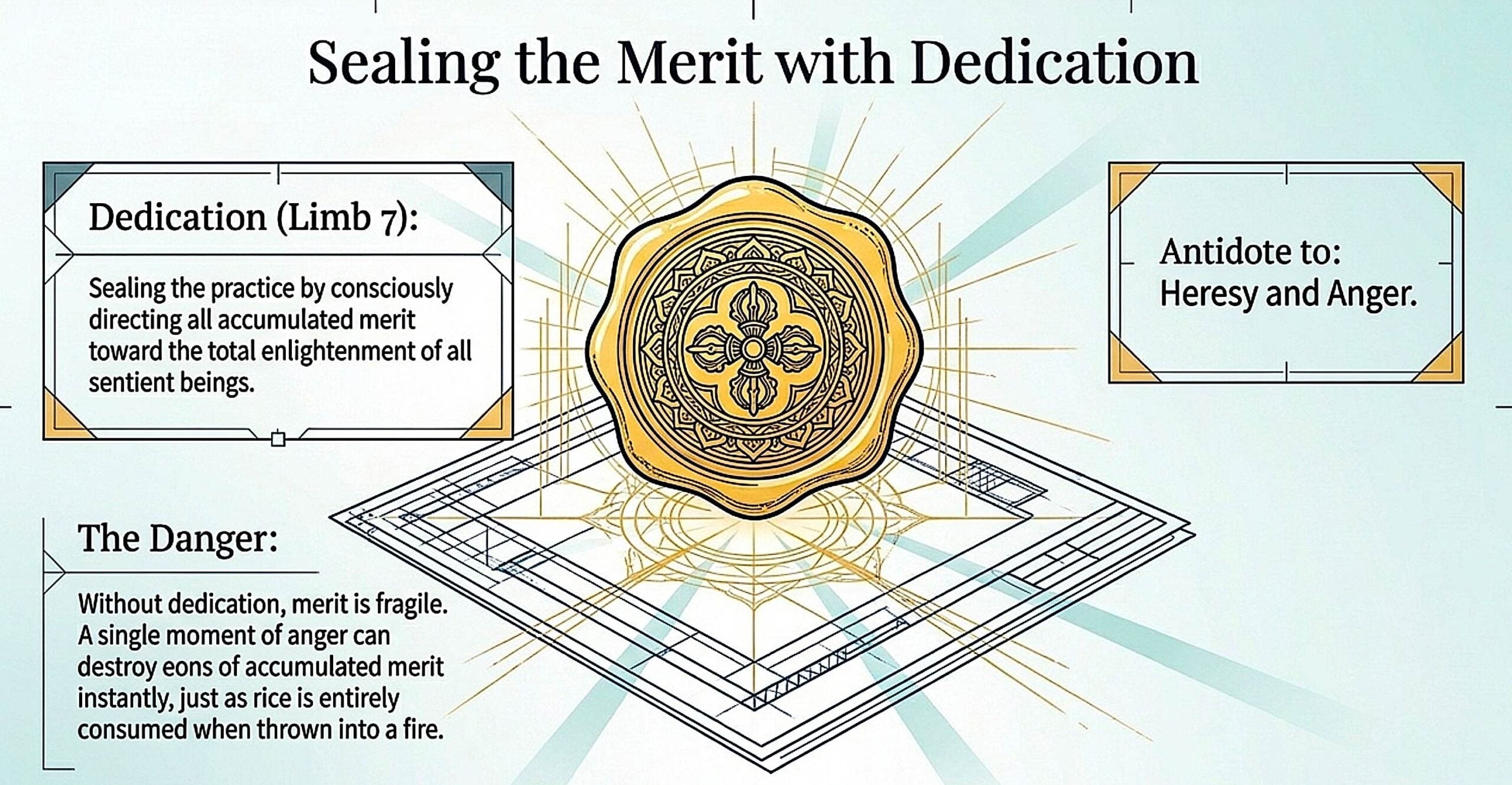
Number 7, finally, the most crucial step is dedication, which is the ultimate remedy. With our Dedication we state Bodhichitta Intention: the intention to become Enlightened for the benefit of all sentient beings. Even if we are specifically supplicating a virtuous request, such as healing for a teacher, friend, family or ourselves, we always end by dedicating our merit to the cause for Enlightenment to benefit all beings. This seals the practice and acts as an antidote to everything. It seals the entire practice with intention.
We give away all the positive energy we just created: ‘What little virtue I have gathered, all of it I dedicate to the enlightenment of all beings!’. This creates vast merit and virtue.
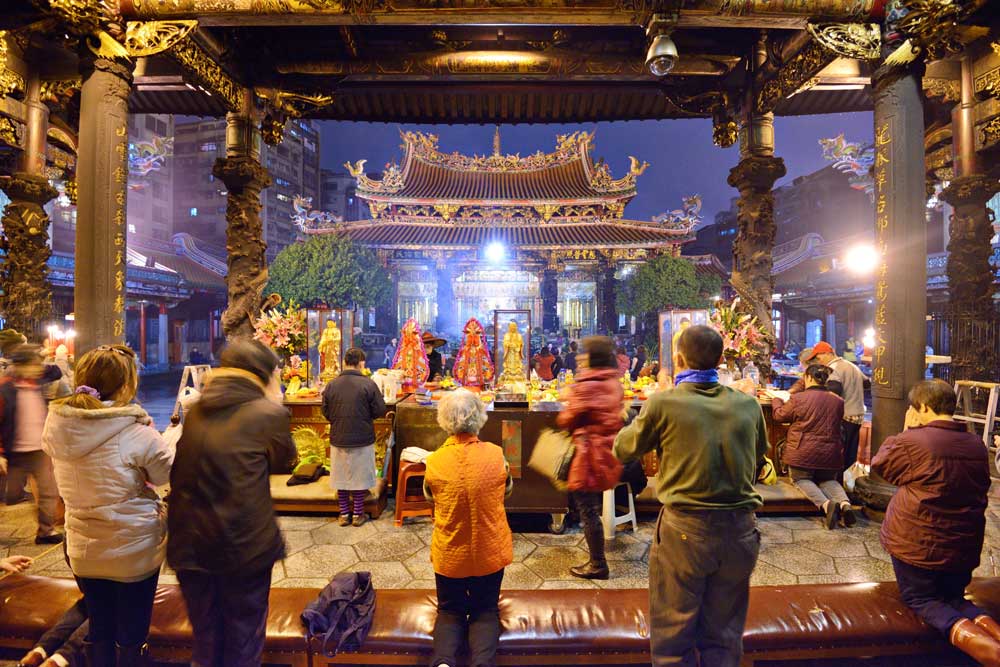
Before we wrap up, you might be wondering where you should do this daily practice. As we said, you can do this anywhere, even in bed before sleep, or on the bus to work. However, the act of setting up a simple sacred space at home is highly virtuous and creates merit and good karma.
It doesn’t need to be elaborate. You can use a simple shelf or table covered with a beautiful cloth, and place a Buddha statue or a printed picture of the enlightened beings on it to represent your safe direction, or Refuge. We have many images of various Buddhas and Yidams on the Buddha Weekly site in our Dharma Art Gallery at BuddhaWeekly.com, which are free to download.
Set up your altar in a high place, if you can. Buddhas and Dharma Texts traditionally should be higher than everything else, although this is symbolic. Anywhere is ultimately fine.
Keep this area clean, neat, and aesthetically pleasing to help put your mind into a joyous and comfortable state conducive to meditation.
For your offerings, providing bowls of clean water is completely sufficient, symbolic of the purity of water, though if you wish a more elaborate set up you can add flowers, light, tea, fruit or vegetarian food. We always offer sound as well, in the form of our mantras.
But what if you have absolutely no space at all, or you are traveling on a bus or airplane? The beautiful thing about this practice is that it can be done entirely in your mind! You can visualize your offerings, imagining them completely filling the entire sky.
It’s easy to find 7 minutes every day to engage in the seven precious limbs of practice to generate the virtuous merit of the 7 actions that purify the 7 poisons each day. May all beings benefit.
RESOURCES
CONCISE DAILY PRACTICES PLAYLIST on YOUTUBE with Amitabha Buddha, Green Tara, 21 Taras, Guru Rinpoche, Lama Tsongkhapa, Vairochana Buddha, Akshobhya Buddha, Medicine Buddha and Vajrasattva Buddha: https://www.youtube.com/playlist?list=PL8d71VyWOwkH5KFhKs3Xt51x0ZJwDTfrp
7-Minute Tara Practice: https://www.youtube.com/watch?v=RgbHrXKTyDE
12-Minute Shakyamuni Practice https://www.youtube.com/watch?v=bYeMrCVI7ZU&t
9-Minute Ratnasambhava Puja with Dharani and Mantra: https://www.youtube.com/watch?v=vGFnLmSkWhs
BUDDHA WEEKLY PDFs of PUJAS for Download: https://buddhaweekly.com/pdfs-downloads/
BUDDHA WEEKLY ART GALLERY FOR ALTAR PICTURE DOWNLOADS: https://buddhaweekly.com/dharma-art-galleries/
1 thought on “7-minute Buddhist Practices, 7 Step Puja, 7 Purifications, 7 Accomplishing Merits”
Leave a Comment
More articles by this author
Video: Under Attack? Instantly Banish Black Magic, External Obstacles & Curses | Black Tara Protection Mantra

“Grief Attack” Quick Fix – Four Anchors to Ground Grief with Amitabha Mantra and Pureland Dharani meditation and chanting
Uposatha Observance Days Each Month are the Renewal Dedication Practice Days, Traditionally Practiced on the New, Full and Quarter moons each month
Search
Latest Features





Please support the "Spread the Dharma" mission as one of our heroic Dharma Supporting Members, or with a one-time donation.
Please Help Support the “Spread the Dharma” Mission!
Be a part of the noble mission as a supporting member or a patron, or a volunteer contributor of content.
The power of Dharma to help sentient beings, in part, lies in ensuring access to Buddha’s precious Dharma — the mission of Buddha Weekly. We can’t do it without you!
A non-profit association since 2007, Buddha Weekly published many feature articles, videos, and, podcasts. Please consider supporting the mission to preserve and “Spread the Dharma." Your support as either a patron or a supporting member helps defray the high costs of producing quality Dharma content. Thank you! Learn more here, or become one of our super karma heroes on Patreon.
Lee Kane
Author | Buddha Weekly
Lee Kane is the editor of Buddha Weekly, since 2007. His main focuses as a writer are mindfulness techniques, meditation, Dharma and Sutra commentaries, Buddhist practices, international perspectives and traditions, Vajrayana, Mahayana, Zen. He also covers various events.
Lee also contributes as a writer to various other online magazines and blogs.

Thank you for sharing this clear and inspiring presentation of the 7-step Buddhist practice and its profound benefits. The way the article explains these traditional practices in a simple and accessible manner makes them feel both approachable and deeply meaningful for modern practitioners.
I especially appreciate how the seven-step puja is presented not merely as ritual, but as a complete path of purification, merit, mindfulness, and spiritual transformation. Each step—from offering and confession to rejoicing, requesting teachings, and dedication—beautifully reflects essential qualities of the Buddhist path such as humility, gratitude, compassion, and wisdom.
The emphasis on purification is particularly valuable. The reminder that sincere practice can help transform negative habits, obscurations, and harmful tendencies into clarity and positive intention is deeply encouraging. It highlights that spiritual growth is possible through consistent reflection and mindful action.
I also value the teaching that even brief daily practices, when done with sincerity and awareness, can have profound effects on the mind and heart. This makes the Dharma feel practical and accessible, even within busy modern lives.
Thank you for sharing such thoughtful and beneficial guidance. Teachings like this help practitioners connect more deeply with the path while cultivating mindfulness, merit, compassion, and inner peace.
Regards,
Antique Buddhas
https://www.antique-buddhas.com