


Threads of Awakening: Interview with artist and author Leslie Rinchen-Wongmo
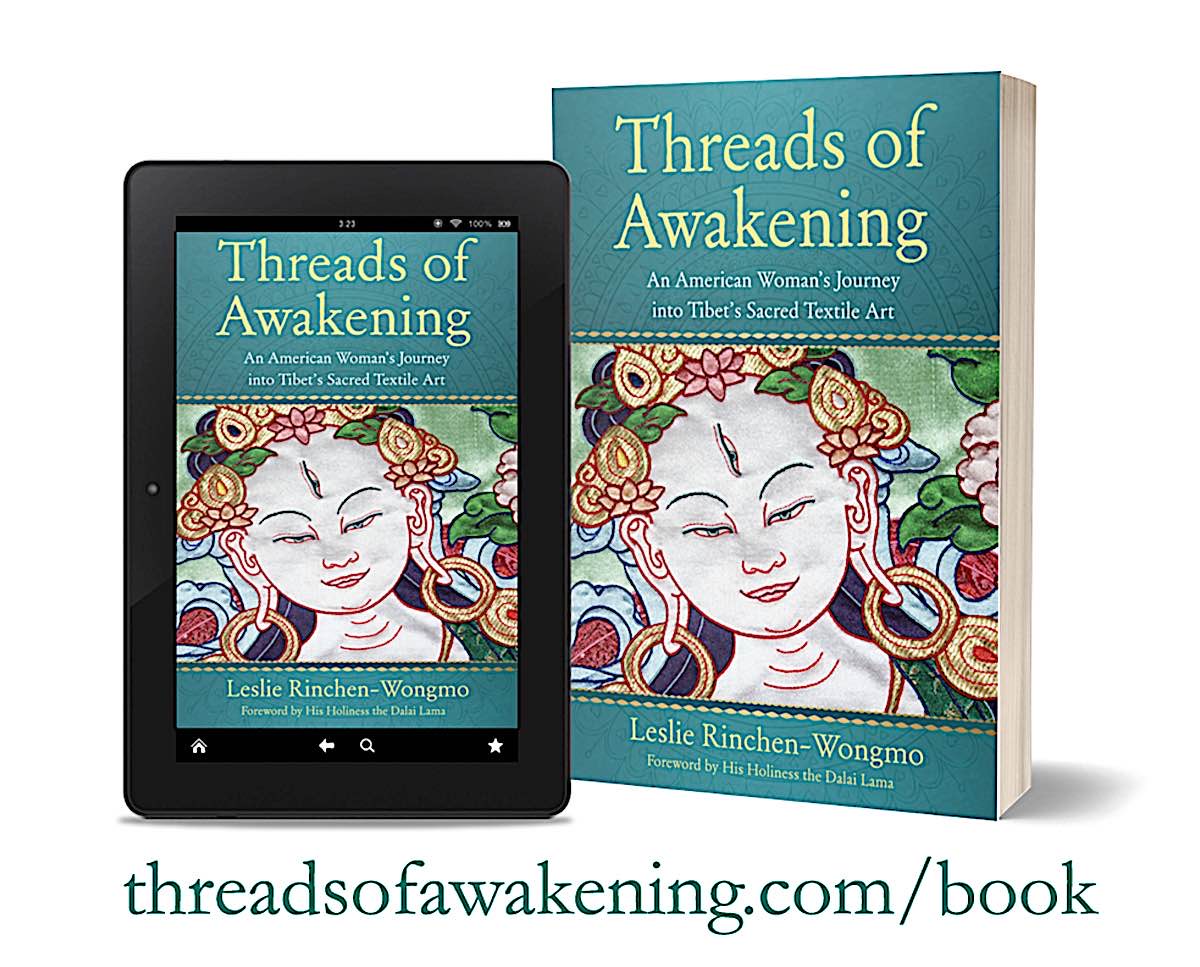
With a foreword by His Holiness the Dalai Lama, the book Threads of Awakening — An American Woman’s Journey into Tibet’s Sacred Textile Art, by Leslie Rinchen-Wongmo is more than the fascinating story of one woman’s quest to help preserve the rare art of applique thangkas. Her intimate quest memoir reveals a sacred and beautiful world of precious Dharma art, against the fascinating backdrop of Dharamsala.
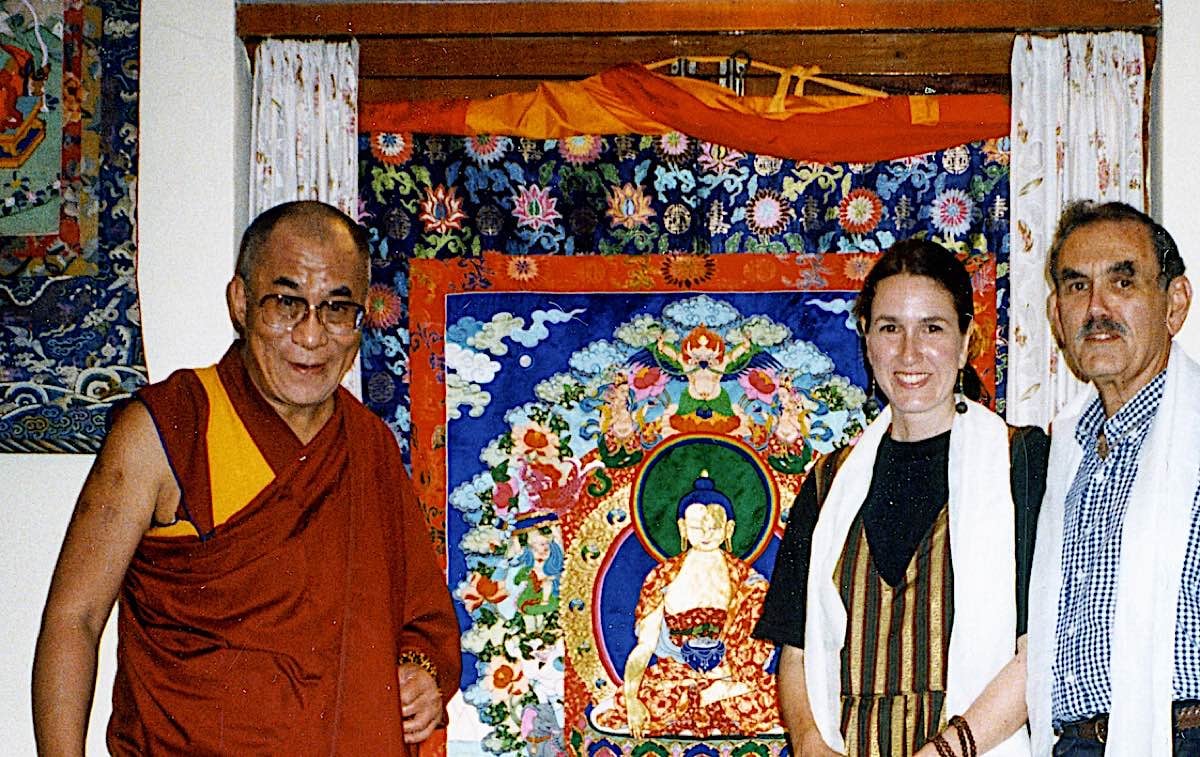
Leslie’s storytelling is as meticulous and fascinating as her art. His Holiness the Dalai Lama explains, in his foreword:
“This book, Threads of Awakening, reveals the intricacies and richness of the appliqué tradition. I am sure it will enhance appreciation for our unique artistic traditions.”
In Threads of Awakening, Leslie Rinchen-Wongmo beautifully tells her story as a personal spiritual memoir, seamlessly weaving (pun intended) elements of artistic tradition and method, personal memoir — and even beautiful descriptions of many popular Buddhas and Yidams. It makes the flow of the narrative very captivating.
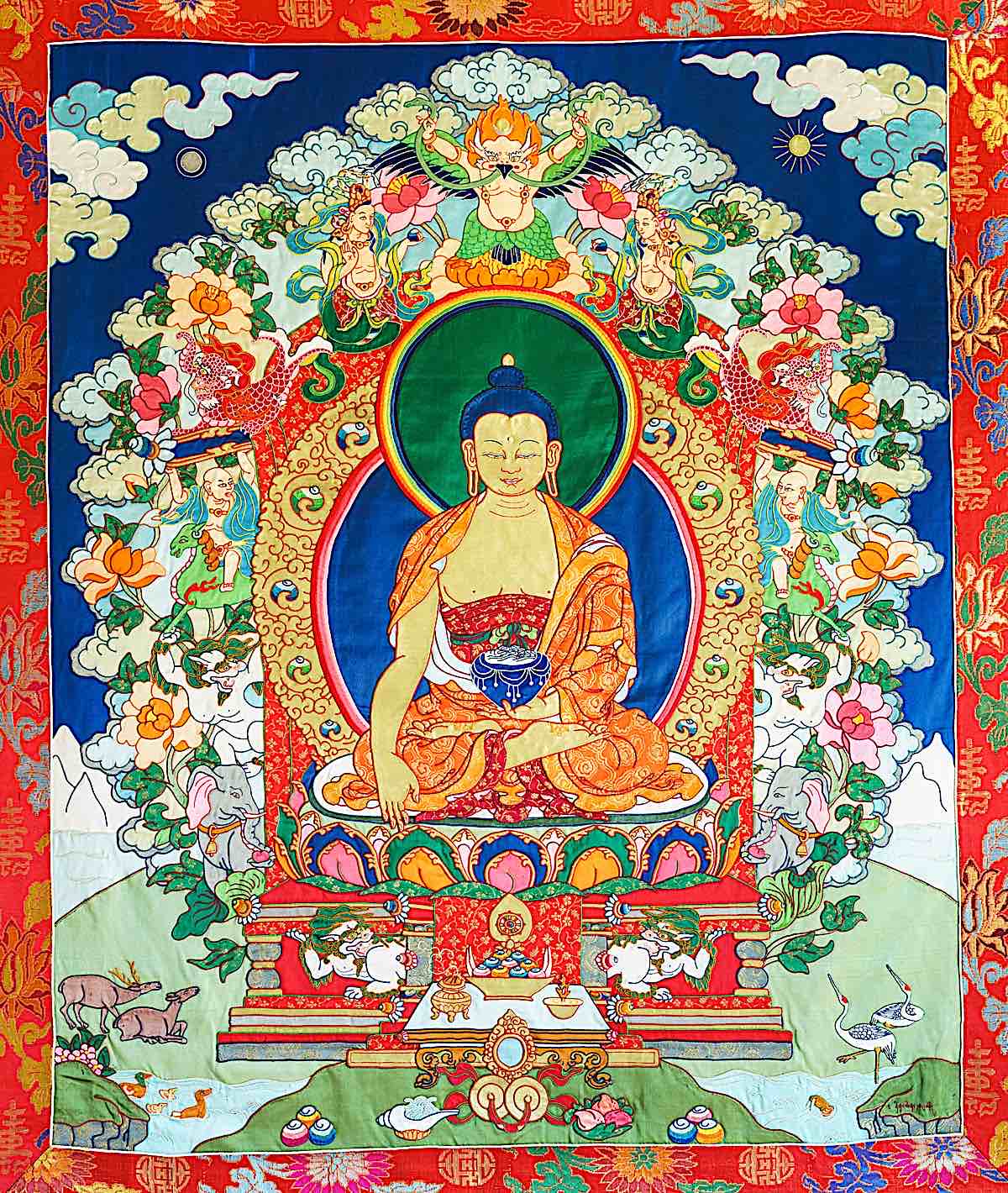
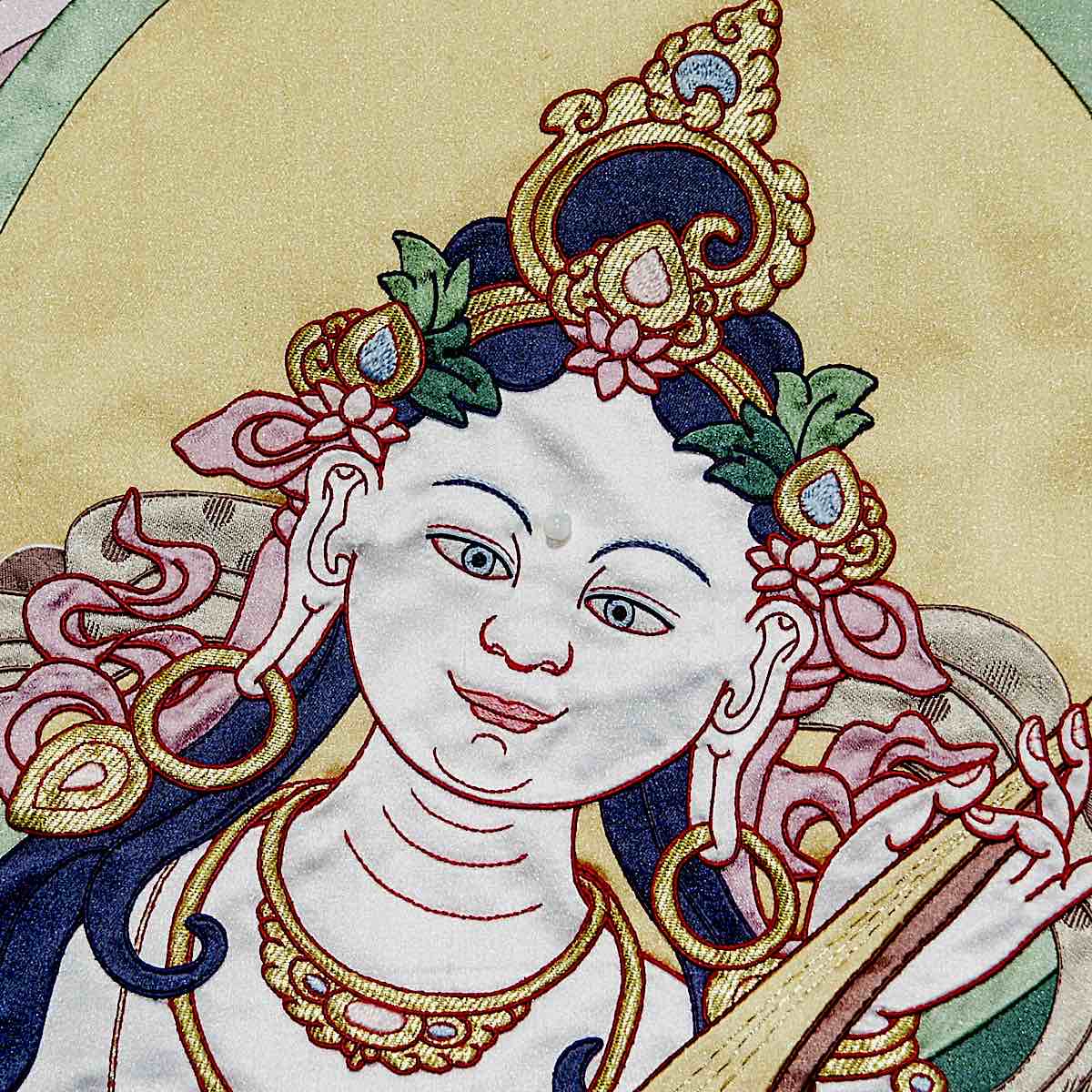
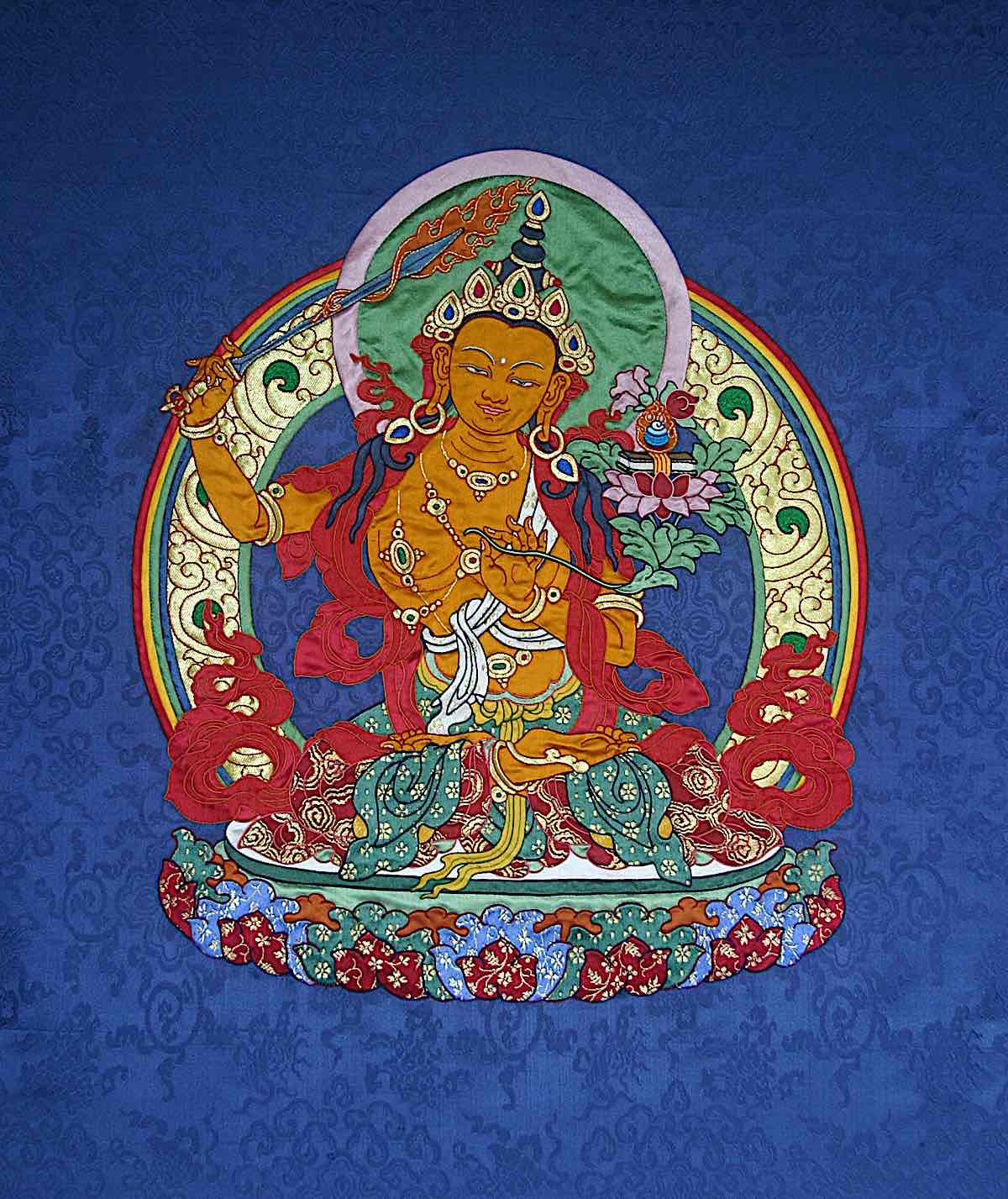
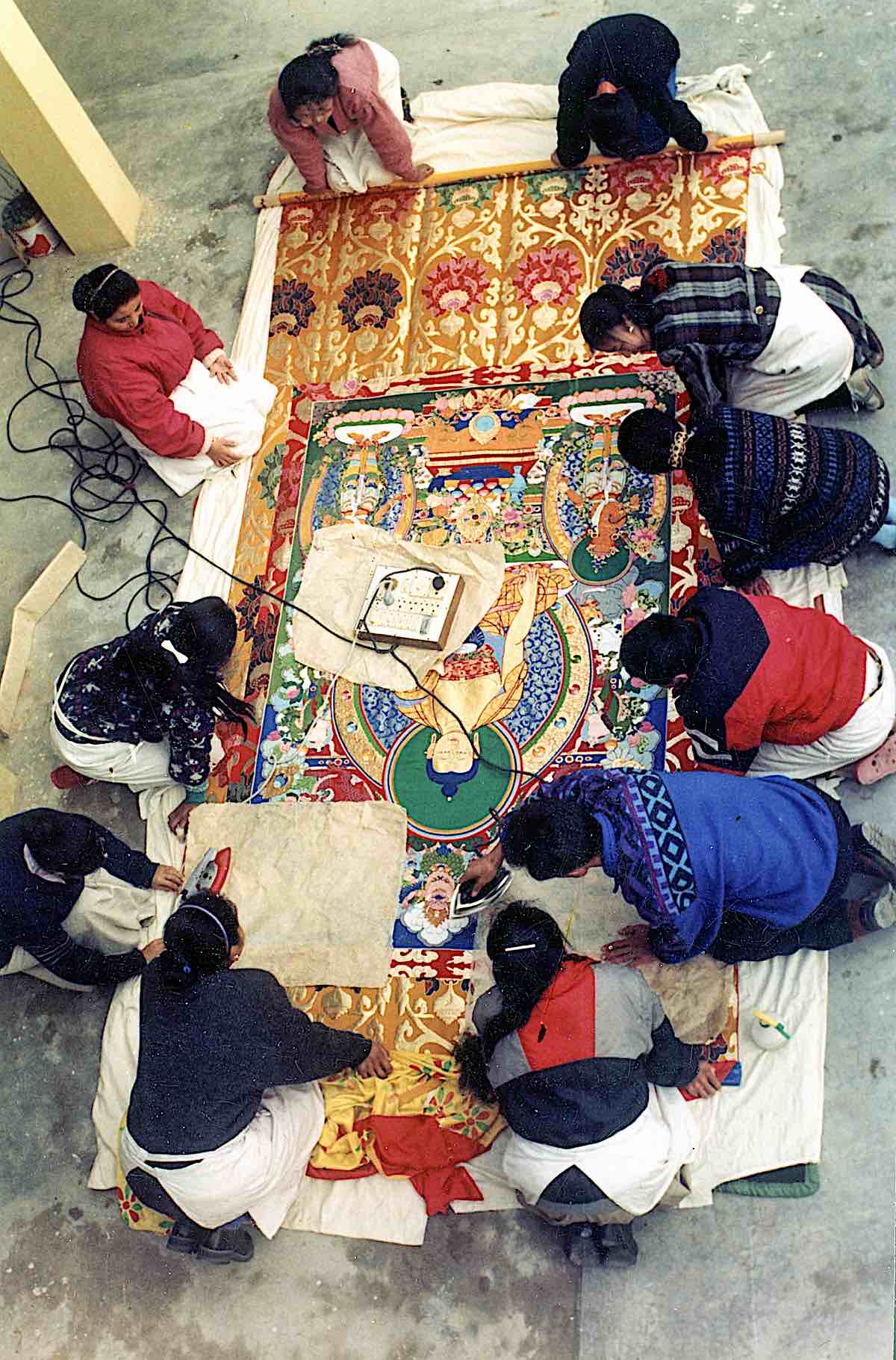
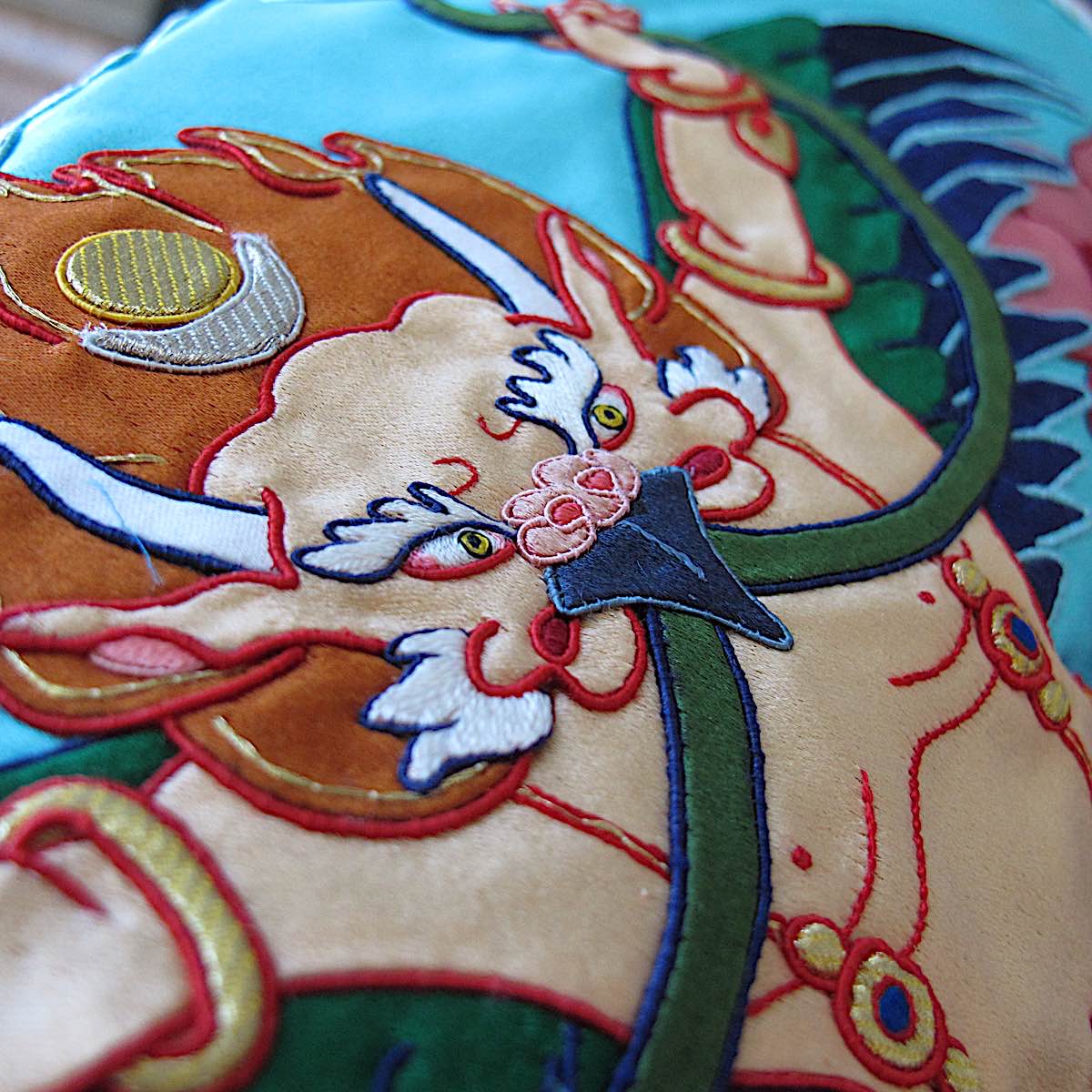
We asked Leslie to answer a few questions about the new release. She also kindly gave permission for us to showcase some of her amazing and intricate art. Her answers are as delightful and revealing as the chapters in her excellent book. Woven throughout the interview are some beautiful pictures, with the progressive steps illustrated where possible.
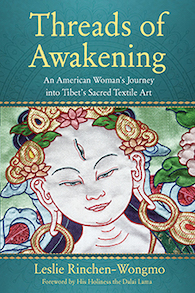
- Threads of Awakening — An American Woman’s Journey into Tibet’s Sacred Textile Art
- Leslie Rinchen-Wongmo
- Author Events web page>>
- ISBN: 978-1-64742-093-2 | $24.95
- Release Date: August 23, 2022
- Publisher: She Writes Press Distribution: Ingram Publisher Services
Interview with Leslie Rinchen-Wongmo
BW: What led you to this unique and beautiful art form? Can you give us a short “background story”?
Leslie: I’ve always been drawn to Eastern spiritual traditions. After grad school, I went trekking in Northern India and felt a resonance with the Tibetan culture I met there. On that trip, I also met Westerners doing long, low-budget travel and some who had settled in India and Nepal after serving in the Peace Corps.
A couple of years later, I took off on my own for what I thought would be a year of backpack travel. I had arranged to volunteer for the Tibetan Planning Council in Dharamsala for an undefined period, which I imagined would last a couple of months. But when the bus pulled into Dharamsala, I felt immediately at home.
I worked at the Planning Council for a year helping to plan a census. One day, as part of this work, I joined a tour of Tibetan handicraft centers. When we walked into a sewing workshop at the still-under-construction Norbulingka Institute, I fell head over heels in love with the pieced silk images I saw there. Shortly thereafter, I found a teacher—and then another—and set my life in a whole new direction.
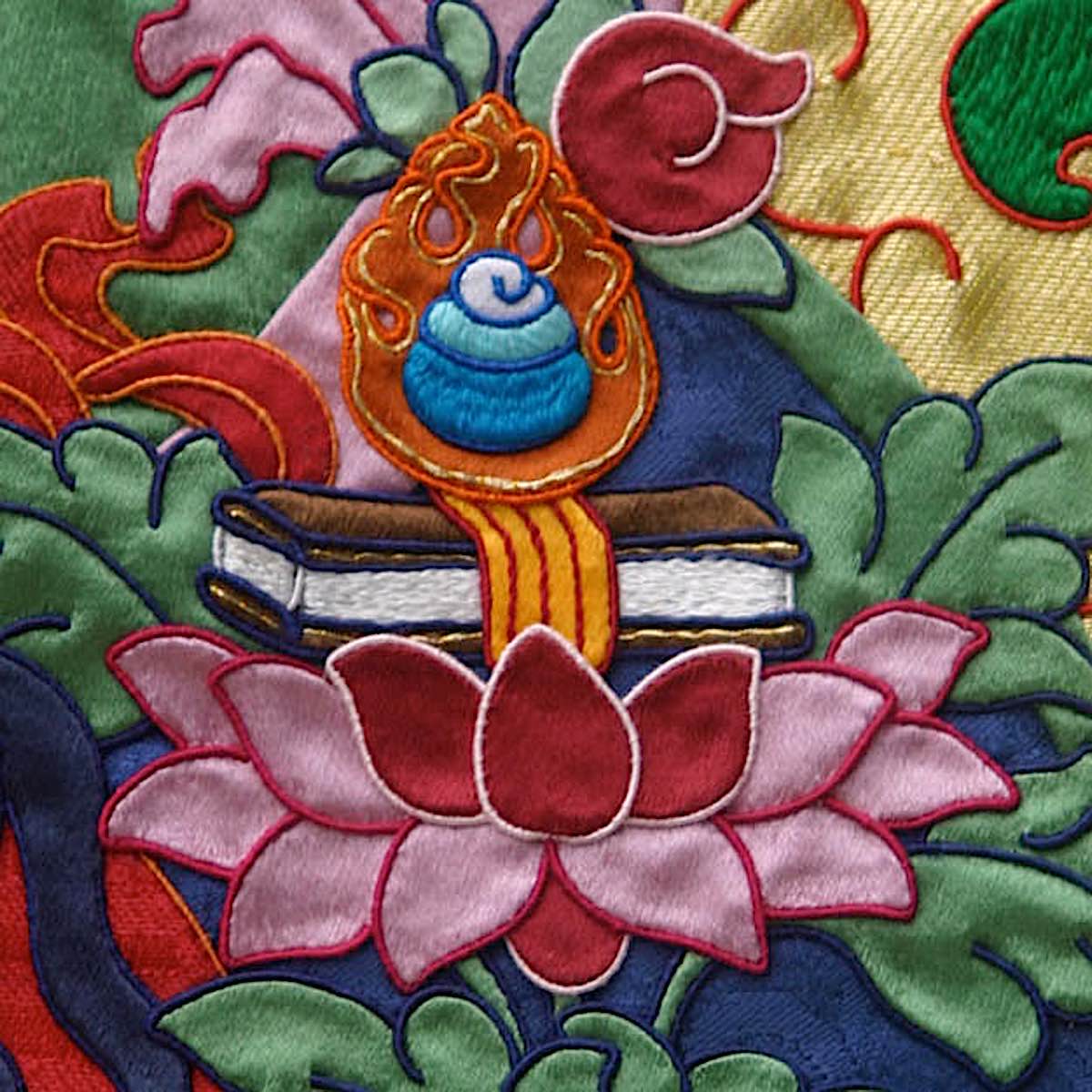
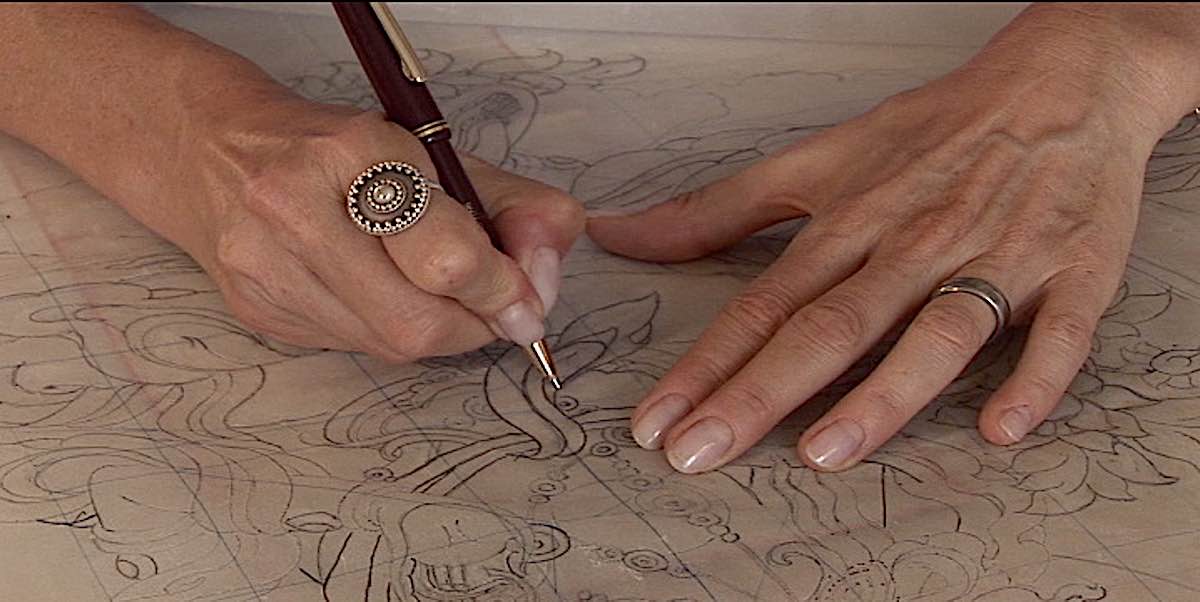
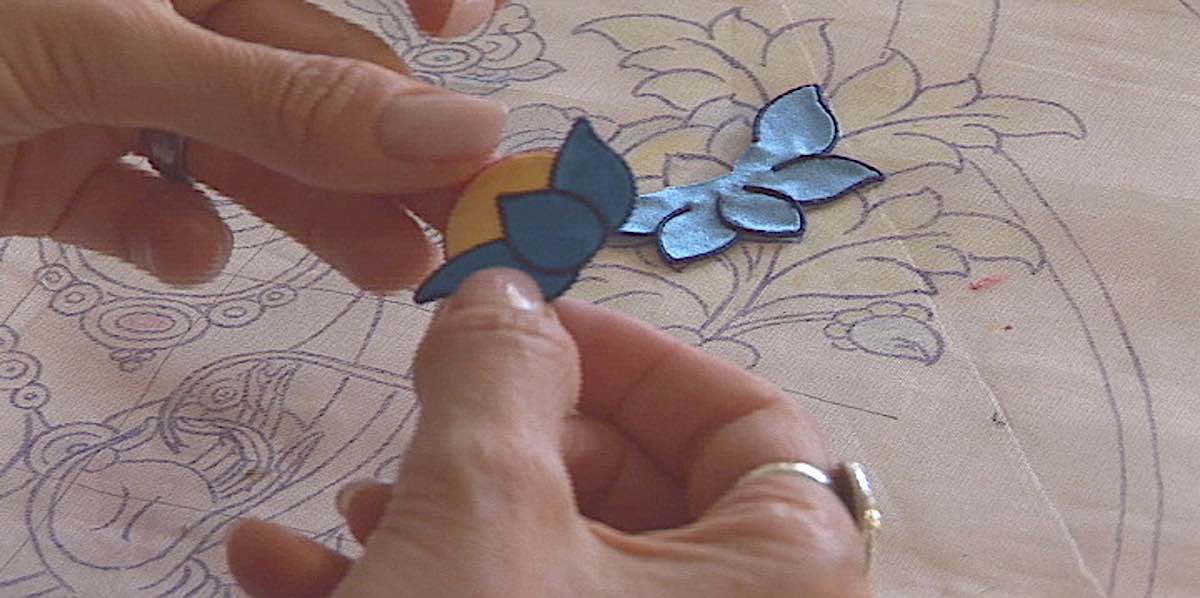
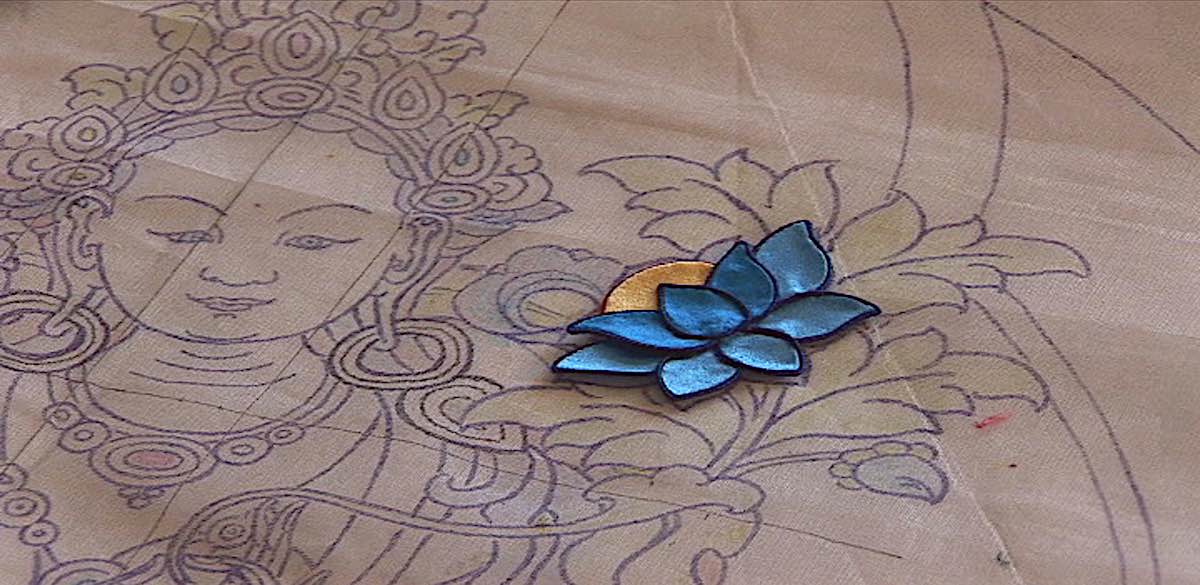
A 1-2-3 step-by-step photo series featuring Leslie at work.
Leslie: “This series of photos shows how sections of the drawing are transferred to various fabrics. Lines are stitched on. Pieces are cut out and edges turned under. then pieces are assembled into clusters and stitched together.”
1
2

3
4
Teachers and Guides
BW: Can you tell us about your teachers, guides and helpers on your journey?
Leslie: So many I could write about: Geshe Sonam Rinchen, Tenzin Gyaltsen, Dorjee Wangdu, Khamtrul Rinpoche… I may come back to this question.
Mission: helping preserve Tibetan appliqué
BW: What was your key mission in writing this profound life story?
Leslie: Early in my apprenticeship, I realized I was uniquely positioned to write a book about Tibetan appliqué thangkas. There are no books on this art form in any language, just a few articles and a paragraph or two in books about other Tibetan arts. I’m a literate English speaker with uncommon access to a little-known precious tradition. I felt a responsibility and a debt of gratitude to my teachers to document the form. It felt like a life assignment that I would need to fulfill one day…
But, for many years, I preferred making art over writing about it. (I really don’t love writing.) Then, for another several years, I thought I needed to get some formal education in art history so that I could trace the art form’s origins and speak on it authoritatively. I looked into advanced degrees but was discouraged by a couple of professors from taking that path.
Finally, I realized my direct experience was the most accessible and interesting way to approach the topic. So, I started writing my memories of apprenticeship, of the tsemkhang (sewing workshop), of life in Dharamsala, and of my experience making specific thangkas. The story gradually took shape over the next few years. I had to find the story in the writing of it.
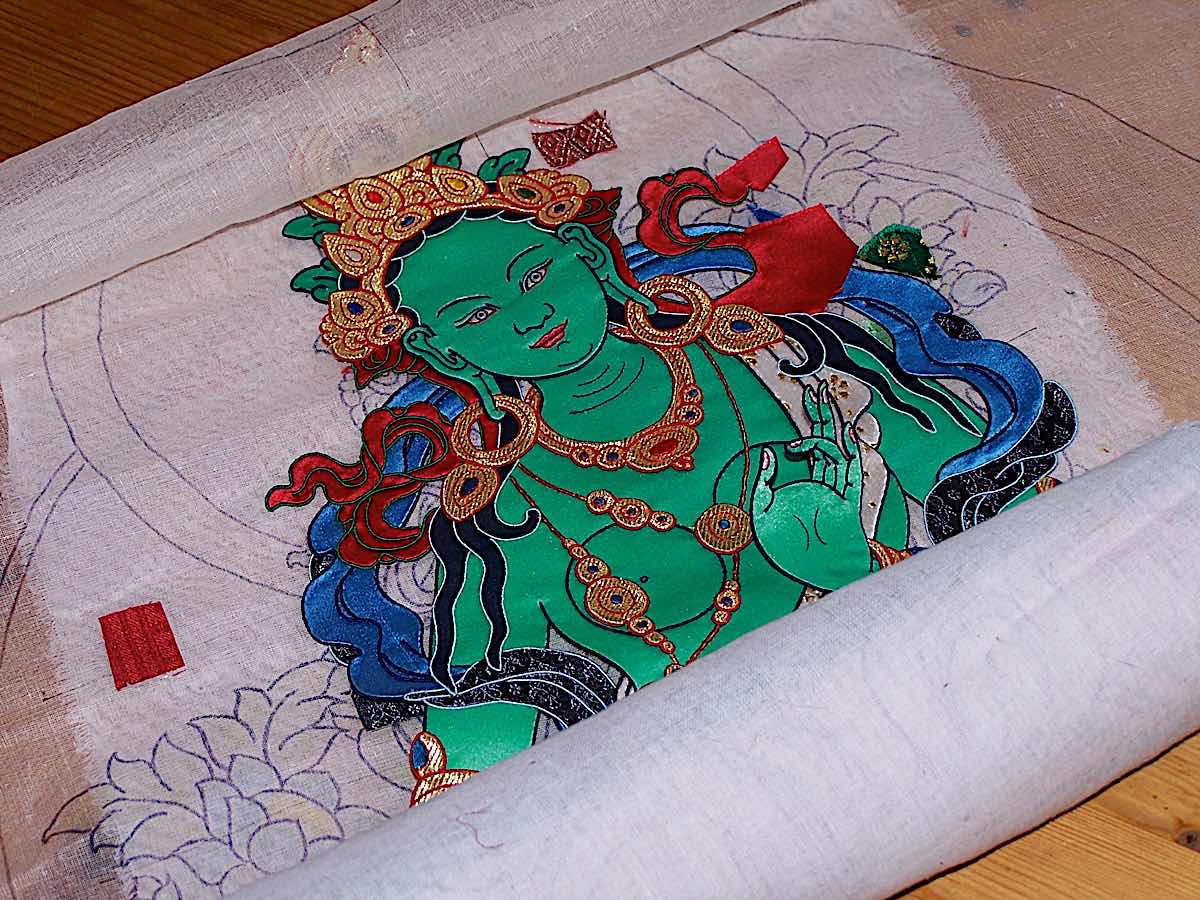
Another step-by-step photo series featuring Leslie at work on a Green Tara thangka.
1

2
Threads of Awakening: the title
BW: Threads of Awakening is a brilliant title — can you tell us your inspiration for the title? You use the language of threads and connections and the idea of “Kabar dro ge?” throughout. One chapter starts off “walking clockwise around objects.” Later, part Three is “WARP” which is very twenty-fourth century. You even have a Zoom talk called “When Your Detour Becomes Your Life’s Path” — similar metaphors. Can you elaborate on your inspirations?
Leslie: Thank you for appreciating my title. I named my website, my thangka-making business, Threads of Awakening several years ago. I honestly don’t remember how the words came to me. In writing the book, I considered many different titles (and subtitles). I have long lists of ideas and early manuscript drafts with a variety of titles. But I kept coming back to “Threads of Awakening.” I’m glad the title worked.
I tried to bring the language of threads and fabric into the book to provide a sense of connected structure. I actually don’t feel I succeeded to the extent I’d hoped to, but you seem to have found it in places I didn’t even know it was there! I think thread is naturally metaphorical for a path—whether that be a spiritual path or a path of travel or, as I like to say, of wandering.
Interdependence is a key concept in Buddhism, in my own world view, and in this art form of overlapping, interconnected pieces of fabric, pieces of the picture. There is no ground, no underlying entity on which everything rests. The pieces of our world, and we ourselves, arise out of relationships.
“Warp” was not intended to be “twenty-fourth century” at all. It refers to the linear threads on a loom. It provides structure. Weft threads weave through warp threads to create fabric.

Greatest Inspiration
BW: Who was your greatest inspiration and why?
Leslie: I’m not good at these kinds of questions, at superlatives, at choosing the “greatest.” My response may change if asked in a different moment. Reflecting on the question right now, I think my greatest inspiration may have been Ram Dass. He was smart, successful, funny, and willing to re-create himself again and again. He left academic life to wander, met a teacher, became a teacher, and was consistently unconventional and of inestimable service.
Dharamsala: “I’ve come home”
BW: In your postcard to your parents when you arrived in Dharamsala, you wrote: “I’ve come home…” Is it still “like home?”
Leslie: The feeling was palpable and immediate. I felt warm and happy. I felt related. I felt like I belonged. A smile lit up my face. I went to sleep that night in a hard bed in an unfamiliar guest house with an outdoor squat toilet during monsoon… And I was completely comfortable.
Is it still home? Not really. It’s developed and changed. It’s much more crowded now, and somehow less distinct from other places, for me. And I think that chapter has closed. But who knows?
The Nechung Oracle
BW: One interesting story in your book was about the Nechung Oracle. Can you tell our readers that story?
Leslie: There are so many meaningful anecdotes! The Nechung Monastery was right outside my window. For my first three or four years in Dharamsala, I’d wake every morning to the sound of chanting and drums. Occasionally, long horns and loud cymbals would rouse me out of bed, announcing that the Nechung medium was going into trance and the oracle would be consulted. Crowds gathered to get a glimpse of the oracle and receive his blessing. Attendants beat back the surging crowds. One day, I stood with a Tibetan friend of mine, a young thangka painter, watching the mayhem. My friend lamented the reckless and greedy manner in which devotees scrambled for the blessed balls of tsampa (roasted barley flour). “Don’t they realize,” my friend said, “that the real blessings are in our own minds? We Tibetans should know at least that.”
Another favorite anecdote, probably my favorite of all is when one of my apprentice colleagues asked me if Westerners believe in ghosts. When I said that most probably don’t, she replied with deep sincerity and perplexity, “But if they don’t believe in ghosts, what do they say when they see them?”
Proudest moments
BW: What are you most “proud of” moments in regard to your long journey on the Threads of Awakening?
Leslie: I think I’m most proud of finishing my assignment, of actually writing and publishing a book that documents and honors the tradition I inherited. If a large number of people read and learn from the book—and are maybe even inspired by it—I’ll be even more satisfied.
“An even higher art…”
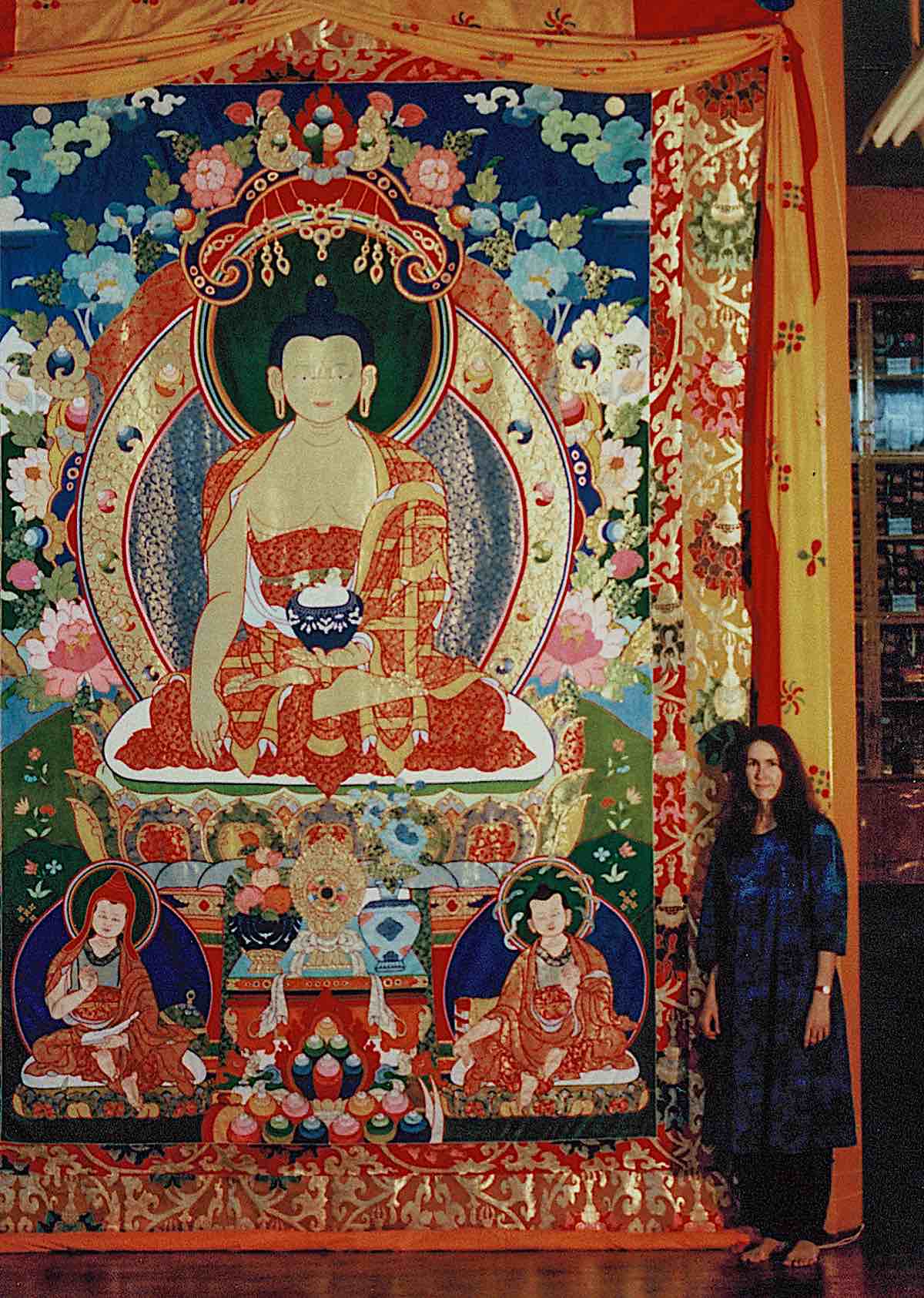
BW: You quoted Glenn Mullin, saying “For us, painting and sculpture are the two finest forms of art but, for Tibetans, appliqué and embroidery are an even higher art.” Can you explain what he meant, or you meant by quoting him?
Leslie: Well, in the Western art world, textile arts are not given the same respect that painting and sculpture are. Textile arts are usually relegated to the craft category, and fiber artists—many of whom happen to be women—are often not considered to be fine artists. That is not the case in Tibetan culture according to Tibetan art expert Glenn Mullin and others such as Valrae Reynolds, former curator at the Newark Museum, and Pema Namdol Thaye, traditional Tibetan artist and architect. Perhaps (at least partly) because fabric thangkas were traditionally stitched by men and because they’ve always been rarer than paintings and sculpture, they have long been considered to be among the very finest arts in the Tibetan region.
Even my book, Threads of Awakening, gets categorized as “Crafts & Hobbies,” rather than “Arts & Photography” when I use the keywords “textile art.” I don’t mind because I think crafts are cool, admirable, and infinitely valuable. But it does say something about how Western culture thinks about sewing and fabric arts.

“Don’t think too much”
BW: Can you share your favorite related inspirational teaching, sutra or practice?
Leslie: I included my favorite practice and advice at the end of the book. My root teacher Garje Khamtrul Rinpoche gave me this succinct advice:
“Think a little about emptiness. Arouse some compassion. Visualize Chenrezig. Recite his mantra. Don’t think too much.”
I get distracted easily and enthusiastic about new things. I also often feel like I’m not doing as much as I should. Rinpoche kept bringing me back to essentials. He assured me that any one authentic practice is enough. And he also supported me in trusting my own resonance. I feel a deep connection with Chenrezig (Avalokiteshvara), the embodiment of awakened compassion. I don’t need to feel I’m missing something. That resonance is a trustworthy guide. And any moment of practice or reflection is better than none.
Book Details
- Publisher : She Writes Press (August 23, 2022)
- Language : English
- Paperback : 328 pages
- ISBN-10 : 1647420938
- ISBN-13 : 978-1647420932
- Item Weight : 15.8 ounces
- Dimensions : 6 x 1 x 9 inches
Editorial Reviews
“Threads of Awakening reveals the intricacies and richness of the appliqué tradition. I am sure it will enhance appreciation for our unique artistic traditions.”
—His Holiness the Dalai Lama“. . . the narrative threads . . . weave together in a sensitive work that considers Rinchen-Wongmo’s difficulties navigating Tibetan culture in her quest to learn a new art. . . . Along the way, it effectively delves into the Buddhist thought that she incorporated into her worldview.”
—Kirkus Reviews“Readers interested in Tibetan culture and Buddhist spiritual practices will find this book of interest.”
—Library Journal“Deeply personal, learned, and genuine, this is a beautiful memoir of spiritual self-discovery.”
—Susan Piver, New York Times best-selling author of The Four Noble Truths of Love: Buddhist Wisdom for Modern Relationships“At first glance, it seemed as if this book might be yet another travelogue, with adventures into India and a dip into Buddhist culture. How wrong I was. It is a deeply moving story of how one woman’s decision to help the Tibetan refugees in India led to a lifetime’s work of creation in one of the finest and rarest art traditions. . . . An absolute delight to read.”
—Reedsy Discovery“Threads of Awakening is an illuminating window into the world of pieced brocade thangkas. Leslie Rinchen-Wongmo is, to my knowledge, the first American woman to master this exquisite artistic tradition, and also the first to write extensively on it. We are fortunate to reap the fruits of her endeavors!”
—Glenn H. Mullin, author of Female Buddhas and four more books on Tibetan Buddhist art“Threads of Awakening not only fulfills a critical gap in the recorded literature and preservation of traditional Tibetan appliqué thangkas—it is also sure to enrapture, delight, and inspire you!”
—Pema Namdol Thaye, traditional Tibetan architect, artist, author, and art educator“Part travelogue, part spiritual biography, and part artistic chronicle, Leslie Rinchen-Wongmo’s Threads of Awakening is an eloquent work that is both adventure and homecoming; transformational and grounding . . . her personable and insightful presentation stimulates introspection about our own journeys, whatever they may be.”
—Buddhistdoor Global“All of us are granted the same twenty-four-hour day. But great memoirs show us how much life we can pack into every moment if our heart says yes. Leslie Rinchen-Wongmo, whose name means ‘precious, empowered woman,’ did just that. She came upon a group stitching sacred Tibetan tapestries in India and stayed to become the first Western woman trained to make them. Her story takes us deep into the art and culture she embraced. But just as importantly, Leslie provides a luminous lesson on what she calls ‘the experience of traveling off course to a wondrous life.’”
—Barbara Cornell, Pulitzer Prize–nominated journalist and librarian“I was genuinely moved by Leslie’s courage and compassion as she pursued her dreams. Perhaps one of the most moving moments of the book is her meeting with His Holiness the Dalai Lama. Her book is a joy to read.”
—Cindy Rasicot, author of Finding Venerable Mother: A Daughter’s Spiritual Quest to Thailand“Prepare yourself not just for a fascinating read but also for a profound personal awakening at the depths of your being!”
—Bill Bauman, PhD, author of Emptiness Dreaming: The Story of Creation as Seen through the Eyes of the Quantum Void“Leslie retells her journey in prose that is as beautiful, meticulous, and captivating as the thangkas themselves.”
—Meher McArthur, author of Reading Buddhist Art“Profoundly meaningful and deeply spiritual, Threads of Awakening is a delightful and inspiring travel memoir about an ancient Tibetan Buddhist textile tradition and a woman’s search for purpose.”
—Isadora Leidenfrost, PhD, filmmaker of Creating Buddhas: The Making and Meaning of Fabric Thangkas
About the Author
Leslie Rinchen-Wongmo is a textile artist, teacher, and author. Curiosity carried her from California to India, where she became one of few non-Tibetans to master the Buddhist art of silk appliqué thangka. Her artwork has been exhibited internationally and featured in magazines such as Spirituality & Health, FiberArts, and Fiber Art Now and in the documentary, Creating Buddhas: The Making and Meaning of Fabric Thangkas. To share the gift of Tibetan appliqué with stitchers around the globe, she created the Stitching Buddhas virtual apprentice program, an online, hands-on course that bridges East and West, traditional and contemporary. After two decades abroad, Leslie returned to her native Southern California, where she now lives with three cats and enough fabric to last several lifetimes in Oxnard, CA.
More articles by this author

Buddhist Mantra Time Out: Sadness Quick Fix – Vasudhara Happiness Dharani Instant Pick-Me-Up Guided Visualization and Dharani Chanting
MUSIC VIDEO and PRACTICE: Śaraṇaṃ Gacchāmi Sanskrit Refuge and Offering Chanted Beautifully for Daily Practice
DOCUMENTARY VIDEO: Music is Medicine: The Science of Healing Frequencies – 3 acoustic meditation secrets, 5 Studies
Search
Latest Features



Please support the "Spread the Dharma" mission as one of our heroic Dharma Supporting Members, or with a one-time donation.
Please Help Support the “Spread the Dharma” Mission!
Be a part of the noble mission as a supporting member or a patron, or a volunteer contributor of content.
The power of Dharma to help sentient beings, in part, lies in ensuring access to Buddha’s precious Dharma — the mission of Buddha Weekly. We can’t do it without you!
A non-profit association since 2007, Buddha Weekly published many feature articles, videos, and, podcasts. Please consider supporting the mission to preserve and “Spread the Dharma." Your support as either a patron or a supporting member helps defray the high costs of producing quality Dharma content. Thank you! Learn more here, or become one of our super karma heroes on Patreon.
Lee Kane
Author | Buddha Weekly
Lee Kane is the editor of Buddha Weekly, since 2007. His main focuses as a writer are mindfulness techniques, meditation, Dharma and Sutra commentaries, Buddhist practices, international perspectives and traditions, Vajrayana, Mahayana, Zen. He also covers various events.
Lee also contributes as a writer to various other online magazines and blogs.