




The Noble Dhāraṇī of the Six Gates: Background, Dharani in Sanskrit, Translation and Full Sutra with Benefits
What are the Six Gates in Buddhism? What Dharani when chanted three times each morning and three times each night purifies every poison, obstacle, demonic harm, and downfall with the ultimate goal of liberation from suffering? We answer these questions and recite the full Source Sutra of this powerful Dharani of the Six Gates in this short presentation.
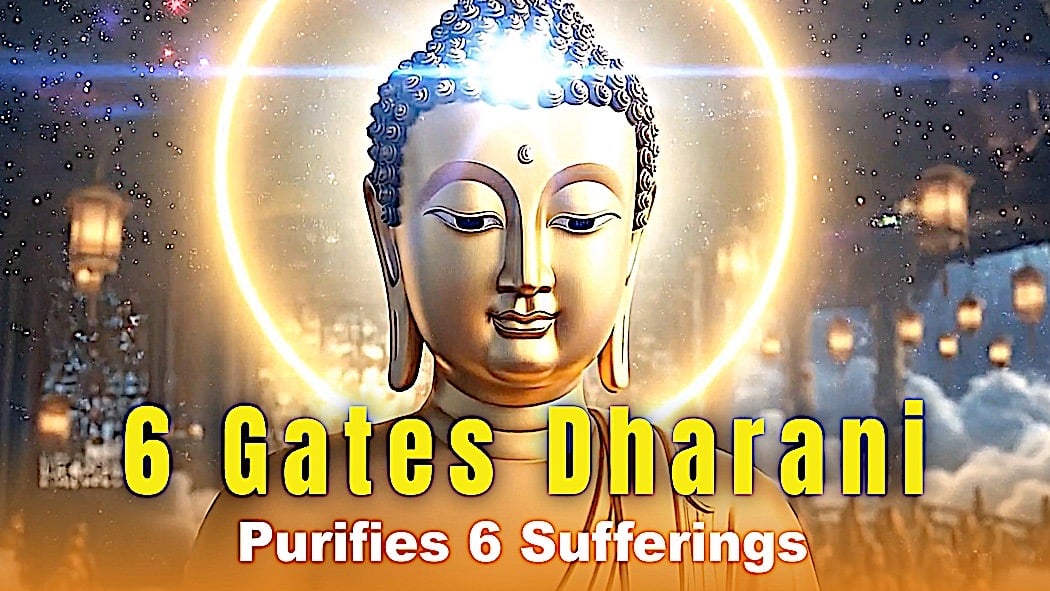
This short but powerful sutra presents six ‘gates’ — six aspirational prayers — that transform how we relate to suffering, happiness, our own mistakes, and even the actions of others. The Buddha teaches these to an assembly of bodhisattvas, urging them to uphold the dhārani for the benefit of the entire world.
Video:
The 6 Gates Aspirational Prayers
What are the Six Gates? They are six essential practices that reorient the mind away from samsara’s causes, steering us back towards wisdom and compassion.
The Gate of Suffering
May I recognize that every pain I experience is no different from the pain of all beings. No separation.
The Gate of Worldly Happiness
May any success or joy I find be shared equally with others, as a basis for genuine understanding.
The Gate of Misdeeds
Whatever non-virtuous actions I have done, may I confess each one completely and without holding back.
The Gate of Demonic Actions
Whatever harm or obstruction has come to me, may I see it clearly for what it is, without fear or confusion.
The Gate of Virtue
May all my roots of virtue — ordinary and transcendent — become the wisdom that benefits every being.
The Gate of Liberation
May I liberate all sentient beings, without clinging to either samsara or nirvana.
The Dharani in Sanskrit
After reciting these six aspirational prayers, the Buddha gives the dhārani itself — a string of Sanskrit syllables that purifies all karmic obscurations. He instructs sincere practitioners to recite it three times by day and three times by night.
The Dharani is:
tadyathā oṃ kṣame kṣame kṣānte kṣānte dame dame dānte dānte bhadre bhadre subhadre subhadre chandre chandre suchandre suchandre chandrakiraṇe chandravati tejovati yaśovati dharmavati brahmavati sarvakleśaviśodhani sarvārthasādhani sarvānarthapraśamani paramārthasādhani kāyaviśodhani vāgviśodhan manaḥsaṃśodhani svāhā
The Meaning of the Dharani
The Dharani, although not meant to be chanted in any language other than Sanskrit. The gist of the Dharani can be understood in this way.
“This dhārani begins with patience and self-taming — the ground of all purification. Then it invokes the auspicious and the moon-like mind: cool, clear, and radiant.
The Dharani then calls on brilliance, glory, Dharma, and the sublime nature of our Buddha Nature— not as external powers, but as qualities already within you.
Then come the five great purifications.
First, we purify all kleśas such as anger, greed, delusion, jealousy, and ignorance.
Next, we purify by acomplishing all meaningful aims.
This is followed by purification through calming all that is meaningless or harmful.
This leads to accomplishing the ultimate goal or liberation.
Finally our body, speech, and mind is completely purified.
It ends with svāhā .
In short: from patience to purity, from the moon’s cool light to the fire of wisdom, this mantra cleanses every layer of your being and fulfills both worldly and transcendent aims — for yourself and all beings.”
Syllabic Translation (word-by-word essence)
|
Sanskrit |
Syllabic meaning |
|
oṃ |
Sacred syllable — invoking body, speech, mind |
|
kṣame kṣame |
Patience, patience / forbearance, forbearance |
|
kṣānte kṣānte |
In patience, in patience (intensified) |
|
dame dame |
Self-control, self-control / taming, taming |
|
dānte dānte |
Well-tamed, well-tamed |
|
bhadre bhadre |
Auspicious one, auspicious one |
|
subhadre subhadre |
Very auspicious, very auspicious |
|
candre candre |
Moon, moon (cool clarity) |
|
sucandre sucandre |
Excellent moon, excellent moon |
|
candrakiraṇe |
Moon-ray (lunar radiance) |
|
candravati |
Possessing the moon (luminous mind) |
|
tejovati |
Possessing fiery energy / brilliance |
|
yaśovati |
Possessing glory / renown |
|
dharmavati |
Possessing the Dharma |
|
brahmavati |
Possessing Brahma’s sublime nature |
|
sarva-kleśa-viśodhani |
Purifier of all emotional afflictions (kleśas) |
|
sarvārtha-sādhani |
Accomplisher of all meaningful goals |
|
sarvānartha-praśamani |
Appeaser of all meaninglessness / harm |
|
paramārtha-sādhani |
Accomplisher of the ultimate goal |
|
kāya-viśodhani |
Purifier of body |
|
vāg-viśodhani |
Purifier of speech |
|
manaḥ-saṃśodhani |
Complete purifier of mind |
|
svāhā |
So be it — an offering / hail |
Gist Summary
This dhāraṇī begins with patience and self-taming — the ground of all purification. Then it invokes the auspicious and the moon-like mind: cool, clear, and radiant.
It calls on brilliance, glory, Dharma, and the sublime nature of Brahma — not as external powers, but as qualities already within you.
Then come the five great purifications:
— purifying all kleśas (anger, greed, delusion)
— accomplishing all meaningful aims
— calming all that is meaningless or harmful
— accomplishing the ultimate goal (liberation)
— and finally purifying body, speech, and mind completely.
It ends with svāhā — ‘offered perfectly.’
In short: from patience to purity, from the moon’s cool light to the fire of wisdom, this mantra cleanses every layer of your being and fulfills both worldly and transcendent aims — for yourself and all beings.
Pronunciation Key (English-friendly)
|
Sanskrit |
Say it like |
|
oṃ |
ohm |
|
kṣa |
ksha (as in “axle”) |
|
kṣā |
kshaa (long a, as in “father”) |
|
e |
ay (as in “say”) |
|
ā |
aa (as in “father”) |
|
c |
ch (as in “church”) |
|
ś |
sh (as in “shush”) |
|
v |
w (or soft v) |
|
svāhā |
swaa-haa |
Line-by-line Summary
oṃ
Sacred syllable of body, speech, and mind
kṣame kṣame
Patience, patience / Forbearance, forbearance
kṣānte kṣānte
In patience, in patience
dame dame
Self-control, self-control / Taming, taming
dānte dānte
Well-tamed, well-tamed
bhadre bhadre
Auspicious one, auspicious one
subhadre subhadre
Very auspicious, very auspicious
candre candre
Moon, moon (cool clarity)
sucandre sucandre
Excellent moon, excellent moon
candrakiraṇe
Moon-ray (lunar radiance)
candravati
Possessing the moon (luminous mind)
tejovati
Possessing fiery energy / brilliance
yaśovati
Possessing glory / renown
dharmavati
Possessing the Dharma
brahmavati
Possessing Brahma’s sublime nature
sarva-kleśa-viśodhani
Purifier of all emotional afflictions (kleśas)
sarvārtha-sādhani
Accomplisher of all meaningful goals
sarvānartha-praśamani
Appeaser of all meaninglessness / harm
paramārtha-sādhani
Accomplisher of the ultimate goal
kāya-viśodhani
Purifier of body
vāg-viśodhani
Purifier of speech
manaḥ-saṃśodhani
Complete purifier of mind
svāhā
So be it — an offering / hail
Benefits of Dharani
Buddha taught that one who chants this Dharani three times in morning and evening with mindful contemplation, will purify every klesha, obstacle, and all negative karma, and remember their previous lives up to seven lifetimes and swiftly attain unsurpassed perfect buddhahood, and in this lifetime will be protected from harm.
Full Sutra: The Noble Dhāraṇī of the Six Gates
Praise to Mañjuśrī Kumārabhūta.
Thus did I hear at one time. The Bhagavān was dwelling together with an assembly of innumerable bodhisattvas in a pavilion ornately decorated with the seven kinds of precious jewels that was located in the firmament of the sky above Śuddhāvāsa.
On that occasion, the Bhagavān said to the bodhisattvas, “Children of a noble family, may you uphold The Dhārani of the Six Gates for the benefit and well-being of the whole world. It is as follows:
“As I pass through life after life in saṃsāra, whatever suffering I experience, may it not be characterized by my not understanding that it is the same for all beings.
“Whatever happiness due to worldly success I experience, may I make use of it in common with all beings to bring about thorough understanding.
“Whatever misdeeds and non-virtuous action I have done, may I not fail to confess each one of them through unsurpassed confession.
“Whatever demonic actions have been done to me, may I not fail to thoroughly understand them through unsurpassed thorough understanding.
“Whatever roots of virtue I may have, both mundane and supramundane, endowed with the perfections, may they become the fruit of unsurpassable wisdom for all beings.
“Whatever liberation I may have, through it may all sentient beings be released. May I stay neither in saṃsāra nor in nirvāṇa.
tadyathā oṃ kṣame kṣame kṣānte kṣānte dame dame dānte dānte bhadre bhadre subhadre subhadre chandre chandre suchandre suchandre chandrakiraṇe chandravati tejovati yaśovati dharmavati brahmavati sarvakleśaviśodhani sarvārthasādhani sarvānarthapraśamani paramārthasādhani kāyaviśodhani vāgviśodhani manaḥsaṃśodhani svāhā
“Therefore, children of a noble family, if any sons or daughters of a noble family recite The Dhārani of the Six Gates three times by day and three times by night, then, having purified all their karmic obscurations, they will remember their previous lives up to seven lifetimes and will swiftly and fully awaken to unsurpassed perfect buddhahood.”
When the delighted Bhagavān had spoken these words, the assembly of bodhisattvas and the world with its devas, humans, asuras, and gandharvas rejoiced in what the Bhagavān had said.
Thus ends “The Noble Dhārani of the Six Gates.”
Dependent Arising Mantra
śubham astu sarvajagatām
ye dharmā hetuprabhavā hetuṃ teṣāṃ tathāgato hy avadat
teṣāṃ cha yo nirodha evaṃvādī mahāśramaṇaḥ
maṅgalaṃ bhavatu
Here ends our recitation of The Noble Dhārani of the Six Gates. May all beings benefit.
More articles by this author




Search
Latest Features





Please support the "Spread the Dharma" mission as one of our heroic Dharma Supporting Members, or with a one-time donation.
Please Help Support the “Spread the Dharma” Mission!

Be a part of the noble mission as a supporting member or a patron, or a volunteer contributor of content.
The power of Dharma to help sentient beings, in part, lies in ensuring access to Buddha’s precious Dharma — the mission of Buddha Weekly. We can’t do it without you!
A non-profit association since 2007, Buddha Weekly published many feature articles, videos, and, podcasts. Please consider supporting the mission to preserve and “Spread the Dharma." Your support as either a patron or a supporting member helps defray the high costs of producing quality Dharma content. Thank you! Learn more here, or become one of our super karma heroes on Patreon.
Lee Kane
Author | Buddha Weekly
Lee Kane is the editor of Buddha Weekly, since 2007. His main focuses as a writer are mindfulness techniques, meditation, Dharma and Sutra commentaries, Buddhist practices, international perspectives and traditions, Vajrayana, Mahayana, Zen. He also covers various events.
Lee also contributes as a writer to various other online magazines and blogs.