


The Siddha Tradition in Indian Spirituality, and in Buddhism
The various schools of Buddhist tenets have different ways of speaking about the nature, power, activities of a Buddha. These are not contradictory, but rather are intended to suit the predispositions of the various types of trainees.
It is useful {then} to study the different tenet systems so that the diverse interpretations of the points of doctrine come into a balanced perspective. Otherwise, there is the danger of misunderstanding…
– The Thirteenth Dalai Lama
Most of the Buddhism that reached my country in the last century is of a far eastern asian character. What has appealed to people, and flourished here is of a decidedly psychological nature – and images of people sitting, quietly together in a zendo, or on retreat are what first come to mind.
 Editorial By Jason Espada
Jason Espada’s Author Page and Other Features
Gradually the last few decades the Tibetan Tradition has also begun to make its way into American culture, but it not without its meeting some resistance. For one, the world view of the Tibetans is radically different than what we find in our modern, scientific, materialistic culture. For another, their view of the Buddha or an enlightened being is rooted in Indian Spirituality, which is quite far from the Eastern or Western psychological idea of a person.
In India, they have what they call Siddhas, or people with extraordinary spiritual and psychic development and abilities.
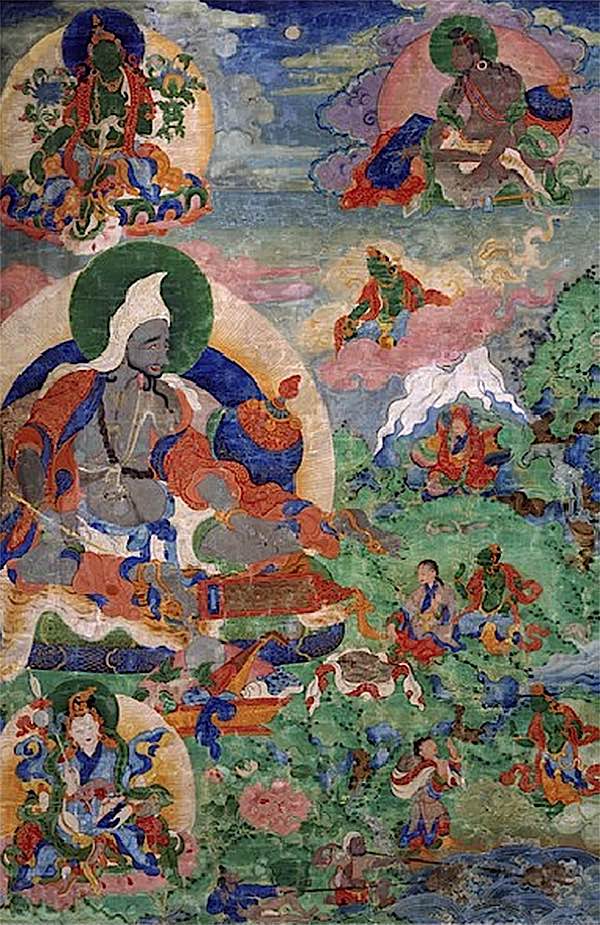
A siddhi, as it’s defined in Buddhism of Tibet is an ability such as being able to fly, or walk through matter, or to heal, or prophesy, or control the weather, and so on.
How far this is from the common idea of a Buddha, or a holy person we have in the West!
Actually, siddhis, the development of some abilities, are not as uncommon as they would seem. They just challenge us to extend our view of what is possible for a human being.
Now, when we compare our commonly held idea of a Buddha, an Awakened One, with the idea of someone who has various extraordinary abilities, we’ll see a great gulf between the two. Somehow they seem irreconcilable, yet to more fully understand the Buddhism that has arrived from India, via the Tibetan Traditions we’ll have to bridge this gap.
It’s our mundane view of ourselves, and each other, and our world that gets in the way of appreciating the qualities that are shown to us in realized teachers, and in the life and activity of the Buddhas and Bodhisattvas. To our ordinary view, we are all more or less the same, as just struggling and suffering human beings, with flaws, and some positive aspects that can be cultivated.

This, of course, in all Buddhist Traditions can be brought to a state of development we would call liberated – free from ego and the afflictive emotions, but a very limited view can still be there. It’s held onto on a very deep level as the conceived of fundamental nature of a person. It easily becomes the unspoken but prevailing standard. I see this quite often with Western Buddhist teachers. Such has been my observation over the years.
If we don’t know that Tibetan Buddhism is rooted in the spiritual beliefs and practices of India, and if we don’t know just what those fundamental ideas are, it’s almost certain we will not recognize, or we will misinterpret what we see of the practices that come to us from Tibet.
The siddha tradition has a shadow, of course, which is common to all forms of spirituality that develop a person’s spiritual or psychic capacities. There are warnings in every tradition I know of, East and West, against the use or an overriding fascination with these abilities. They can be a sidetrack at least, and at their worse, they can cause harm to ourselves and others.
So it’s understandable that in Traditions the subject is either avoided altogether, or dismissed as unnecessary, or meaningless.
When we come to the Mahayana motivation though, the intention to help others in every way we can, these capacities become quite important;
And when we get to the Vajaryana, the form of Buddhism that uses prayer, mantra, and visualization as a means to achieve these compassionate aims, the development of our latent faculties, our natural human abilities becomes quite important.
Without a view supporting these practices, and symbols, it’s easy to misunderstand them, or not see them as Buddhist practice, but when we see the ground of Indian Spirituality these come from, they begin to make complete sense.
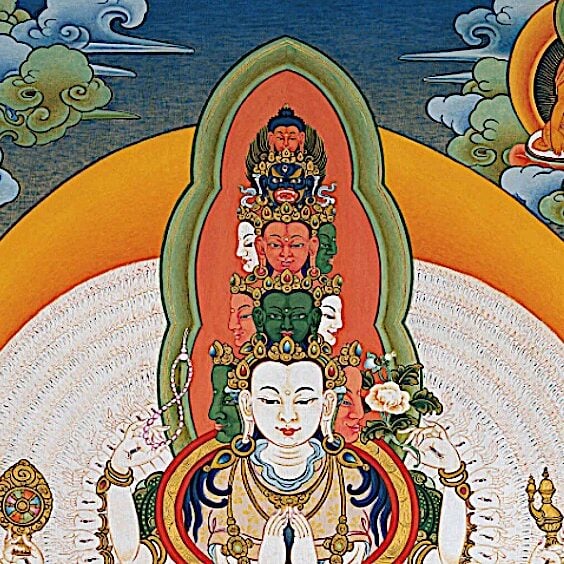
Look at the forms given to the Enlightened Beings, Thousand-Armed Avalokiteshvara, the Bodhisattva or Buddha of Compassion for example, or Manjushri, the Buddha of Wisdom, sitting on a lion and brandishing a flaming sword, or the Healing Buddha, or the Bodhisattva – Divinity Tara. Each of these, to a staid, conventional Buddhist way of thinking, seem far from Shakyamuni Buddha and his Noble followers.
If we see these in light of the Indian Spiritual worldview however, they are delightful, inspiring, sacred names and forms that express the enlightened intention and activities of the Buddha.
In Indio-Tibetan Buddhism they would say they are the actual expression or the divine manifestation of the Buddhas, the Awakened Ones.
Part of the problem, of course, is that not everyone is a poet, or is able to understand metaphor, or symbols. Their minds just do not work that way. For them, it’s best they stay far from religious poetry and mythology, but of course this isn’t going to happen. So there is criticism, or condemnation, and worst of all, they don’t benefit from these traditions as they could.
From what I can tell, two things are needed to connect with these the Mahayana and Vajrayana traditions and practices. One is a karmic affinity, and the other is a sensitivity to subtle energies. Without these, nothing stirs for a person, and more likely than not they won’t get what these practices are all about.
Those two are enough however, for the door to open.
Affinity is something interesting to reflect on. When it is there, it’s unmistakable. About all I can say is that at times reading texts or prayers, or reciting mantras can have a distinct effect. There can be a change in consciousness that is quite tangible. Whereas before there was no experience, something can awaken.
It can also be said that affinity is not a once and for all matter. It can be that what a person got no result from, or felt no attraction to at one time in their life can change, and there can be an appeal, and interest, and the unfolding of experience.
Then, when it comes to sensitivity to energy, some people have it, and most I would say don’t. This accounts for the different interpretations of teachings, and Buddhas and Bodhisattvas, great teachers, and protectors, or devas, or angelic beings.
This is not a path for everyone, but it should be known by all with an interest in Buddhism. This is our inheritance.
Then, if we understand and respect the siddha tradition in India and elsewhere by other names all over in our world’s spiritual traditions, we’ll be in a much better position to appreciate, and avail ourselves to those fine spiritual forces that grace our lives, and our world.
More articles by this author



Search
Latest Features



Please support the "Spread the Dharma" mission as one of our heroic Dharma Supporting Members, or with a one-time donation.
Please Help Support the “Spread the Dharma” Mission!
Be a part of the noble mission as a supporting member or a patron, or a volunteer contributor of content.
The power of Dharma to help sentient beings, in part, lies in ensuring access to Buddha’s precious Dharma — the mission of Buddha Weekly. We can’t do it without you!
A non-profit association since 2007, Buddha Weekly published many feature articles, videos, and, podcasts. Please consider supporting the mission to preserve and “Spread the Dharma." Your support as either a patron or a supporting member helps defray the high costs of producing quality Dharma content. Thank you! Learn more here, or become one of our super karma heroes on Patreon.
Jason Espada
Author | Buddha Weekly
Jason Espada is a writer and classical musician living in San Francisco; a steward of his father’s photography, and the founder of A Buddhist Library: http://www.abuddhistlibrary.com. Over the years, he’s made a number of recordings of Buddhist teachings. These days his focus is on the natural connection between spirituality and social action. His new website is at JasonEspada.com.