

You Are Never Alone; You were Never Impure: The Meaning of the Śuddha Mantra. Power of Chants: Overview
Why Every Buddhist Practice Begins With the Śuddha Mantra
Oṃ svabhāva śuddhāḥ sarvadharmāḥ svabhāva śuddho ‘haṃ.
Why does almost every formal Buddhist sadhana begin with this one ancient Sanskrit chant? And why did Lama Thubten Yeshe call it the “Universal Love Mantra”? What are the 7 Benefits of this powerful mantra?
Video (Transcript is below, along with time stamps for chapters)
In this video, we explore the Śuddha Mantra (the Purity Essence Mantra) — what it means, how to recite it, and why affirming that all phenomena are pure can settle the mind, clear obscurations, and anchor us in the present moment.
We break down the Sanskrit word by word, share Lama Yeshe’s teaching on adventitious stains, and look at how this ancient insight resonates with modern physics — where atoms are 99.999999% empty space, yet that space is fertile, alive, and interconnected.
You don’t practice to become pure. You practice from the powerful platform of your innate purity.
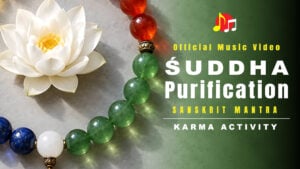
🎵 Listen to the companion music video: (see embed below)
In this video:
- 00:00 Why every sadhana starts with this chant
- 01:00 Rethinking Purity (Ego Traps): You were never Impure
- 01:50 The mantra and its meaning (Mantra 3 times)
- 02:35 Mantra Meaning
- 02:47 Sunya Mudra
- 03:20 When to Chant: 7 Benefits of the Mantra
- 04:20 Mantra translation word-by-word
- 05:38 Gelek Rimpoche on the Mantra
- 06:37 Lama Yeshe on purity (The sun behind the clouds)
- 07:45 How to practice with it (mudra, visualization, daily uses)
- 08:36 Purity, emptiness, and modern physics
- 10:04 Zen Master Thich Nhat Hanh: “Oneness, not Nothiness”
- 11:03 Resting in Oneness and Visualization
Oṃ svabhāva śuddhāḥ sarvadharmāḥ svabhāva śuddho ‘haṃ.
All dharmas in their own-being are pure; in my own-being I too am pure.
BENEFITS
Because this is, perhaps, the most powerful of all Buddhist affirmations due to it’s simple essence, its practical application in our everyday lives is vast.
We chant it at the beginning of every formal meditation, sadhana, or mantra accumulation after taking Refuge to establish our pure ground.
We use it to bless and purify our mala beads, vajra, bell, and altar offerings.
We chant it over our food and water to purify its essence before eating.
We recite it upon waking or after nightmares to ground our body and mind in tranquility.
We chant it to clear negative energy in a space, a so-called haunted space.
We use it to comfort a sick person.
We can also use this to reassure those who are passing away, reminding their consciousness of their ultimate, unstained nature.
We dedicate the merit of this presentation to the benefit of all sentient beings.
Transcript
Why do we as Buddhist practitioners begin almost every formal sadhana meditation session, and ritual with the exact same ancient Sanskrit chant, the Śuddha Mantra ? How can affirming that all phenomena are pure instantly settle our minds, clear our obscurations, and anchor us in the present moment? And why did the great Lama Thubten Yeshe call this foundational chant the “Universal Love Mantra”?
In our daily practice, we often catch ourselves falling into psychological ego traps—feeling stained, inadequate, anxious, or paralyzed by self-doubt. We hold onto an artificial self-image, whispering mistaken beliefs that we are flawed, helpless, or inherently impure. But Buddha Dharma offers us a radical, liberating truth: our fundamental, intrinsic nature is not broken, sinful, or damaged. At the deepest level of reality, we are spontaneously and naturally pure.
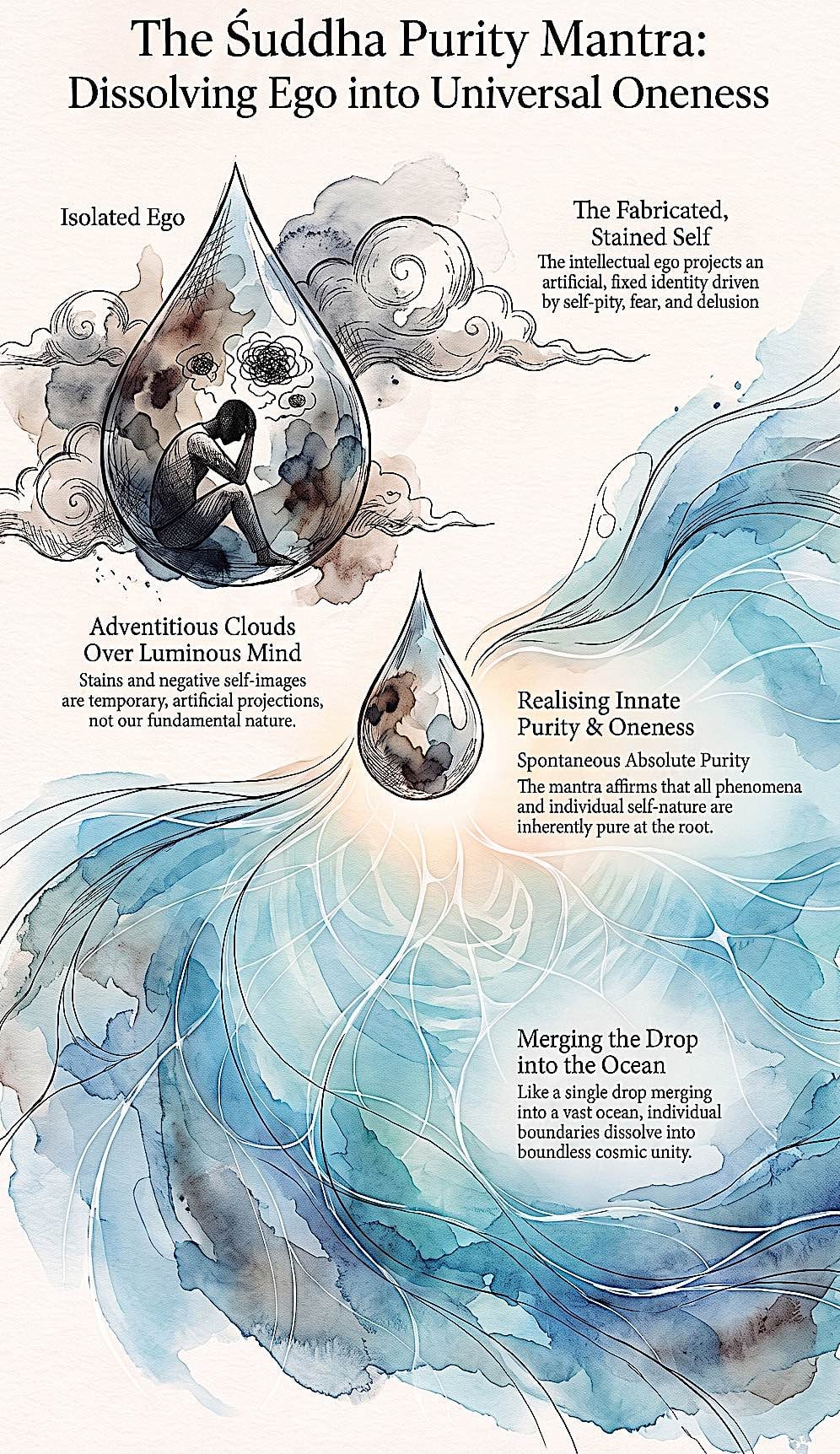
This fundamental realization is encapsulated in the Śuddha Mantra—also known as the Purity Essence Mantra or the Śūnyatā Mantra. The mantra is:
Oṃ svabhāva śuddhāḥ sarvadharmāḥ svabhāva śuddho ‘haṃ.
The Śuddha Mantra affirms universal purity, speaking deeply to our own essence. It literally means: “Oṃ. All dharmas in their own-being are pure; in my own-being I too am pure!”
We can accompany our recitation with the Shunya Mudra—bending the middle finger to touch the base of the thumb and holding it gently with the thumb—as the sacred gesture of emptiness and oneness.
Because this is, perhaps, the most powerful of all Buddhist affirmations due to it’s simple essence, its practical application in our everyday lives is vast.
We chant it at the beginning of every formal meditation, sadhana, or mantra accumulation after taking Refuge to establish our pure ground.
We use it to bless and purify our mala beads, vajra, bell, and altar offerings.
We chant it over our food and water to purify its essence before eating.
We recite it upon waking or after nightmares to ground our body and mind in tranquility.
We chant it to clear negative energy in a space, a so-called haunted space. We use it to comfort a sick person. We can also use this to reassure those who are passing away, reminding their consciousness of their ultimate, unstained nature.
When we break down the Sanskrit words we chant, the profound symmetry of the practice reveals itself.
Oṃ is the sacred primordial syllable, invoking universal vibration and blessing.
Svabhāva means intrinsic nature or own-being. Sva means “my own”, and bhāva means nature or being.
Śuddhāḥ and Śuddho translate as pure—not in a relative or moralistic sense, but as spontaneously and unconditionally untainted in the absolute sense.
Sarvadharmāḥ means all phenomena, all existences, and all teachings without a single exception.
‘Ham or Aham translates as “I am” — or as tradition emphasizes, the universal “we are”.
So, together, translated literally, this means: “Oṃ. All dharmas in their own-being are pure; in my own-being I too am pure!”
Or as Gelek Rinpoche beautifully translated it: “Nature’s empty; everything is pure; naturally pure, that’s what I am”.
This mantra possesses a two-part structure that mirrors the heart of Mahayana practice. First is the objective, universal truth: every phenomenon and every being in existence is pure at the level of its ultimate nature.
The second line brings this directly into our personal practice by affirming that we ourselves are not excluded from this universal purity.
In other words, our own inner purity and the purity of all phenomena are completely inseparable.
Lama Thubten Yeshe explained in his teachings that we have to understand what “pure” or śuddha means in the Buddhist context.
It does not mean “clean” in a moralistic or relative sense. He explained that from our everyday relative viewpoint, we experience emotional afflictions, confusion, and karma.
He then pointed out that these defilements are merely temporary, adventitious stains — like storm clouds passing across the sun. The sun itself was never dimmed or altered by the clouds.
He finished his teaching by summarizing that when we chant this mantra, we are not making a request for a higher power to purify us, nor are we trying to manufacture a clean slate from scratch. Instead this is affirming what has always been true.
We do not practice to become pure; we practice from our innate purity. We are always innately pure.
Reciting the Śuddha Mantra cuts through the conceptual errors that lead us to misery, and takes us instead to a mindful state of Oneness.
When we recite these words with deep awareness, we shake what Lama Yeshe called the “Mt. Meru of our ego,” allowing our rigid, samsaric mandala to collapse.
We dissolve the sensory barriers that appear to separate us from others, instead realizing we are a drop of water in a proverbial ocean.
When dualistic grasping vanishes, when we realize we are part of the great ocean, not a drop of water, our genuine compassion and universal love naturally arises.
And it’s probably no suprise that, this ancient Buddhist insight directly aligns with modern physics and cosmology. Over 80 percent of the volume of the known universe consists of vast, empty space between galaxies, and on a microscopic scale, an atom is over 99.999999 percent empty space. Yet this cosmic space is not a void of nothingness; it is the fertile field connecting all matter and energy.
So when we chant this mantra, we can imagine the vastness and aliveness of the cosmos. As the astrophysicist Carl Sagan famously wrote, “We are made of star-stuff”.
In Buddhism, this mantra reaffirms our Buddha Nature, which unlike ego is permanent because it is empty of a separate, rigid ego, and full of limitless, interconnected life.
In fact, the Sanskrit word Śūnya (the root of Śūnyatā) is the direct historical origin of the mathematical Zero through the Arabic ṣifr. Zero does not mean nothing; it represents potential, limitlessness, and total union. This is why Zen Master Tich Nhat Hanh often preferred translating Śūnyatā as “Oneness” or “Fullness” rather than emptiness. Many modern teachers prefer “Oneness” to Emptiness or “nothingness” although ultimately they are all labels.
The mantra is also universal. Regardless of your practice, your yidam, your emphasis in practice, this mantra almost always starts and finished your daily practice if you follow formal sadhana. For this reason, 3 Gems Band, in their beautiful new mini-album collection on this mantra have created five separate but related melodies which they associated with the five Buddha Families and five wisdoms. See our linked playlist.
When we sit in quiet contemplation, we can close our eyes to turn away from dualistic sense impressions. We visualize a beam of radiant light entering our heart, transforming all our rigid self-pity and doubt into luminous light. As that light dissolves into the open space of non-duality, we rest in complete awareness. We affirm our Oneness with all sentient beings.
We do not struggle to build a new identity; we simply let go. In the great universal reality of emptiness, there is no fear, no isolation, and no duality—only supreme peace, ultimate purity, and the natural freedom of enlightenment.
Oṃ svabhāva śuddhāḥ sarvadharmāḥ svabhāva śuddho ‘haṃ.
All dharmas in their own-being are pure; in my own-being I too am pure.
We dedicate the merit of this presentation to the benefit of all sentient beings.
More articles by this author
Descending Light: Celebrating Lhabab Duchen 2026 — The Day of Ten Million Multiplied Merits: Buddha’s Descent From Heaven

You Are Never Alone; You were Never Impure: The Meaning of the Śuddha Mantra. Power of Chants: Overview
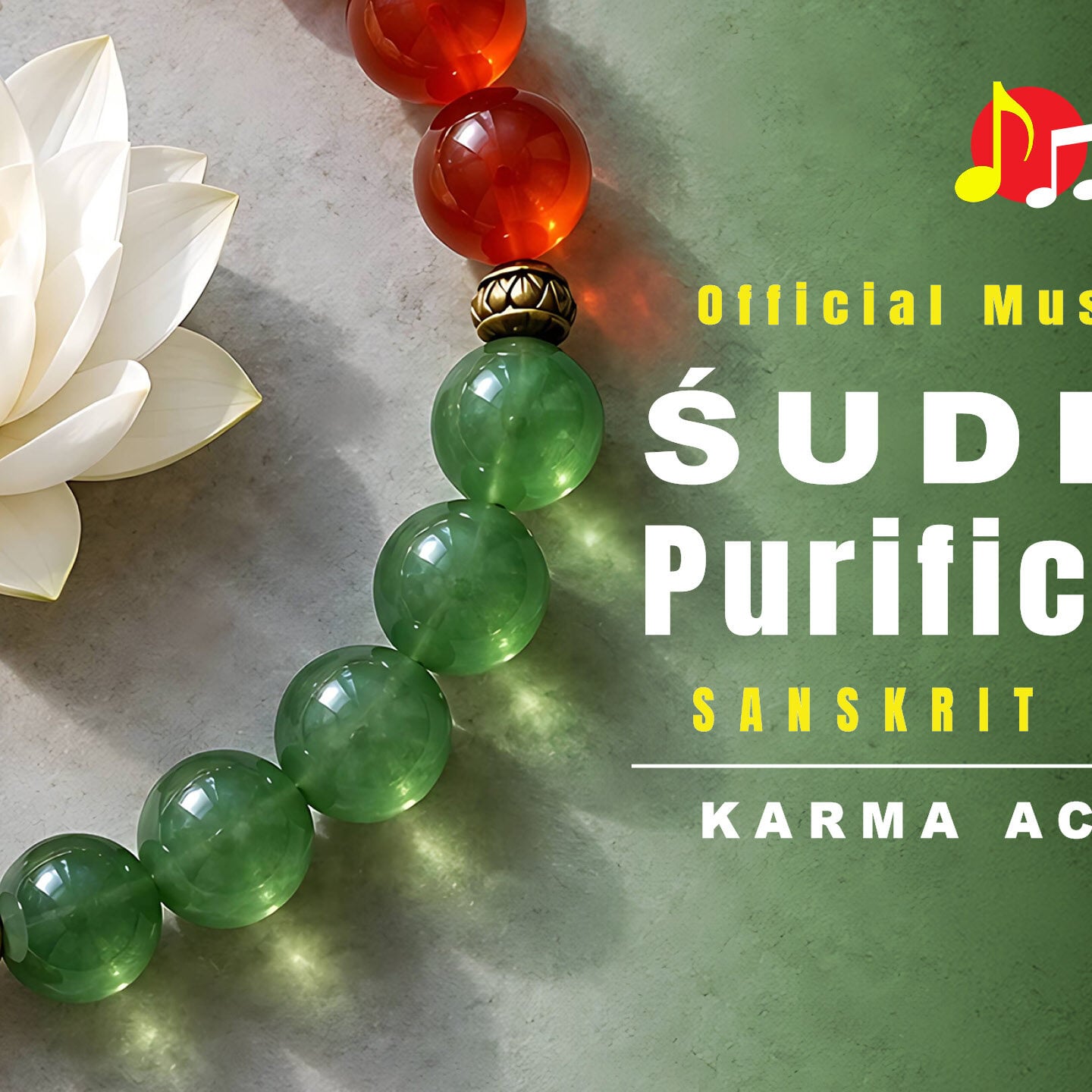
Śuddha – Purity Mantra: Also known as the Śunyata mantra, and the “Universal Love” mantra, all Buddhist practices begin with it
Search
Latest Features
Please support the "Spread the Dharma" mission as one of our heroic Dharma Supporting Members, or with a one-time donation.
Please Help Support the “Spread the Dharma” Mission!
Be a part of the noble mission as a supporting member or a patron, or a volunteer contributor of content.
The power of Dharma to help sentient beings, in part, lies in ensuring access to Buddha’s precious Dharma — the mission of Buddha Weekly. We can’t do it without you!
A non-profit association since 2007, Buddha Weekly published many feature articles, videos, and, podcasts. Please consider supporting the mission to preserve and “Spread the Dharma." Your support as either a patron or a supporting member helps defray the high costs of producing quality Dharma content. Thank you! Learn more here, or become one of our super karma heroes on Patreon.
Lee Kane
Author | Buddha Weekly
Lee Kane is the editor of Buddha Weekly, since 2007. His main focuses as a writer are mindfulness techniques, meditation, Dharma and Sutra commentaries, Buddhist practices, international perspectives and traditions, Vajrayana, Mahayana, Zen. He also covers various events.
Lee also contributes as a writer to various other online magazines and blogs.