

Palden Lhamo Glorious Goddess SriDevi of Protection and Good Fortune: MANTRA in SANSKRIT with Commentary
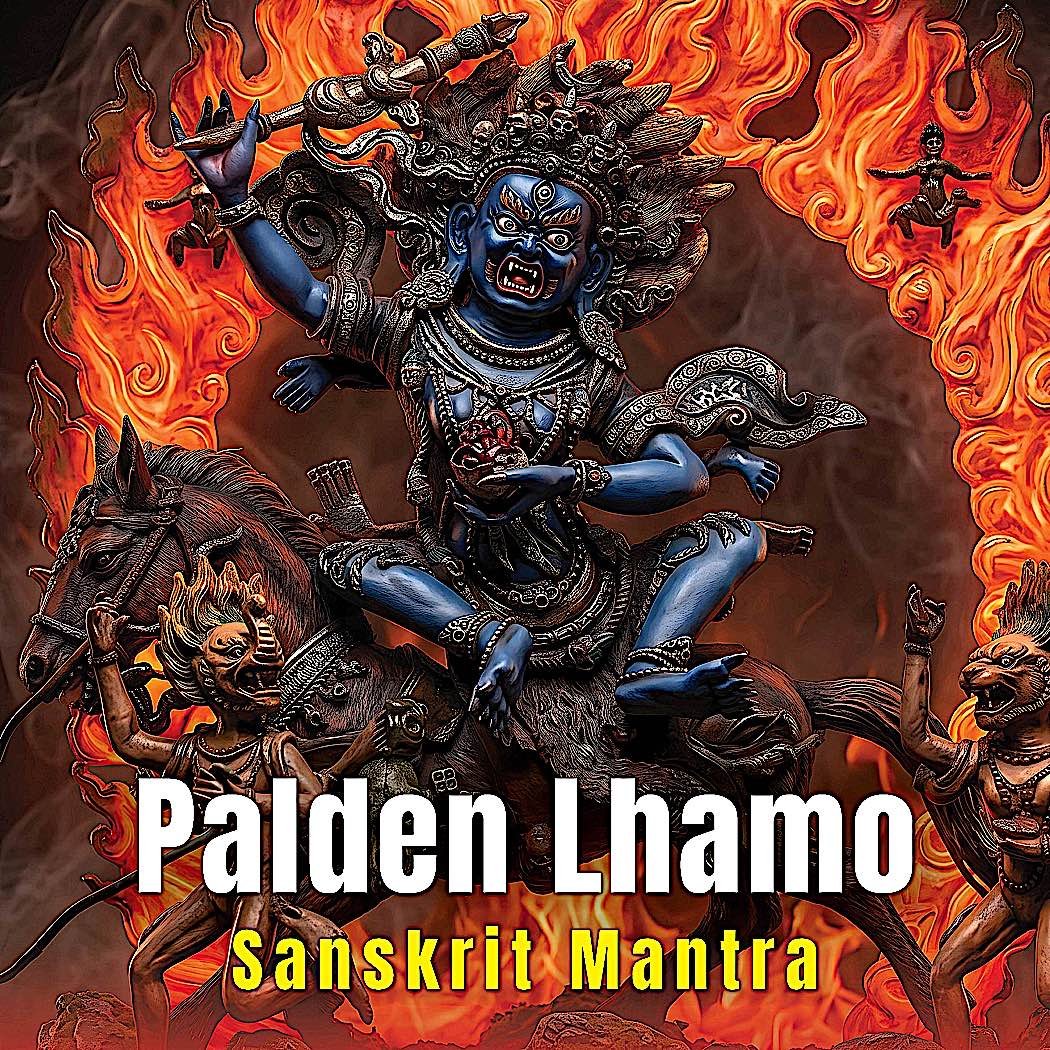
🙏 🙏 🙏 Who is Palden Lhamo?
Palden Lhamo simply means “Glorious Goddess” which is also a fair translation of her Sanskrit name Sri Devi. She is the main protector of Tibet and of the Dalai Lamas.
- For a full feature on Palden Lhamo, see: https://buddhaweekly.com/?p=8125
🎵 🙏 Mantra:
bhyo rakṣa mo
bhyo rakṣa mo
bhyo bhyo rakṣa mo
tṛuṁ bhyo kha-kṛṣṇa-vastrā rakṣa mo
avyāt tṛuṁ bhyo rulu rulu hūṁ bhyo hūṁ
Devanagari:
भ्यो रक्ष मो भ्यो रक्ष मो भ्यो भ्यो रक्ष मो
तृं भ्यो ख–कृष्ण–वस्त्रा रक्ष मो
अव्यात् तृं भ्यो रुलु रुलु हूं भ्यो हूं
IN TIBETAN Sanskrit Hybrid (we do not chant this in Tibetan, this is for reference):
Jho Rakmo Jho Rakmo Tun Jho Kalarak Chenmo Rakkmo Adja Tadja Tun Jho rulu rulu hung Jhno Hung
Sometimes this is even more loosely chanted in the purely Tibetan version:
Jo Ramo Jo Ramo Tunjo Kalarak Chenmo Ramo Adja Tadja Tun Jo Rulu Rulu Hung Jo Hung.,
However, BHYO is the seed syllable in original Sanskrit. It has become transliterated into Tibetan as Jo.
The canonical Sanskrit/Tibetan source is Śrīdevīkālīnāmāṣṭaśataka Toh 672
🙏 🙏 🙏 Wrathful Tara, Vasudhara or Lakshmi
She is ultimately a “usually wrathful” form of Tara. One of Tara’s forms is Vasudhara, the 11th Tara, in her peaceful form. In her wrathful form — Palden Lahmo. She is also considered an aspect of Lakshmi, who is, in Buddhist 21 Taras pratice, also a form of Tara. In Chinese Buddhism, her mantra for her peaceful form is one of the 10 Small Mantras as Mahasri Devi, the Good Fortune Goddess.
As a Tara, albeit usually wrathful, she is an Enlightened Goddess. For this reason, anyone can make offerings — notably black tea offerings are preferreed — and chant her mantra with her visualized in front of them. She is normally not a Yidam for self-generation. You normally start with your own Yidam practice — for example visualizing yourself as Tara or Avalokiteshvara — with Palden Lhamo appearing in front of you as you make offerings.
Her mantra is most often chanted in Tibetan – Sanskrit blend, due to centuries of transmission from India to Tibet. Here, we chant in pure Sanskrit. See the translation below.
Line-by-Line Commentary and Translation
1. bhyo rakṣa mo
“O Goddess, protect me!”
- bhyo — A fierce, vocative particle addressing Palden Lhamo directly. It carries the energy of an urgent, heart-felt call.
- rakṣa — Sanskrit for “protect” (imperative mood). A direct command, yet offered with devotion.
- mo —(female, goddess). It reminds us she is the divine feminine protector — motherly yet wrathful.
Repeat three times (lines 1–3) — each repetition deepens the plea until it becomes a roar from the heart.
2. bhyo bhyo rakṣa mo
“O Goddess, O Goddess — protect me!”
Doubling bhyo intensifies the invocation. It’s no longer a simple call — it’s a cry of urgency, the voice of a practitioner surrounded by inner and outer obstacles, turning to the only one who can cut through them.
3. tṛuṁ bhyo
“Hear me, O Goddess!”
- tṛuṁ — A wrathful seed syllable (bīja). In Palden Lhamo’s sādhana, tṛuṁ is the heart seed of her power — the condensed essence of her ability to overcome all forces that harm the dharma and its practitioners. It vibrates at the point where compassion meets fierceness.
Together with bhyo, this line signals: I am now entering your field of power. Strike my ignorance. Guard my practice.
4. kha-kṛṣṇa-vastrā
“She whose garment is the black sky”
This phrase replaces the Tibetan kha la rak chen mo with a pure Sanskrit equivalent, while preserving the original image.
- kha — sky, space, ether.
- kṛṣṇa — black, dark, the unmanifest, the vast night.
- vastrā — garment, robe, cloak.
Meaning: Palden Lhamo does not wear a black cloak — she wears space itself. Her robe is the night sky, infinite and empty, yet utterly present. This image symbolizes her all-encompassing protection: wherever you are, she is already there, as vast as the cosmos, as dark as the primordial void from which all dharmas arise.
In practice, visualizing her cloak expanding to cover the horizon helps the practitioner feel held, hidden, and guarded by her power.
5. rakṣa mo (repeated)
“Protect me, O Goddess”
The plea returns, now strengthened by the vision of her sky-cloak. After seeing her true nature, the practitioner asks again — not out of doubt, but from renewed devotion.
6. avyāt tṛuṁ bhyo
“May she never depart — O Goddess of the heart-seed!”
- avyāt — Third-person optative of av (to protect) or vyā (to pervade). Purified from the earlier hybrid avyātavya, now meaning: “May she protect / may she remain / may she not leave.”
This line is a vow-seal. The practitioner acknowledges that Palden Lhamo’s presence is not conditional — she has sworn to protect the dharma and its holders. avyāt is our expression of trust in that unbroken vow.
Together with tṛuṁ bhyo: May the tṛuṁ in her heart and mine never fade. May she abide with me until enlightenment.
7. rulu rulu
“Hahaha! / The rattle of the reins / The thunder of her laughter”
- rulu — It can mean:
- The fierce, mocking laughter of Palden Lhamo as she tramples ego and fear.
- The sound of her mule’s reins shaking, signaling her approach.
- A mantric canopy — a protective vibration that seals the space.
In practice, chanting rulu rulu should feel like joyful wrath — the sound of all obstacles being laughed out of existence.
8. hūṁ bhyo hūṁ
“So be it! O Goddess! So be it!”
- hūṁ — The vajra seed syllable of enlightened wrathful compassion. It seals, destroys, and establishes all at once.
- It destroys the three poisons (desire, hatred, ignorance).
- It seals the protection.
- It establishes Palden Lhamo’s presence in every cell of the practitioner’s being.
The final hūṁ is a resonant closure — after calling, seeing, trusting, and laughing, the practitioner rests in the sound of hūṁ, which is Palden Lhamo’s own heart-sound.
Together: “Her wrathful compassion is here, now, and never leaves. Hūṁ — it is done. Hūṁ — it is sealed.”
Complete English Translation (Flowing Summary)
“O Goddess, protect me. O Goddess protect me. O Goddess, O Goddess, protect me.
Seed of power, O Goddess — She whose robe is the black sky — protect me, O Goddess.
May she never depart. Seed of power, O Goddess.
Hahaha! The laughter of space! Hūṁ — O Goddess — Hūṁ!”
Practical Use Note
This mantra can be chanted:
- 3, 7, 21, or 108 times as a daily protector practice.
- Before any dharma activity, travel, or difficult decision.
- As a mo divination tool (as per earlier Dalai Lamas) — chanting 21 times, then asking a yes/no question, observing the first letter or image that arises.
More articles by this author
Uposatha Observance Days Each Month are the Renewal Dedication Practice Days, Traditionally Practiced on the New, Full and Quarter moons each month
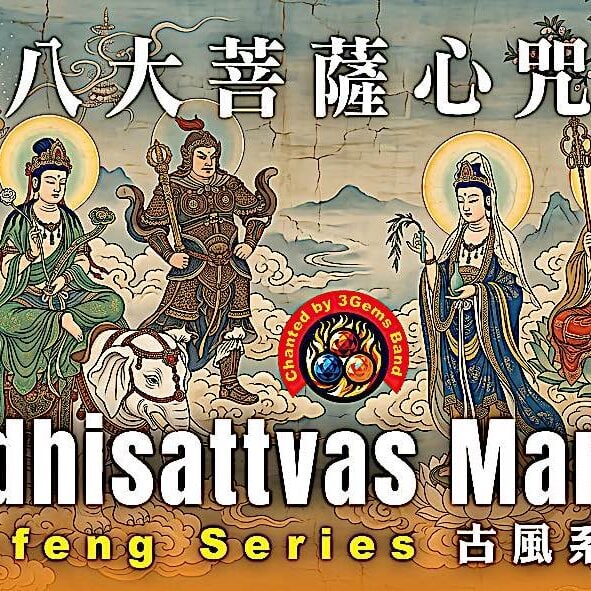
8 Bodhisattva Heart Mantras: Wisdom, Compassion, Power, Activity and Merits of the Buddha – 3 Gems Band Gufeng Series
Tara’s 108 Namo Sanskrit Praises 8 Minute Daily Protection & Abundance Practice Sung by Hrishikesh Sonar and Buddha Weekly Band
HEALING VIDEO: Black Manjushri “most powerful healing” (Ven. Zasep Rinpoche) 1 Hour chanting Mantra in Sanskrit

Search
Latest Features



Please support the "Spread the Dharma" mission as one of our heroic Dharma Supporting Members, or with a one-time donation.
Please Help Support the “Spread the Dharma” Mission!
Be a part of the noble mission as a supporting member or a patron, or a volunteer contributor of content.
The power of Dharma to help sentient beings, in part, lies in ensuring access to Buddha’s precious Dharma — the mission of Buddha Weekly. We can’t do it without you!
A non-profit association since 2007, Buddha Weekly published many feature articles, videos, and, podcasts. Please consider supporting the mission to preserve and “Spread the Dharma." Your support as either a patron or a supporting member helps defray the high costs of producing quality Dharma content. Thank you! Learn more here, or become one of our super karma heroes on Patreon.
Lee Kane
Author | Buddha Weekly
Lee Kane is the editor of Buddha Weekly, since 2007. His main focuses as a writer are mindfulness techniques, meditation, Dharma and Sutra commentaries, Buddhist practices, international perspectives and traditions, Vajrayana, Mahayana, Zen. He also covers various events.
Lee also contributes as a writer to various other online magazines and blogs.