




The Meditator’s Guide to Dharma Journaling: Integrating Practice and Daily Life – Bridging “Knowing” and “Living the Dharma Path”
Bridging the Gap Between Knowing and Living the Path — Prajna to Karma and Merit
You’ve sat on the cushion. You’ve tasted moments of clarity and peace. But what happens when that calm dissolves into the chaos of a morning commute, a work deadline, or a difficult family conversation? Many dedicated students of the Dharma find themselves in this familiar predicament, struggling to apply profound wisdom amidst the relentless pressures of daily, “samsaric” life. How do we bridge this critical gap between intellectual understanding and lived, embodied experience?
Journaling — with Intention
Journaling, when approached with intention, emerges as a powerful and practical tool to forge this connection. As Buddhist monk, Ven. Nick Keomahavong (video below) recalls how essential it was to have time to simply “process what I was being taught.”
This guide frames journaling not as a mere diary, but as a form of mindful writing—a vital supplement to formal meditation and spiritual study. It is a private, safe, and effective space for self-exploration and transformation.
Note Ven. Nick Keomahavong, previously a practicing psychotherapist, has been ordained as a Theravada Buddhist monk in Thailand since 2018.
Throughout this guide, we will explore core journaling techniques that can help you transform negative mental patterns, process difficult emotions, deepen self-awareness, and systematically improve your meditation practice. By putting pen to paper, you create a tangible record of your inner world, allowing you to study your own mind with the curiosity and care of a dedicated practitioner.
Let us begin by exploring the foundational principles that establish journaling as a legitimate and powerful Dharma practice, supported by both ancient wisdom and modern science.
The Foundation: Why Journaling is a Dharma Practice
To fully benefit from any practice, it is crucial to understand the principles that give it power. Dharma journaling is not merely record-keeping; it is an active form of mind training with deep roots in Buddhist tradition and compelling support from modern neurological research. It is a way to actively engage with the material of your life and cultivate insight.
The synergy between meditation and journaling is profound. Meditation helps to quiet the incessant mental chatter and foster a state of deep self-awareness, creating a calm mental state that allows your thoughts to flow more freely. In this clear space, we can observe our thoughts and feelings as they arise without judgment. Journaling then becomes the sacred space to capture, reflect on, and process these observations. As described by experts at Headspace, this practice is a “retrospective exercise in reflection,” allowing us to join the dots and see patterns and behaviors that we may have missed in the rush of everyday life. This is the path to genuine self-discovery.
Note: Dr. Arif, a mental health expert and neuroscience enthusiast, as he breaks down complex topics from psychology, motivation, emotional intelligence, and brain science into practical tools you can use every day.
This method of self-reflection has strong justification within Buddhist traditions. The founding Master Sotasan of the Won Buddhist tradition taught that practitioners should keep a diary for two primary reasons:
- To “appraise our right and wrong conduct for the day” and become aware of our balance of transgressions or merits, thereby illuminating our ability to make skillful choices.
- To “assess our progress in understanding the principles” of the Dharma, documenting our personal awakenings and impressions as we walk the path.
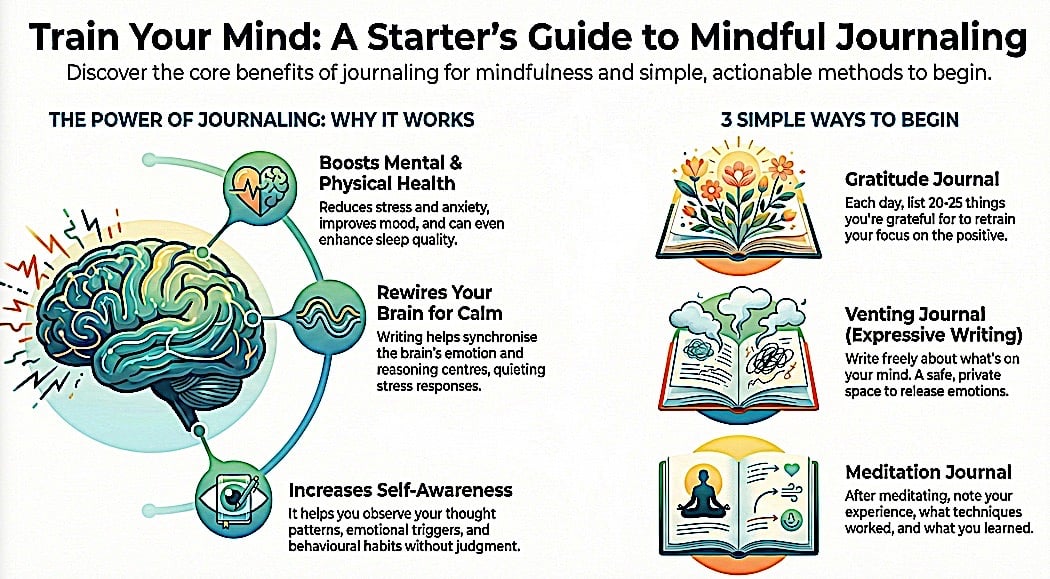
This ancient practice is now being validated by modern science. Dr. Arif Khan explains the neurological power of journaling as a form of “neurological repair.” Brain scans reveal that when people write about their feelings, the prefrontal cortex (the region for reasoning) and the amygdala (the region for emotion) begin to synchronize, as if the brain is learning to “talk to itself.” This is particularly true of handwriting, which activates more areas of the brain than typing. The physical act of writing slows the mind “just enough to make sense of itself,” fostering cognitive control and emotional regulation.
Having established the “why” of Dharma journaling, we can now turn to the “how,” exploring a toolbox of specific techniques to apply on your path.
Core Journaling Techniques for the Meditator’s Path
This section offers a practical toolbox of journaling methods. Think of each technique as a specific antidote to the challenges that arise in daily life, such as habitual negative thinking, a judgmental mind, or the overwhelm of powerful emotions. You can choose the journal that best fits your current situation or use several in concert to support your overall practice.
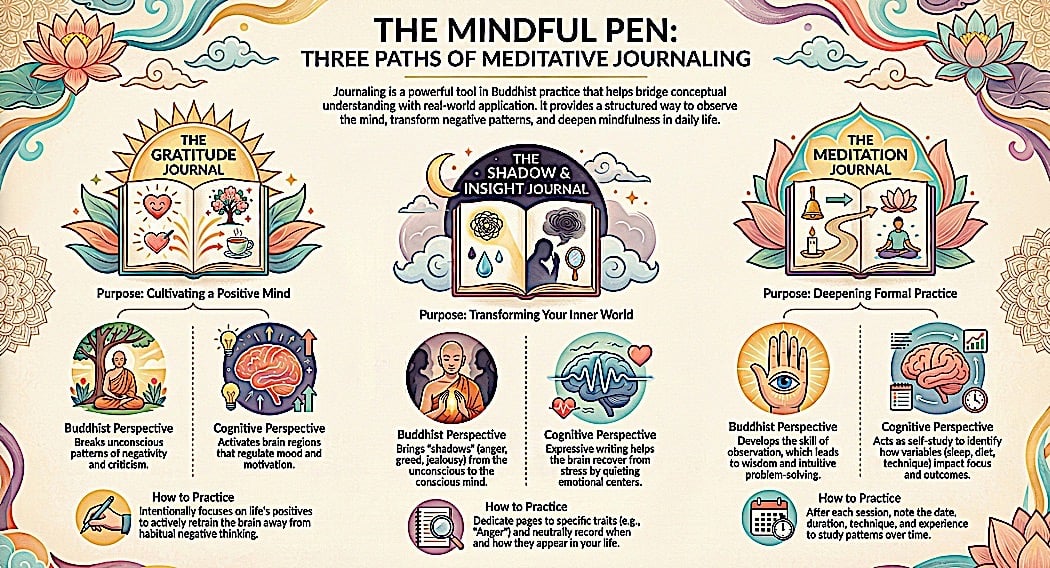
Cultivating a Positive Mind: The Gratitude Journal
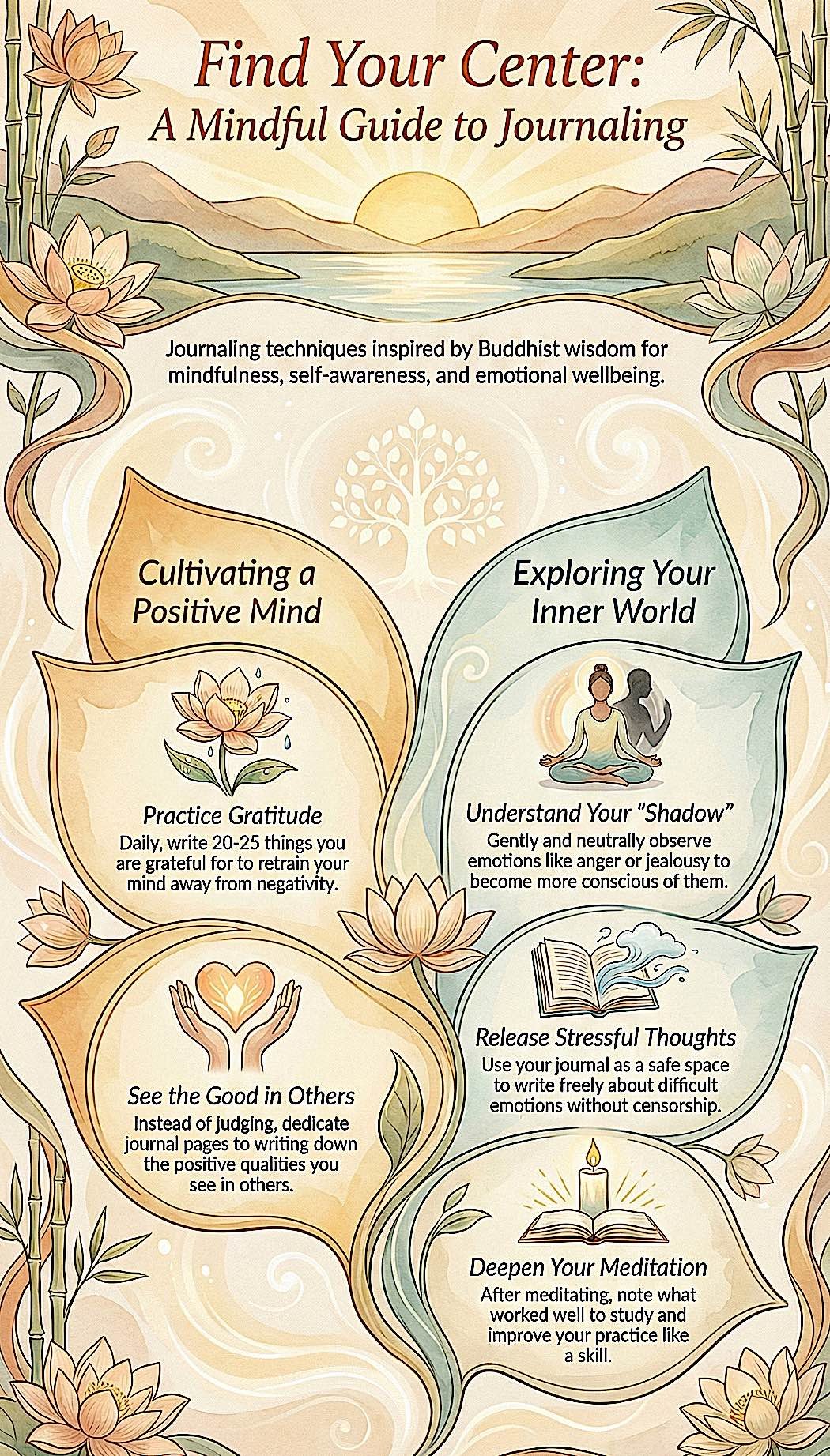
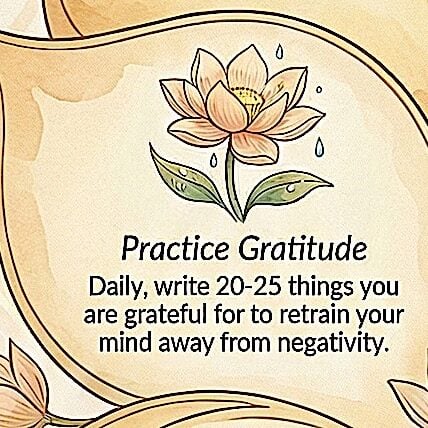
One of the most common obstacles on the path is the unconscious habit of negative thinking. A gratitude journal is a powerful tool to actively break this pattern. It is a direct practice of mudita (sympathetic joy) for one’s own conditions, actively counteracting the craving (tanha) for what is missing. It systematically retrains the brain to scan for what is stable, positive, and supportive, rather than automatically focusing on what is threatening or lacking.
Based on the method taught by Ven. Nick Keomahavong, here are some gentle instructions for this practice:
- Frequency: Write a minimum of two times per day, once in the morning and once in the evening before bed.
- Volume: Make a list of 20 to 25 things you are grateful for in each session.
- Scope: Include both large and small things. It can be anything from having a job or loving parents to having clean clothes, shoes to wear, or a working refrigerator. You might begin each entry with the words: “Today I am grateful because…”
- Intensive Practice: As an “antidote,” any moment you notice your mind becoming negative, you can bring out your journal and start writing a gratitude list. This is how you catch the habit in the act and actively retrain yourself.
The long-term goal of this discipline is to rewire your behavioral patterns so deeply that a positive, appreciative mindset becomes your second nature, effortlessly informing how you experience your world.

Dissolving Judgment: The “Good in Others” Journal
A critical and judgmental mind is a significant mental defilement. Looking down on others and pointing out their flaws “taints your mind,” clouds your perception, and provides a “deluded sense of self-worth.” This technique is a direct method for counteracting this tendency by actively cultivating metta (loving-kindness) and practicing the Bodhisattva ideal of seeing the Buddha-nature in all beings.
The exercise, as taught by Ven. Nick Keomahavong, is simple and transformative:
- Take a page in your journal and write a person’s name at the top.
- Instead of allowing your mind to fall into its habitual pattern of looking for flaws, consciously train yourself to list the good you see in that person.
- Examples could include their passion, their punctuality, their kindness, their drive, or their ability to speak up for themselves. Observe them with the intention of discovering their strengths.
The outcome of this practice is a profound softening of the mind. It makes you less reactive, more compassionate, and fundamentally improves your relationships with others and, most importantly, with yourself. It allows you to see the world through a clearer, more generous lens.

Processing Daily Stress: The Expressive & Venting Journal
Modern life—with its traffic, work demands, and family responsibilities—can be overwhelmingly stressful. Without a healthy “release valve,” these emotions can become trapped and toxic, affecting both our mental and biological well-being. This journal provides a safe and private space for that essential release.
There are two effective approaches to this practice:
- Expressive Writing: This is a focused practice for processing significant emotional experiences, stressors, or trauma. Drawing from research highlighted by Headspace, the method involves writing about a difficult experience for 15-20 minutes a day, for at least 4 days. This act helps create emotional distance and gives your reasoning brain a chance to gain cognitive control over the experience.
- The Venting Journal: Based on Ven. Nick Keomahavong’s advice, this is a more general, daily tool for releasing minor agitations through a freestyle “brain dump” or “emotion dump.” The invitation here is to let whatever comes to mind flow onto the page without censoring, erasing, or worrying if it is appropriate. The page is a container for your raw thoughts and feelings, allowing you to release them instead of carrying them.
Exploring the Inner World: The Shadow Journal
This is a more advanced practice for those serious about deep self-transformation. Ven. Nick Keomahavong uses the analogy of a car’s blind spot to explain the concept of the “shadow self”—those aspects of ourselves that we haven’t paid attention to or simply do not want to see. This work requires holding ourselves with radical self-compassion, or karuna, as a container for what we discover.
A great danger on the spiritual path is delusion—pretending we don’t have anger, greed, or jealousy. As human beings walking the path, we all have these mental defilements. The shadow journal is a tool to look at them directly, neutrally, and courageously.
Here is the step-by-step method:
- You might dedicate a fresh page for each “shadow” aspect you wish to explore. Start with key defilements like: Anger, Greed, Jealousy, Pride, Ego, Manipulation, and Resentment.
- Keep your eyes on yourself. Without judgment, record instances in your daily life where these aspects arise.
- Note the specifics: the situation that triggered it, the thought patterns that were sparked, the emotions that arose, and the behavior that manifested as a result.
Remember to hold this practice with immense gentleness. You are not gathering evidence for self-criticism, but rather illuminating hidden corners of your mind with the lamp of kind awareness. The primary goal of this work is to bring the unconscious into consciousness. We cannot fix problems we are not aware of. This journal is the crucial first step of neutral identification, which is the prerequisite for any genuine transformation.
With these tools for navigating daily life, let us now shift from techniques for managing daily life to those designed for actively cultivating insight and accelerating progress on the formal path.
The Dharma Journal: Deepening Insight and Formal Practice
Beyond managing the challenges of daily life, journaling is a crucial tool for accelerating your progress on the formal meditative path. The following methods are designed to help you systematically analyze your meditation sessions and integrate Dharma principles more directly into your moment-to-moment experience.
The Meditation Journal: A Scientist’s Logbook for the Mind
The core purpose of a meditation journal is to systematically analyze your sessions to understand what works, what doesn’t, and why. This analytical approach can speed up your progress tremendously. Every session, even a “bad” one filled with a wandering mind, is a valuable learning opportunity. By keeping a record, you study yourself like a scientist, building a repository of wisdom about your own mind.
Synthesizing advice from Ven. Thanajayo Bhikkhu and Ven. Nick Keomahavong, here are the key data points to record after each meditation session:
| Data Point | Description & Purpose |
| Date & Time of Day | Note whether it was early morning, afternoon, or late night. This helps identify patterns related to your daily energy cycle. |
| Duration | Record how long you sat. This tracks consistency and endurance over time. |
| Technique Used | Specify your meditation object or method (e.g., watching the breath, using a mantra like “clear and bright,” visualizing a crystal ball). |
| Pre-Meditation Factors | Note your physical and mental state. Did you have enough sleep? Did you consume caffeine? Did you work out? This reveals how external conditions affect your practice. |
| Session Experience | Describe what happened. Was the mind still or wandering? Did you feel sleepy or focused? Did specific thoughts, emotions, or inner images arise? Write neutrally. |
| Insights & Wisdom | Record any moments of clarity or intuitive understanding that arose when your mind was calm and stable. This is the “wise part of you” that helps answer questions. |
| Effective Adjustments | What did you do when you faced a hindrance? If you were drowsy, what technique helped? If your mind wandered, what brought it back? This builds your toolkit of effective responses. |
It is critical to remember that the goal is not to attach to good results or to generate an expectation that they will repeat. The purpose is to “study the technique that got you to get to this point,” so you can skillfully apply what you learn in future sessions.
Like any rigorous scientist, your aim is not to cherry-pick favorable results but to understand the underlying principles of cause and effect in your own mind. This logbook is your data, and consistent analysis is the path to repeatable insight.
Reflective Journaling: Applying the Threefold Practice
This powerful and structured method, rooted in the Won Buddhist tradition, is designed to integrate Buddhist principles directly into your daily actions. It moves beyond simple reflection to a systematic analysis of your conduct, helping you cultivate wisdom through inquiry.
As taught by Steve Hadcock, the “Threefold Practice” provides a framework for analyzing a specific condition or interaction from the previous day. Take a moment to bring a situation to mind and reflect on it using the following three headings:
- Samadhi (Cultivating Spirit): Ask yourself: Did I have a meditative pause during the instance, or did I react on autopilot? What did I do (or not do) to cultivate a calm spirit?
- Prajna (Inquiry into Facts & Principles): Ask yourself: Did I use my natural wisdom? What were the underlying causes of my thoughts and feelings? Could I have viewed this from another’s perspective?
- Sila (Choice in Action): Ask yourself: Did I have the right thought, right speech, and right action? What, if anything, could I do differently next time to have a different outcome?
Reviewing these entries over time provides a clear and honest gauge of your progress in cultivating a more mindful, wise, and ethical way of being in the world.
Having explored these specific methods, let’s now review some general best practices for starting and maintaining a journaling habit.
Putting Pen to Paper: How to Begin Your Practice
Starting any new habit can feel daunting, but the process of Dharma journaling can be made simple and accessible. By following a few key principles, you can build a sustainable and deeply rewarding practice.
Here is a summary of best practices synthesized from our sources to help you begin:
- Start Small and Be Consistent: Like meditation, consistency is far more important than duration. Commit to an attainable goal, such as 5 minutes or one page a day. Find a regular time to write, such as in the morning or before bed, to help establish the habit.
- Pick One Journal to Start: If you feel overwhelmed by the options, just pick the one that would be most helpful for you right now. There is no ‘right’ place to begin, only your place. Choose the practice that speaks most directly to what you need in this moment.
- Create a Peaceful Space: Find a comfortable, distraction-free spot where you can sit and write. A calm environment supports mindfulness and allows for deeper reflection.
- Use Pen and Paper: The physical act of writing by hand is neurologically more effective than typing. It requires more attention, slows down the mind, and engages more of the brain, facilitating deeper processing of your thoughts and emotions.
- Forget the Rules: This journal is for you and you alone. Do not worry about perfect grammar, spelling, or making sense. This freedom from self-judgment is what allows your authentic thoughts and feelings to emerge without censorship.
- Use Prompts When Stuck: If you sit down and don’t know what to write, use a prompt to get started. Here are a few examples adapted from the sources:
- “Name three thoughts that made you smile today.”
- “What might challenge me today, and what will I do if I feel stressed?”
- “I am mindful of the challenges I have faced. I feel grateful for them because…”
- Practice Self-Compassion: After writing about difficult experiences, be gentle with yourself. Take a moment to reflect on what you wrote, and then let it go. It can be helpful to go for a walk, take a few deep breaths, or do a short loving-kindness meditation to release any rumination before continuing with your day.
These practical tips provide the foundation for a powerful practice. Now, let us conclude with a final reflection on the transformative potential of this work.
Journaling as a Path to Self-Transformation
Dharma journaling is far more than a simple diary; it is an active, private, and profoundly effective form of “self-construction” and mind training. It is the laboratory where you become the gentle scientist of your own inner world, observing, reflecting, and cultivating the conditions for wisdom and compassion to grow.
The practices outlined in this guide provide a compassionate and insightful way to soften the mind, process the inevitable challenges of life, and turn the noble theories of the Buddhist path into your own living reality. By creating a consistent dialogue with yourself on the page, you build awareness, deepen your understanding, and empower yourself to make conscious, skillful choices day by day.
This guide is offered in support of your transformation journey. Keep up your practice, and may you find clarity and peace on your path.
2 thoughts on “The Meditator’s Guide to Dharma Journaling: Integrating Practice and Daily Life – Bridging “Knowing” and “Living the Dharma Path””
Leave a Comment
More articles by this author

100-Syllable Yidam Samaya Mantra: Union, Bliss, Bonding, Renewal, Purification, Wish Fulfilment and Wisdom
The Meditator’s Guide to Dharma Journaling: Integrating Practice and Daily Life – Bridging “Knowing” and “Living the Dharma Path”




Search
Latest Features




Please support the "Spread the Dharma" mission as one of our heroic Dharma Supporting Members, or with a one-time donation.
Please Help Support the “Spread the Dharma” Mission!

Be a part of the noble mission as a supporting member or a patron, or a volunteer contributor of content.
The power of Dharma to help sentient beings, in part, lies in ensuring access to Buddha’s precious Dharma — the mission of Buddha Weekly. We can’t do it without you!
A non-profit association since 2007, Buddha Weekly published many feature articles, videos, and, podcasts. Please consider supporting the mission to preserve and “Spread the Dharma." Your support as either a patron or a supporting member helps defray the high costs of producing quality Dharma content. Thank you! Learn more here, or become one of our super karma heroes on Patreon.
Lee Kane
Author | Buddha Weekly
Lee Kane is the editor of Buddha Weekly, since 2007. His main focuses as a writer are mindfulness techniques, meditation, Dharma and Sutra commentaries, Buddhist practices, international perspectives and traditions, Vajrayana, Mahayana, Zen. He also covers various events.
Lee also contributes as a writer to various other online magazines and blogs.

Thank you so much for this beautiful and practical guide. Your article on Dharma journaling offered a clear and compassionate bridge between meditation practice and everyday life — a connection many of us deeply long to cultivate. I especially appreciate how you framed journaling not just as record-keeping but as a mindful practice that deepens self-awareness and supports genuine transformation. The specific techniques you outlined — from gratitude and expressive journaling to exploring the shadow and keeping a meditation log — feel both profound and accessible. The guidance on integrating Dharma principles into daily life has already begun to shift how I reflect on my experiences and how I show up each day.
Grateful for your effort in distilling these teachings so thoughtfully and for offering tools that help make the path alive in each moment.
With deep appreciation,
Antique Buddhas
https://www.buddhashop.net
Thank you for your kind words, and most happy it was helpful. I find journaling to be the most important part of my Dharma practice:-)