

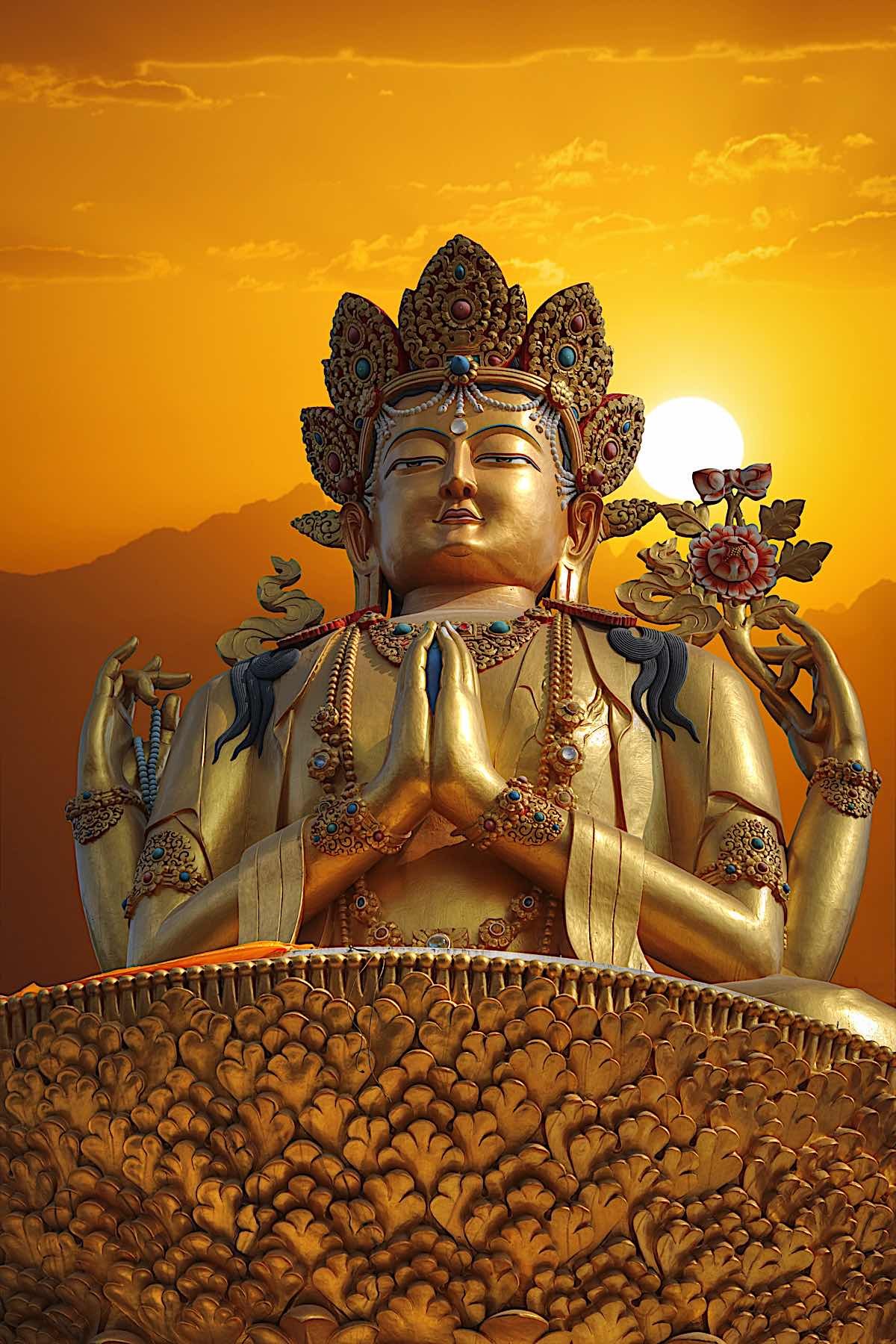
Avalokiteshvara Chenrezig, the Buddha of the Three Worlds; bringing love and compassion to the path:
The face of Loving Kindness?
No image, no face, no Buddha could be more inspiring than the image of the Lord of the Three Worlds, Avalokiteshvara (Chenrezig, Guan Yin, Kuan Shi Yin, Kanon). His “lotus” face conveys the ideal of love and compassion, Metta and Karuna. He is both the Buddha of Metta and Karuna, and its ideal exemplar. Simply seeing his loving, compassionate face, or chanting his mantra, known as the “compassion mantra” or Lotus Mantra — Om Mani Padme Hum — is a complete practice.
Of the countless sutras in the Mahayana canon, none is more important or moving than the Heart Sutra — the words of the Compassionate One Avalokiteshvara — and the core of the Prajna Paramita Sutras, the “Heart of the Perfection of Wisdom.” His words can be reduced to “Form is Emptiness, Emptiness is Form” — a profound soundbite that can take a lifetime of study to comprehend. [For the full Heart Sutra, see video chanting and text below.]
Mantra of Chenrezig, chanted by Yoko Dharma (no permission or lung required):
These are words and wisdom taught by the Compassionate One, Avalokiteshvara, endorsed by Shakyamuni Buddha. Aside from Shakyamuni Himself, Avalokiteshvara appears in more sutras than any other Bodhisattva or Buddha, including an entire chapter of the massive Lotus Sutra, The Prajnaparamita Sutras, Maha Karuna Dharani Sutra and many others:
- Chapter 25 of Lotus Sutra Delivering Us From Every Danger (full chapter in English)>>
- Great Compassion Dharani Sutra (in English)
- The Heart of the Perfection of Wisdom Sutra (in English)
- Choral chanted version of the Heart Sutra>>

What did Chenrezig mean when he spoke these sizzling, concise and profound words? In essence, the doctrine of Two Truths, that ultimately all phenomena are Sunyata (Emptiness), empty of unchanging essence. What does Emptiness have to do with Compassion? They are co-equal, as explained by Venerable Khenpo Rinpoche:
“These two natures, the absolute and the relative, are not opposites; they always arise together. They have the same nature; they are inseparable like a fire and its heat or the sun and its light. Compassion and emptiness are not like two sides of a coin. Emptiness and compassion are not two separate elements joined together; they are always coexistent.”

All Yidams Chenrezig?
In Tibetan Buddhism, there is a saying, “all male Yidams are Chenrezig.” In the context of the Heart Sutra, or of ultimate reality or Shunyata (Emptiness), this is certainly a core truth. The compassion of Avalokiteshvara manifests in many forms, as a skillful means. Yet, whether the manifestation is “angry” compassion — such as Hayagriva, or a motherly compassion — such as Guanyin — all are faces of compassion; all are Chenrezig. When we prostrate to any of these manifestations, we are bowing, ultimately, to compassion and loving-kindness.
In all Buddhist traditions — from the Elder Path (Theravada) to Mahayana and Vajrayana — we typically prostrate to a statue or image of a Buddha on our altar. This is not superstition or blind devotion. We are practicing the remedy for Pride, one of the great obstacles in our path. We bow to what that image represents. We don’t literally believe the statue is alive. We are inspired by the serenity, compassion, love and peace of that image. We connect with the symbolism of the image, engaging the visual power of our minds.
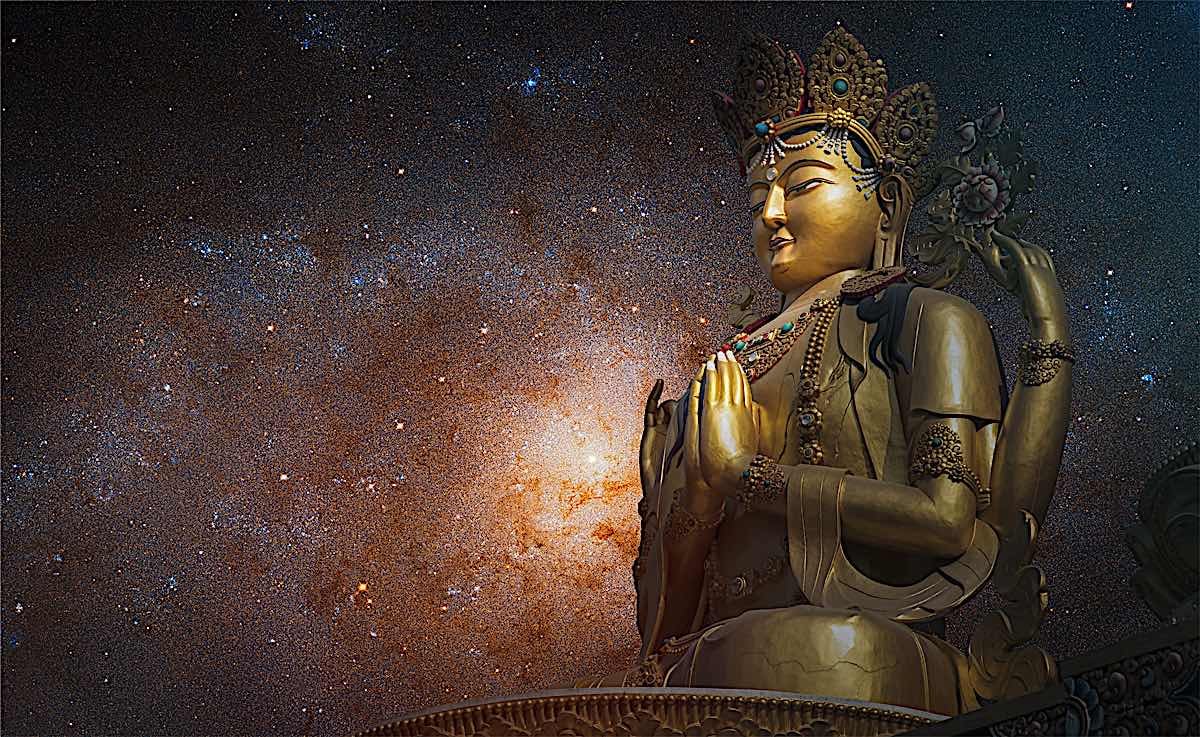
Connecting Mind with Symbol
In Theravada, the statue is likely to be Shakyamuni Buddha seated in meditation. Teacher Bhante Heepola Gunarantan explains,
“When we treat our shrine area as a sanctuary where the Triple Gem — the Buddha, Dhamma and Sangha — reside, we are reminded of our reverence for them… Remember that the Buddha image is not alive, but only represents the Buddha’s perfected qualities of serenity, composure, peacefulness, and purity.” [1]

In Mahayana — the big bus vehicle of Buddhism that embraces the Bodhisattva ideal — the image on the altar plays a similar role, although perhaps with many faces, depending on the student’s practice. Mahayana might be represented by the Eight Great Bodhisattvas who symbolize the Eight Great Qualities of a Buddha:
- wisdom,
- compassion,
- power,
- activity,
- merit,
- qualities,
- blessings
- and aspirations.
- For more on the Eight Bodhisattvas, see>>
If our focus was Compassion (Karuna) and Loving Kindness (Metta) our altar would likely feature the kind face and image of Avalokiteshvara — also known as Guanyin (Kuan shi yin) or Chenrezig in Tibetan Buddhism.
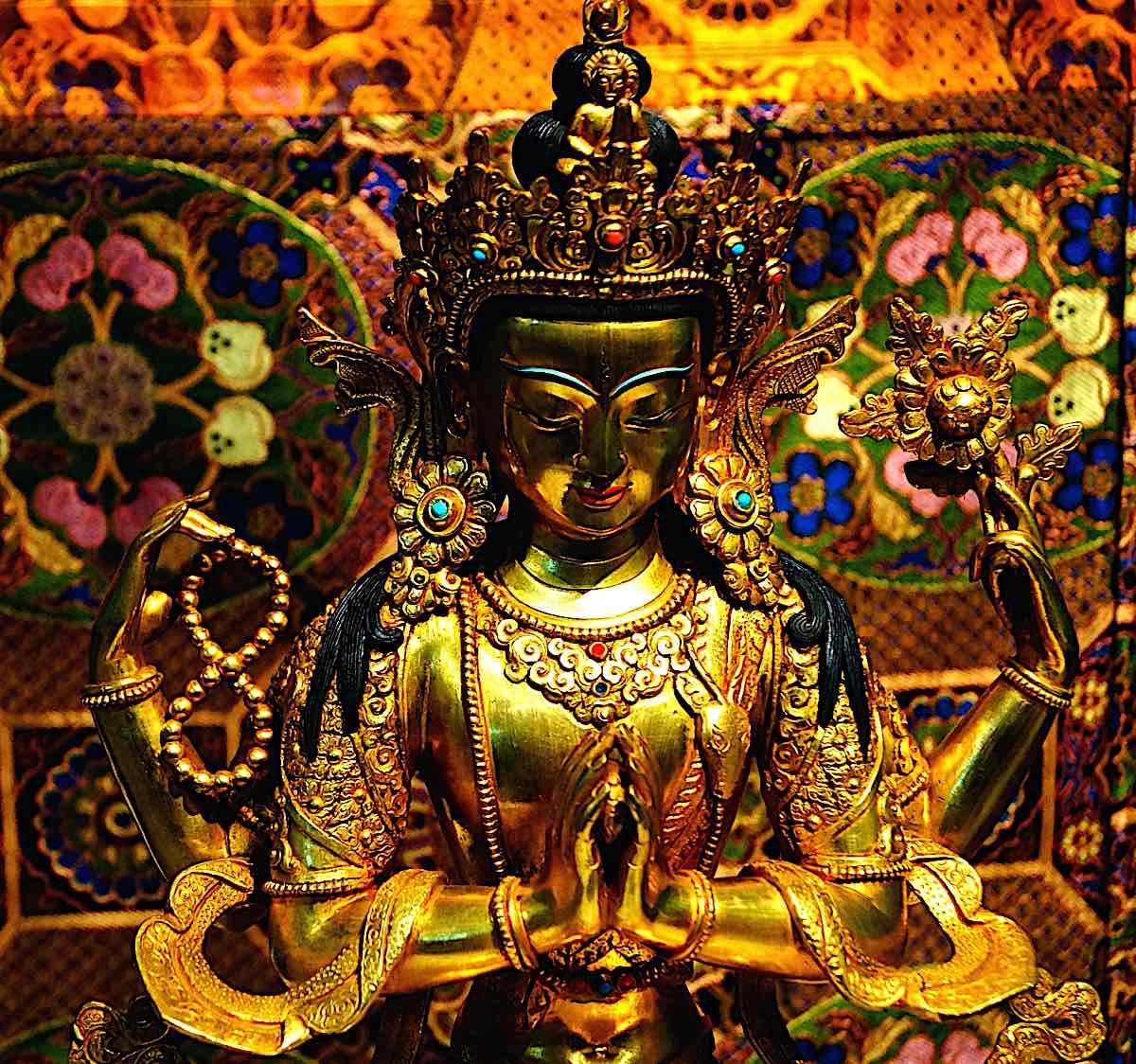
Gate Gate Paragate Paramsamghate Bodhi Soha
The Prajnaparamita Mantra taught by Avalokiteshvara and endorsed by Shakyamuni Buddha in the Heart Sutra, here chanted by Yoko Dharma:
Om Gate Gate Paragate Para Samgate Bodhi Soha
Chanted daily, this mantra is an essence mantra in both Mahayana and Vajrayana — stills the mind, helps one focus on Wisdom and Emptiness, and generates good merit.
From Heart Sutra: “Therefore, the mantra of the perfection of wisdom, the mantra of great knowledge, the unsurpassed mantra, the mantra equal to the unequaled, the mantra that thoroughly pacifies all suffering, should be known as truth since it is not false.
The mantra of the perfection of wisdom is declared:
TADYATHA [OM] GATE GATE PARAGATE PARASAMGATE BODHI SVAHA
“Shariputra, the bodhisattva mahasattva should train in the profound perfection of wisdom like that.” Then the Bhagavan arose from that concentration and commended the bodhisattva mahasattva arya Avalokiteshvara saying: “Well said, well said, son of the lineage, it is like that. It is like that; one should practice the profound perfection of wisdom just as you have indicated; even the tathagatas rejoice.”
THE SUTRA OF THE HEART OF TRANSCENDENT KNOWLEDGE
Thus have I heard. Once the Blessed One was dwelling in Råjagriha at Vulture Peak mountain, together with a great gathering of the sangha of monks and a great gathering of the sangha of bodhisattvas. At that time the Blessed One entered the samådhi that expresses the dharma called “profound illumination,” and at the same time noble Avalokiteshvara, the bodhisattva mahåsattva, while practicing the profound prajñåpåramitå, saw in this way: he saw the five skandhas to be empty of nature.
Then, through the power of the Buddha, venerable Shåriputra said to noble Avalokiteshvara, the bodhisattva mahåsattva, “How should a son or daughter of noble family train, who wishes to practice the profound prajñåpåramitå?”
Addressed in this way, noble Avalokiteshvara, the bodhisattva mahåsattva, said to venerable Shåriputra, “O Shåriputra, a son or daughter of noble family who wishes to practice the profound prajñåpåramitå should see in this way: seeing the five skandhas to be empty of nature. Form is emptiness; emptiness also is form. Emptiness is no other than form; form is no other than emptiness. In the same way, feeling, perception, formation, and consciousness are emptiness. Thus, Shåriputra, all dharmas are emptiness. There are no characteristics.
There is no birth and no cessation. There is no impurity and no purity. There is no decrease and no increase. Therefore, Shåriputra, in emptiness, there is no form, no feeling, no perception, no formation, no consciousness; no eye, no ear, no nose, no tongue, no body, no mind; no appearance, no sound, no smell, no taste, no touch, no dharmas; noeye dhåtu up to no mind dhåtu, no dhåtu of dharmas, no mind consciousness dhåtu; no ignorance, no end of ignorance up to no old age and death, no end of old age and death; no suffering, no origin of suffering, no cessation of suffering, no path, no wisdom, no attainment, and no nonattainment.
Therefore, Shåriputra, since the bodhisattvas have no attainment, they abide by means of prajñåpåramitå. Since there is no obscuration of mind, there is no fear. They transcend falsity and attain complete nirvåna. All the buddhas of the three times, by means of prajñåpåramitå, fully awaken to unsurpassable, true, complete enlightenment.
Therefore, the great mantra of prajñåpåramitå, the mantra of great insight, the unsurpassed mantra, the unequaled mantra, the mantra that calms all suffering, should be known as truth, since there is no deception. The prajñåpåramitå mantra is said in this way:
OM GATE GATE PÅRAGATE PÅRASAMGATE BODHI SVÅHÅ
Thus, Shåriputra, the bodhisattva mahåsattva should train in the profound prajñå-påramitå.”
Then the Blessed One arose from that samådhi and praised noble Avalokiteshvara, the bodhisattva mahåsattva, saying, “Good, good, O son of noble family; thus it is, O son of noble family, thus it is. One should practice the profound prajñåpåramitå just as you have taught and all the tathågatas will rejoice.”
When the Blessed One had said this, venerable Shåriputra and noble Avalokiteshvara, the bodhisattva mahåsattva, that whole assembly and the world with its gods, humans, asuras, and gandharvas rejoiced and praised the words of the Blessed One.
NOTES
[1] Buddhist Suttas for Recitation: A Companion for Walking the Buddha’s Path, Bhante Heepola Gunarantan, Wisdom books.
More articles by this author
Seven Mantras of the Seven Successive Buddhas: Removes All Obstacles, Negative Karma, Illness, Posession with FULL SUTRA and Mantra Commentary

The Noble Dhāraṇī of the Six Gates: Background, Dharani in Sanskrit, Translation and Full Sutra with Benefits

Special Merit Opportunity: Avalokiteshvara Guanyin’s “Money Borrowing Day” — Need a Loan on your “merit”? March 14, 2026 is the Day
Search
Latest Features
Please support the "Spread the Dharma" mission as one of our heroic Dharma Supporting Members, or with a one-time donation.
Please Help Support the “Spread the Dharma” Mission!
Be a part of the noble mission as a supporting member or a patron, or a volunteer contributor of content.
The power of Dharma to help sentient beings, in part, lies in ensuring access to Buddha’s precious Dharma — the mission of Buddha Weekly. We can’t do it without you!
A non-profit association since 2007, Buddha Weekly published many feature articles, videos, and, podcasts. Please consider supporting the mission to preserve and “Spread the Dharma." Your support as either a patron or a supporting member helps defray the high costs of producing quality Dharma content. Thank you! Learn more here, or become one of our super karma heroes on Patreon.
Lee Kane
Author | Buddha Weekly
Lee Kane is the editor of Buddha Weekly, since 2007. His main focuses as a writer are mindfulness techniques, meditation, Dharma and Sutra commentaries, Buddhist practices, international perspectives and traditions, Vajrayana, Mahayana, Zen. He also covers various events.
Lee also contributes as a writer to various other online magazines and blogs.