

Alavaka Sutta Protection Paritta: Chant away fear, hostility & negative forces — in 20 minutes.
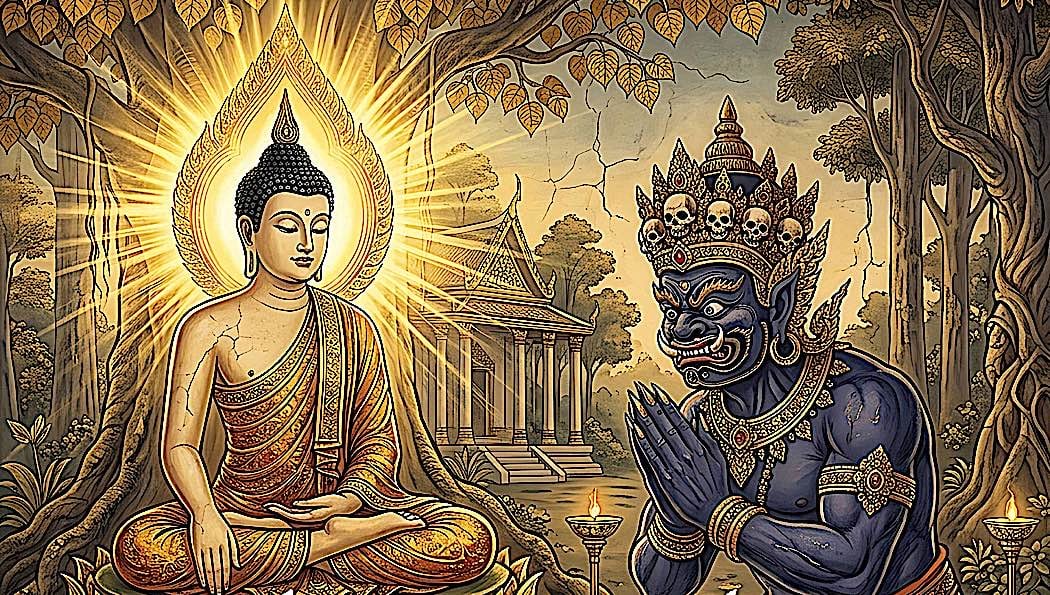
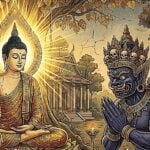
by 3 Gems Band. IN THIS Image: Alavaka, after offering violence to the Buddha is overcome by Buddha’s shining wisdom and becomes his sworn protector and lay follower.
🎵 NEW RELEASE: Āḷavaka Sutta Paritta — Our 20-Minute Sutta Opera 🎵
(Releases October 29 on Music Streaming Platforms such as Spotify, Apple, Youtube and many others.)
Friends, we’re thrilled to share our most ambitious chant yet: the Discourse to Āḷavaka the Demon, a full dramatic sutta opera in the traditional Paritta tradition. (FULL LYRICS 🎵 with ENGLISH below!)
MOST PROTECTIVE OF PARITTAS
This is the famous daily chant for protection and overcoming fear — the story of the Buddha’s fearless encounter with the fearsome forest spirit Āḷavaka, who torments him with repeated demands, threatens to drive him insane and explode his heart… and is ultimately transformed through non-violence and wisdom, not force.
“Hatred is not overcome by hatred; by non-hatred is it overcome.”
✨ In this 20-minute sutta opera you’ll hear:
- The complete essence of the Āḷavaka Sutta (lightly condensed for length) (NOTE: for the full translated Sutta for study, see the full Sutta after the lyrics.)
- Pali chanting with English translation throughout
- The full dramatic arc: the challenge → the threat → the Buddha’s fearlessness → the three questions on wealth, wisdom & the good life → Āḷavaka’s conversion & refuge
🛡️ Traditionally chanted for:
• Protection from harm
• Overcoming fear
• Healing
• Conflict resolution
• Removing hauntings
• Transforming bullies into protectors
“Hatred is not overcome by hatred; by non-hatred is it overcome.” (translation from Sutta)
Āḷavaka (or Ālavaka) is Pāli meaning “forest-dweller” (or āḷavī), which means forest or wilderness. In the story, Buddha shelters in a deserted house in the forest, and is confronted by this forest dweller, a Yakkha (Yaksha in Sanskrit, a natural or wild land god or demon), who is a fearsome cannibal who had been tormenting the local people. Through “non-violence”
Remedy
In the traditional Paritta chanting tradition, the Āḷavaka Sutta is often chanted for:
- Protection from harm (yakkhas, spirits, negative forces)
- Overcoming fear (the Buddha’s fearlessness is the model)
- Healing (Āḷavaka was originally a flesh-eating demon who became a protector)
- Conflict resolution (hostility transformed through wisdom, not force)
- Removes Hauntings and Ghosts
- Protects from Tyrants and Invaders
- Removes Hostility
- Transforms Bullies into Helpful Protectors
✨ Song Title: Alavaka Sutta Protection Paritta
✨ Artists: 3Gems Band
✨ Record Label: Buddha Weekly Mantras
✨ Release date: October 29, 2026
✨ DistroKid UPC: 700200634851
Album Cover: (on Music Streaming)
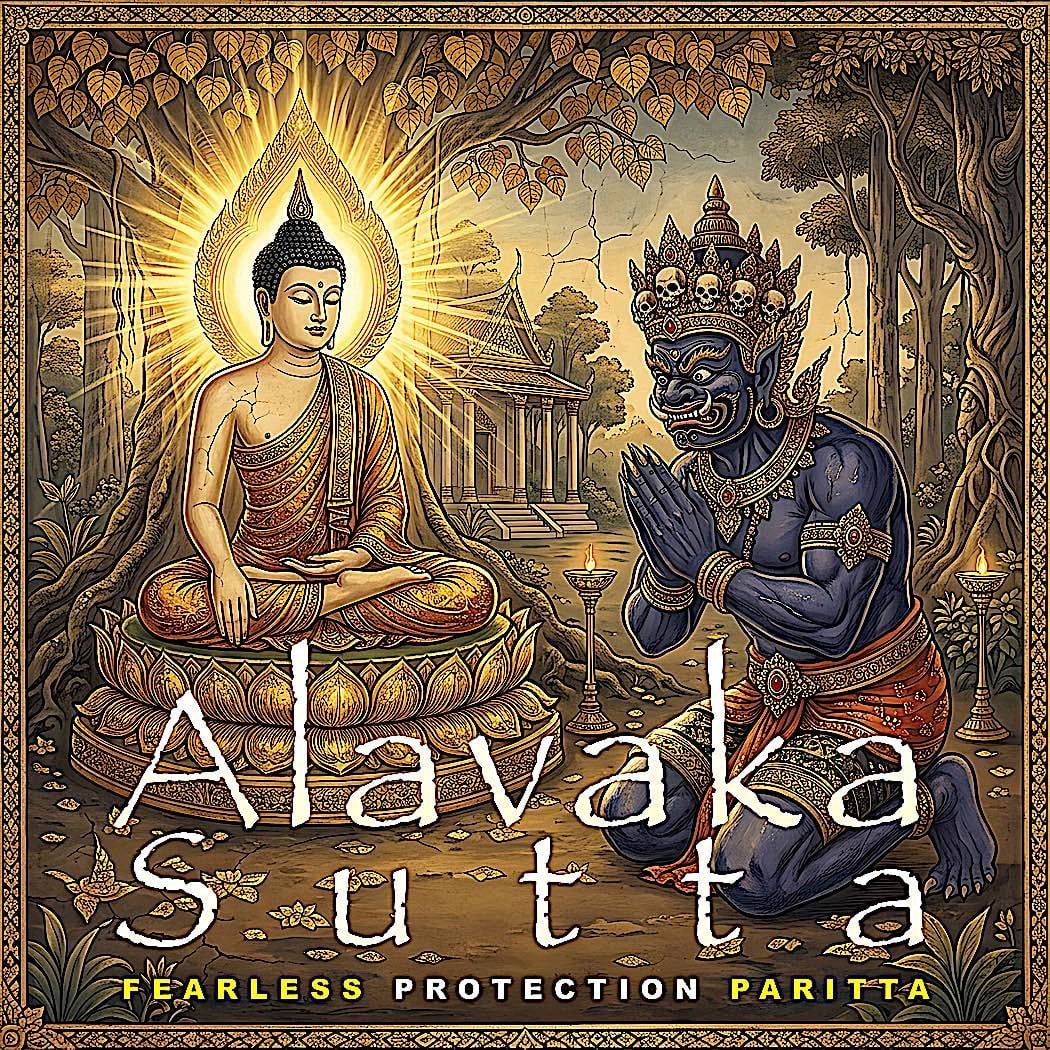
🎵 3Gems Band: Āḷavaka Sutta Paritta
Opening — Homage
Namo tassa bhagavato arahato sammā-sambuddhassa
Homage to the Blessed One, the Worthy One, the Rightly Self-Awakened One
Namo tassa bhagavato arahato sammā-sambuddhassa
Homage to the Blessed One, the Worthy One, the Rightly Self-Awakened One
Namo tassa bhagavato arahato sammā-sambuddhassa
Homage to the Blessed One, the Worthy One, the Rightly Self-Awakened One
Sutta Opening — The Setting
Evaṁ me sutaṁ.
Thus have I heard.
Ekaṁ samayaṁ Bhagavā Āḷaviyaṁ viharati,
On one occasion the Blessed One was staying near Āḷavī,
Āḷavakassa yakkhassa bhavane.
In the haunt of the native spirit Āḷavaka.
The Challenge (Āḷavaka)
Atha kho Āḷavako yakkho yena Bhagavā tenupasaṅkami,
Then the native spirit Āḷavaka went up to the Buddha,
Upasaṅkamitvā Bhagavantaṁ etadavoca:
And said to him:
“Nikkhama, samaṇā ti.”
“Get out, ascetic!”
“Sādhāvuso ti” Bhagavā nikkhami.
“All right, respectable sir,” the Buddha went out.
“Pavisa, samaṇā ti.”
“Get in, ascetic!”
“Sādhāvuso ti” Bhagavā pāvisi.
“All right, respectable sir,” the Buddha went in.
The Repeated Demand (2nd & 3rd Times)
Dutiyampi kho Āḷavako yakkho Bhagavantaṁ etadavoca:
And for a second time Āḷavaka said to the Buddha:
“Nikkhama, samaṇā ti”… Pavisa, samaṇā ti”…
“Get out, ascetic!”… “Get in, ascetic!”…
Tatiyampi kho Āḷavako yakkho Bhagavantaṁ etadavoca:
And for a third time Āḷavaka said to the Buddha:
“Nikkhama, samaṇā ti”… “Pavisa, samaṇā ti”…
“Get out, ascetic!”… “Get in, ascetic!”…
The Fourth Demand & Refusal (Āḷavaka / Buddha)
Catutthampi kho Āḷavako yakkho Bhagavantaṁ etadavoca:
And for a fourth time Āḷavaka said to the Buddha:
“Nikkhama, samaṇā”ti.
“Get out, ascetic!”
“Na khvāhaṁ taṁ, āvuso, nikkhamissāmi.
“No, respectable sir, I won’t get out.
Yaṁ te karaṇīyaṁ taṁ karohī ti.”
Do what you must.”
“Na khvāhaṁ taṁ, āvuso, nikkhamissāmi.
“No, respectable sir, I won’t get out.
Yaṁ te karaṇīyaṁ taṁ karohī ti.”
Do what you must.”
The Threat (Āḷavaka)
“Pañhaṁ taṁ, samaṇa, pucchissāmi.
“I will ask you a question, ascetic.
Sace me na byākarissasi,
If you don’t answer me,
Cittaṁ vā te khipissāmi,
I’ll drive you insane,
Hadayaṁ vā te phālessāmi,
Or explode your heart,
Pādesu vā gahetvā pāragaṅgāya khipissāmī ti.”
Or grab you by the feet and throw you to the far shore of the Ganges!”
Chorus
“Na khvāhaṁ taṁ, āvuso
Na khvāhaṁ taṁ, āvuso
Na khvāhaṁ taṁ, āvuso
Na khvāhaṁ taṁ, āvuso”
The Buddha’s Fearless Response
“Na khvāhaṁ taṁ, āvuso
passāmi sadevake loke,
“I don’t see anyone in this world with its gods,
Samārake sabrahmake,
With Māras and divinities,
Sassamaṇa brāhmaṇiyā pajāya sadevamanussāya,
This population with its ascetics and brahmins, its gods and humans
Yo me cittaṁ vā khipeyya,
Who could drive me insane,
Hadayaṁ vā phāleyya,
Or explode my heart,
Pādesu vā gahetvā pāragaṅgāya khipeyya.
Or grab me by the feet and throw me to the far shore of the Ganges.
Api ca tvaṁ, āvuso, puccha yadā kaṅkhasī ti.
But anyway, ask what you wish.”
Chorus
Na khvāhaṁ taṁ, āvuso
passāmi sadevake loke,
“I don’t see anyone in this world with its gods
Na khvāhaṁ taṁ, āvuso
passāmi sadevake loke,
“I don’t see anyone in this world with its gods
The First Question (Āḷavaka)
“Kiṁsūdha vittaṁ purisassa seṭṭhaṁ,
“What’s a person’s best wealth?
Kiṁsu suciṇṇaṁ sukhamāvahāti;
What brings happiness when practiced well?
Kiṁsu have sādutaraṁ rasānaṁ,
What’s the sweetest taste of all?
Kathaṁjīviṁ jīvitamāhu seṭṭhan ti.”
The one they say has the best life: how do they live?”
Repeats
”Kiṁsūdha vittaṁ purisassa seṭṭhaṁ,
“What’s a person’s best wealth?
Kiṁsu suciṇṇaṁ sukhamāvahāti;
What brings happiness when practiced well?
Kiṁsu have sādutaraṁ rasānaṁ,
What’s the sweetest taste of all?
Kathaṁjīviṁ jīvitamāhu seṭṭhan ti.”
The one they say has the best life: how do they live?”
The Buddha’s First Answer
“Saddhīdha vittaṁ purisassa seṭṭhaṁ,
“Faith here is a person’s best wealth.
Dhammo suciṇṇo sukhamāvahāti;
The teaching brings happiness when practiced well.
Saccaṁ have sādutaraṁ rasānaṁ,
Truth is the sweetest taste of all.
Paññājīviṁ jīvitamāhu seṭṭhan ti.
The one they say has the best life lives by wisdom.”
The Second Question (Āḷavaka)
“Kathaṁ su tarati oghaṁ,
“How does one cross the flood?
Kathaṁ su tarati aṇṇavaṁ;
How does one cross the ocean?
Kathaṁ su dukkhamacceti,
How does one overcome suffering?
Kathaṁ su parisujjhati.”
How is one fully purified?”
The Buddha’s Second Answer
“Saddhāya tarati oghaṁ,
“By faith one crosses the flood.
Appamādena aṇṇavaṁ;
By heedfulness the ocean.
Vīriyena dukkhamacceti,
By energy one overcomes suffering.
Paññāya parisujjhati.”
By wisdom one is fully purified.”
The Third Question (Āḷavaka)
“Kathaṁ su labhate paññaṁ,
“How does one gain wisdom?
Kathaṁ su vindate dhanaṁ;
How does one find wealth?
Kathaṁ su kittiṁ pappoti,
How does one attain fame?
Kathaṁ mittāni ganthati;
How does one bind friends?
Asmā lokā paraṁ lokaṁ,
From this world to the next,
Kathaṁ pecca na socati.”
How does one not grieve after death?”
The Buddha’s Third Answer
“Saddahāno arahataṁ,
“Having faith in the worthy ones,
Dhammaṁ nibbānapattiyā;
The Dhamma for attaining Nibbāna,
Sussūsā labhate paññaṁ,
Through attentive listening one gains wisdom,
Appamatto vicakkhano.
Heedful and clear-seeing.
Patirūpakārī dhuravā,
Doing what is fitting, bearing the burden,
Uṭṭhātā vindate dhanaṁ;
Striving, one finds wealth;
Saccena kittiṁ pappoti,
By truth one attains fame;
Dadam mittāni ganthati.
By giving one binds friends.
Yassete caturo dhammā,
Whoever has these four qualities,
Saddhassa gharamesino;
For the faithful householder —
Saccaṁ damo dhiti cāgo,
Truth, self-control, steadfastness, generosity —
Sa ve pecca na socati.”
He indeed does not grieve after death.”
Āḷavaka’s Invitation to Question Others
“Kathaṁ nu dāni puccheyyaṁ,
“Why should I now question
Puthu samaṇabrāhmaṇe;
The many ascetics and brahmins?
So’haṁ ajja pajānāmi,
I today understand
Yo attho samparāyiko.”
What benefit pertains to the next life.”
The Buddha’s Closing Challenge
“Sace pi te, Āḷavaka, evaṁ hoti:
“If you think, Āḷavaka:
‘Ahaṁ evaṁ jānāmi, ahaṁ evaṁ passāmi,’
‘I know this, I see this,’
Tena te, Āḷavaka, aññe pi samaṇabrāhmaṇe puccha.
Then, Āḷavaka, ask other ascetics and brahmins too.
Ye te saccaṁ damaṁ cāgaṁ khantiṁ,
Whether there is found anything better
Ativattanti, atirocanti, atisayanti.”
Than truth, self-control, generosity, and patience.”
Āḷavaka’s Final Declaration
“Kiṁ nu dāni puccheyyaṁ puthu samaṇabrāhmaṇe;
“Why should I now question the many ascetics and brahmins?
So’haṁ ajja pajānāmi, yo attho samparāyiko.
I today understand what benefit pertains to the next life.
Sā hi me Bhagavā Āḷaviyaṁ vihāsi,
For the Blessed One stayed at Āḷavī for my benefit.
Dānaṁ datvā puññaṁ pasavati.”
Giving gifts produces merit.”
The Refuge & Conversion
“Abhikkantaṁ, bhante! Abhikkantaṁ, bhante!
“Excellent, venerable sir! Excellent, venerable sir!
Seyyathāpi, bhante, nikkujjitaṁ vā ukkujjeyya,
Just as if one were to set upright what was overturned,
Paṭicchannaṁ vā vivareyya,
Or reveal what was concealed,
Mūḷhassa vā maggaṁ ācikkheyya,
Or point out the way to one gone astray,
Andhakāre vā telapajjotaṁ dhāreyya:
Or bring an oil lamp into the darkness:
‘Cakkhumanto rūpāni dakkhantī’ti;
‘Those with eyes will see forms.’
Evamevaṁ Bhagavatā anekapariyāyena dhammo pakāsito.
Even so the Dhamma has been declared in many ways by the Blessed One.
Esāhaṁ, bhante, Bhagavantaṁ saraṇaṁ gacchāmi,
I go for refuge to the Blessed One,
Dhammañca, Bhikkhusaṅghañca.
To the Dhamma, and to the Saṅgha of monks.
Upāsakaṁ maṁ, bhante, dhāretu ajjatagge pāṇupetaṁ saraṇaṁ gataṁ.”
May the Blessed One remember me as a lay follower who has gone for refuge from this day forward for as long as life lasts.”
Dedication of Merit
Idaṁ me puññaṁ āsavakkhayāvahaṁ hotu.
May this merit of mine lead to the destruction of the taints.
Idaṁ me puññaṁ nibbānassa paccayo hotu.
May this merit of mine be a condition for Nibbāna.
Idaṁ me puññaṁ āsavakkhayāvahaṁ hotu.
May this merit of mine lead to the destruction of the taints.
Idaṁ me puññaṁ nibbānassa paccayo hotu.
May this merit of mine be a condition for Nibbāna.
Sādhu! Sādhu! Sādhu!
Excellent! Excellent! Excellent!
Etena saccena suvatthi hotu!
By this truth, may there be well-being!
Etena saccena suvatthi hotu!
By this truth, may there be well-being!
Etena saccena suvatthi hotu!
By this truth, may there be well-being!
English Translation of the Sutta SN 10.12 Alavakasutta
So I have heard. At one time the Buddha was staying near Āḷavī in the haunt of the native spirit Āḷavaka. Another spirit of place, Āḷavaka’s story (also at Snp 1.10) is perhaps the most beloved of all the yakkha conversions. He is provided with an extensive backstory in the Pali commentaries, and another quite different story in a Chinese Dharmapada (T 211, pp. 575–609). | Āḷavī was a town between Sāvatthī and Rājagaha.
Then the native spirit Āḷavaka went up to the Buddha, and said to him: “Get out, ascetic!”
Saying, “All right, respectable sir,” the Buddha went out.
“Get in, ascetic!”
Saying, “All right, respectable sir,” the Buddha went in.
And for a second time the native spirit Āḷavaka said to the Buddha, “Get out, ascetic!”
Saying, “All right, respectable sir,” the Buddha went out.
“Get in, ascetic!”
Saying, “All right, respectable sir,” the Buddha went in.
And for a third time the native spirit Āḷavaka said to the Buddha, “Get out, ascetic!”
Saying, “All right, respectable sir,” the Buddha went out.
“Get in, ascetic!”
Saying, “All right, respectable sir,” the Buddha went in.
And for a fourth time the native spirit Āḷavaka said to the Buddha,
“Get out, ascetic!”
“No, respectable sir, I won’t get out. Do what you must.”
“I will ask you a question, ascetic. If you don’t answer me, I’ll drive you insane, or explode your heart, or grab you by the feet and throw you to the far shore of the Ganges!”
“I don’t see anyone in this world with its gods, Māras, and divinities, this population with its ascetics and brahmins, its gods and humans who could do that to me. But anyway, ask what you wish.”
“What’s a person’s best wealth?What brings happiness when practiced well?What’s the sweetest taste of all?The one they say has the best life: how do they live?”
“Faith here is a person’s best wealth.The teaching brings happiness when practiced well.Truth is the sweetest taste of all.The one they say has the best life lives by wisdom.”
“How do you cross the flood?How do you cross the deluge?How do you get over suffering?How do you get purified?”
“By faith you cross the flood,and by diligence the deluge.By energy you get past suffering,and you’re purified by wisdom.”
“How do you get wisdom?How do you earn wealth?How do you get a good reputation?How do you hold on to friends?How do the departed not grievewhen passing from this world to the next?”
“One who is diligent and discerninggains wisdom by wanting to learn,having faith in the perfected ones,and the teaching for becoming extinguished.
Being responsible, acting appropriately,and working hard you earn wealth.Truthfulness wins you a good reputation.You hold on to friends by giving.That’s how the departed do not grievewhen passing from this world to the next.
A faithful householder of discernmentwho possesses these four qualities Following Cone’s Dictionary of Pali, Pali gharamesin probably stands for Sanskrit gṛhamedhin, an “householder of discernment”, a man of mature years who has completed his education.does not grieve after passing away:truth, principle, steadfastness, and generosity.
Go ahead, ask others as well,there are many ascetics and brahmins.See whether anything better is foundthan truth, principle, generosity, and patience.” Readings are uncertain. Chinese parallels at SA2 325 and SA 1326 support dama or danta here rather than dhamma. DN 30:1.6.2 has both, and elsewhere we find both dhamma and dama commonly used alongside sacca.
“Why now would I questionthe many ascetics and brahmins?Today I understandwhat’s good for lives to come.
It was truly for my benefitthat the Buddha came to stay at Āḷavī.Today I understandwhere a gift is very fruitful.
I myself will journeyvillage to village, town to town,paying homage to the Buddha,and the clear rightness of the teaching!” [1]
NOTES
More articles by this author
Search
Latest Features


Please support the "Spread the Dharma" mission as one of our heroic Dharma Supporting Members, or with a one-time donation.
Please Help Support the “Spread the Dharma” Mission!
Be a part of the noble mission as a supporting member or a patron, or a volunteer contributor of content.
The power of Dharma to help sentient beings, in part, lies in ensuring access to Buddha’s precious Dharma — the mission of Buddha Weekly. We can’t do it without you!
A non-profit association since 2007, Buddha Weekly published many feature articles, videos, and, podcasts. Please consider supporting the mission to preserve and “Spread the Dharma." Your support as either a patron or a supporting member helps defray the high costs of producing quality Dharma content. Thank you! Learn more here, or become one of our super karma heroes on Patreon.
Lee Kane
Author | Buddha Weekly
Lee Kane is the editor of Buddha Weekly, since 2007. His main focuses as a writer are mindfulness techniques, meditation, Dharma and Sutra commentaries, Buddhist practices, international perspectives and traditions, Vajrayana, Mahayana, Zen. He also covers various events.
Lee also contributes as a writer to various other online magazines and blogs.