



Five faces of wisdom: Mañjuśrī and the 5 prajñās transforming 5 demons and poisons
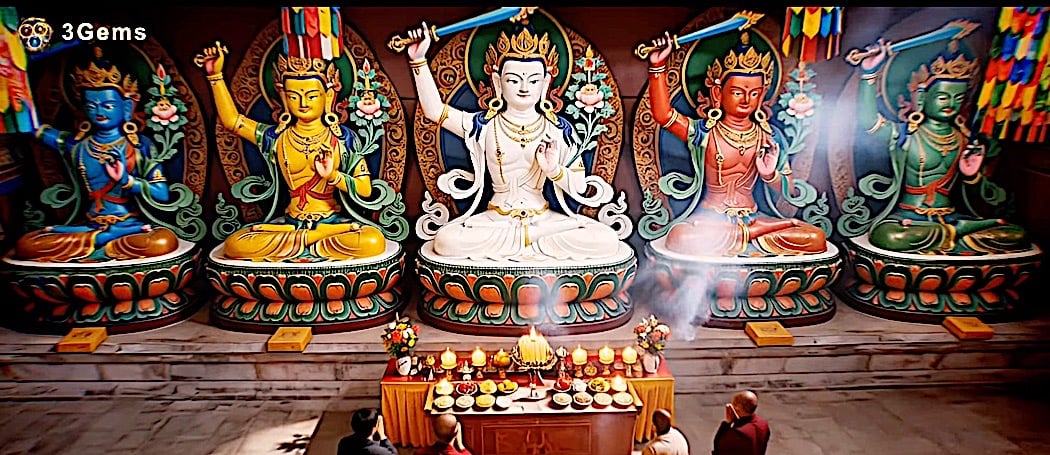
Why are there five Mañjuśrī Bodhisattvas? Why do they appear in five colors? What Wisdoms do they embody? What are their mantras and practices? Why does Mañjuśrī always carry a sword? What is the benefit of the 5 Mañjuśrī practice? Why do we think of the five Mañjuśrī mantras as five keys, which unlock the 5 secret wisdoms to help us overcome the five demons and poisons. We answer these questions and more in this short, but in-depth feature on the five faces of wisdom Mañjuśrī.
Five Manjusri Practice Chanted by @3GemsBand:
Benefits of Practice
The benefits of Mañjuśrī practice, generally, is wisdom overcoming the poisons of ignorance, attachment, envy, anger and greed. The benefits of the 5 Mañjuśrī practice are specifically focused on these 5 poisons, often characterized as the 5 Demons specifically:
- Hell Beings and Demons, or our anger and hate, are tamed by Arapachana Mañjuśrī of the Vajra Buddha family, blue in color.
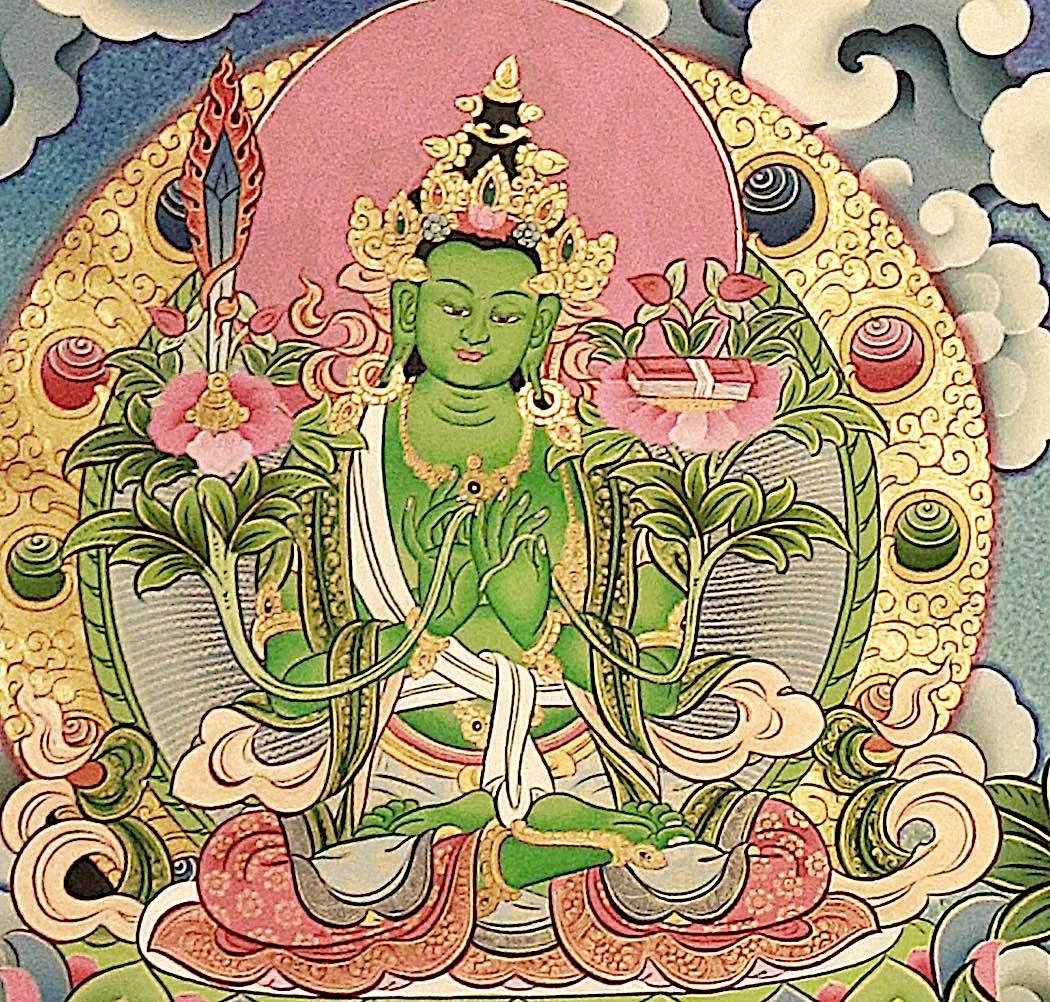
- Asuras, the flashiest and most towering of demons, or, from another perspective, our envy and jealousy, are suppressed by Jñānasattva Mañjuśri, who is the green Mañjuśri of the Karma Buddha Family.
- Human-form demons, those attractive demons with fangs so to speak, which is another way of saying our attachments, addictions, and lust, are overcome by the Sweet-Voiced One, Mañjughoṣa, who arises in the Padma family, red in color. Mañjughoṣa, from the Padma family, red in color.
-
Animal-form demons, the werewolf-like snarling ones often depicted with animal bodies or heads, who can also be thought of as our own ignorance, are tamed by Vāgiśvara Mañjuśri. He is known as the Lord of Reality, who is White in Color and from the Tat-hagata Family.
- Deity-class tempters are usually benevolent higher beings, but subject to the five poisons like all classes, are very ego-driven and selfish. This also refers to our ego, narcissism, and ultimately our greed. This ego-dominated group are transformed by the Wisdom of Equality of Venerable Vajratīkṣṇa Mañjuśrī of the Jewel Family.
Bodhisattva of Wisdom
The cure for all of these delusional states and demons is the wisdom of Bodhisattva Mañjuśrī. Wisdom transforms the poisons, and the demons.
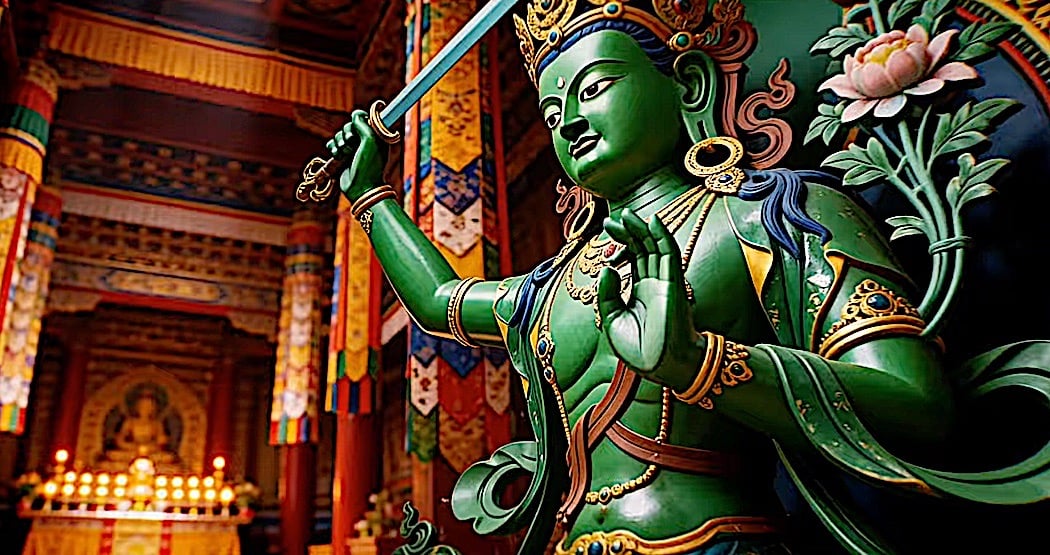
His wisdom is transcendent wisdom, or prajñā, is symbolized by his flaming sword. This sword, seen in all of his forms, symbolizes “cutting through ignorance” which is the main poison overcome by wisdom. It is our ignorance that leads us to misunderstand the true nature of reality and leads to the other four poisons of anger, greed, attachment and envy. Often the sword is a flaming sword, signifying the blazing light of Enlightened Mind, or a sword of meteoric iron, signifying it’s cosmic nature.
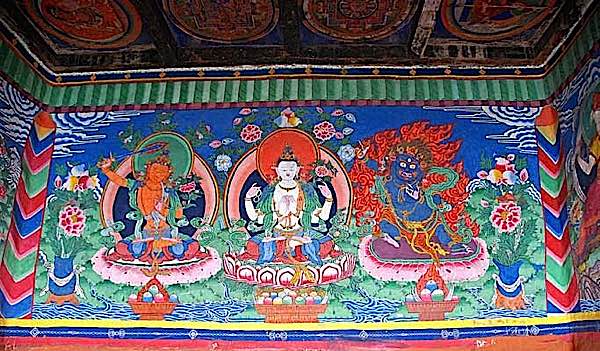
Three Great Bodhisattvas
Mañjuśrī is iconic in Mahayana and Vajrayana Buddhism. He is the Bodhisattva representing the Wisdom of all the Buddhas. Together with Avalokiteśvara representing the Compassion of all the Buddhas, and Vajrapani representing the Power of all the Buddhas, they are the Three Great Bodhisattvas.
Just as with the other Great Bodhisattvas, he also manifests in multiple faces and forms, most notably as the Five Mañjuśrī Bodhisattvas of the Five Buddha Families, but also 108 forms. To celebrate this, the great teacher Jamyang Khyentse Chökyi Lodrö’s transmitted a powerful practice, praise and mantras of the Five Families aspects of Mañjuśrī. @3GemsBand sings a beautiful and stirring version of this great practice in Sanskrit.
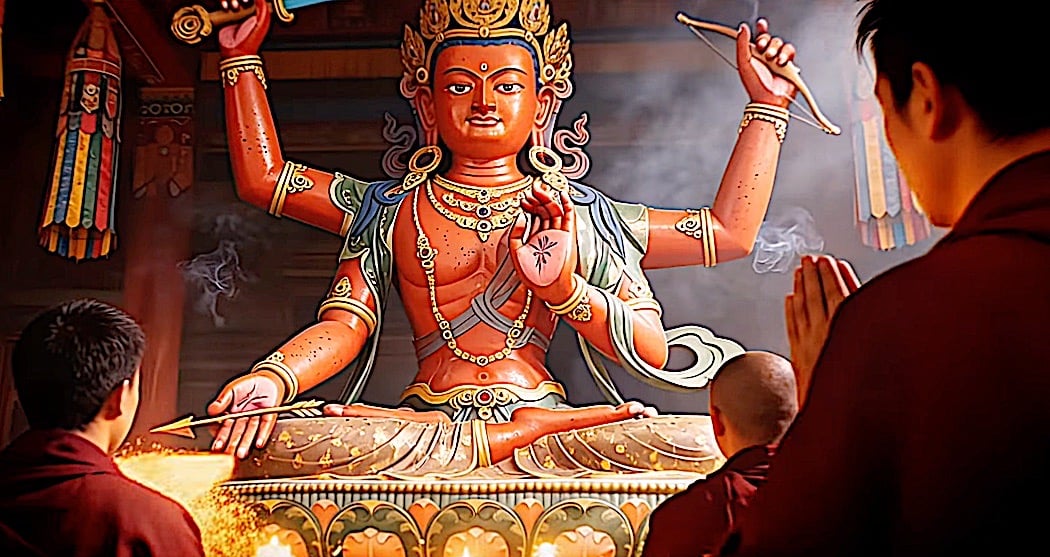
Jamyang Khyentse Chökyi Lodrö
In the Vajrayana tradition, particularly as elucidated by masters like Jamyang Khyentse Chökyi Lodrö, Mañjuśrī is understood to manifest in five principle forms, each perfectly aligned with one of the Five Buddha Families (or Five Tathāgatas). This also aligns with the five Wisdoms of the Buddha Families: all encompassing Dharamadutu Wisdom, Mirror-Like Wisdom, Wisdom of Equality, Discriminating Wisdom and the Wisdom of Activity called All-Accomplishing Wisdom.
For those familiar with the Five Buddha Families and their Five Wisdoms, the symbolism of the Five Manjushris will be similar. Why, then do we have 5 Bodhisattvas when we have 5 Buddhas? It is the Bodhisattvas who are active in our samsaric worlds. They have fully attained Enlightenment and the highest of Siddhis, but their oath is to help all sentient beings.
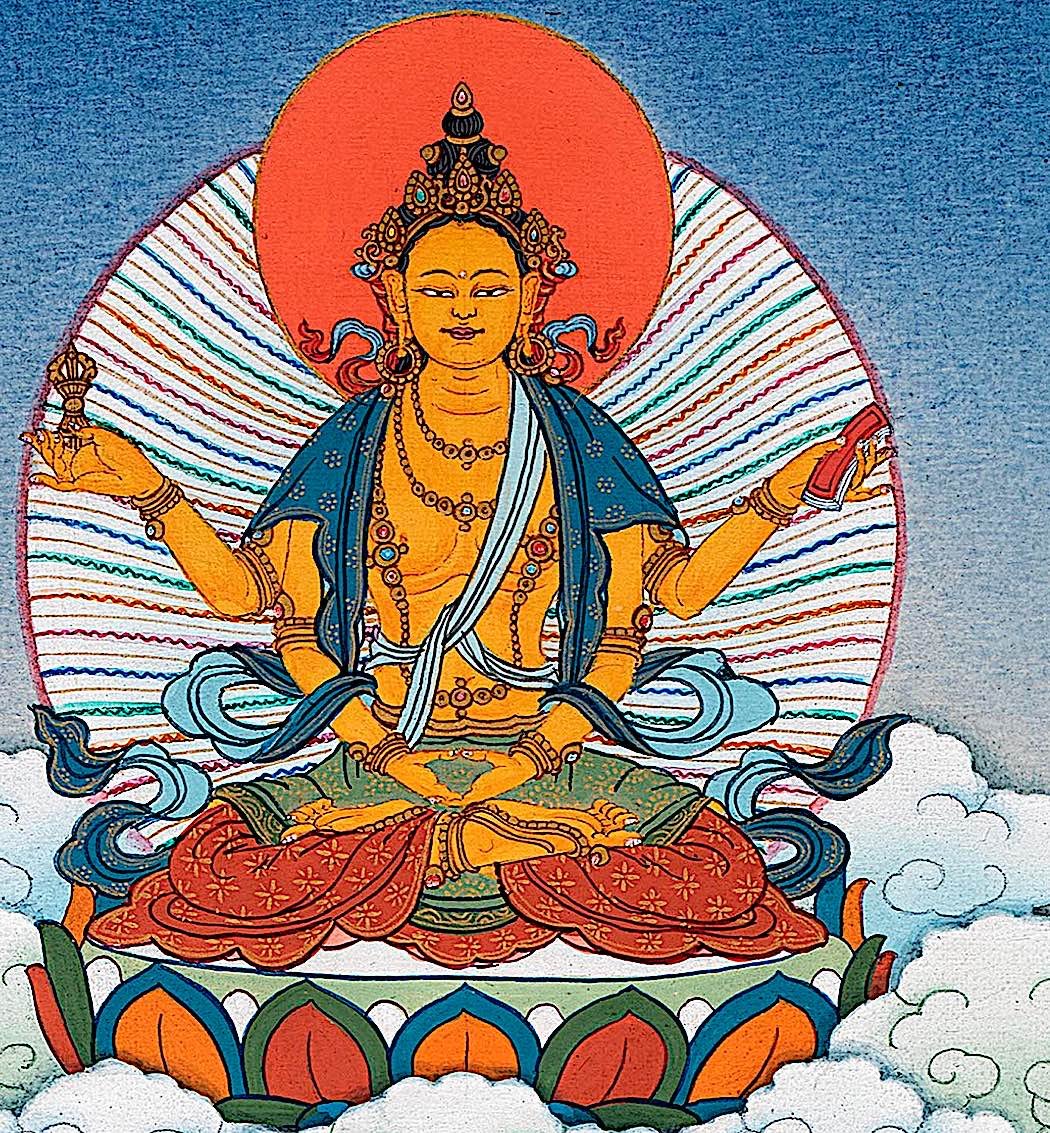
Manjusri’s Many Forms
To better relate to sentient beings suffering from so many delusions, Mañjuśrī has many forms. The simplest forms, which anyone can visualize are the Five Manjusri visualizations by color. The Mañjuśrī of the Tathagatha Buddha family of Vairocahana is white. The Mañjuśrīi of the Vajra family is dark blue or black. The Mañjuśrī of the Ratna or Jewel Family is Yellow. The Mañjuśrī of the Padma family is Red. And, the Manjusri of All Accomplishing Wisdom of the Karma family is Green. They all have his iconic wisdom sword and the Prajnaparamita Sutra.
Yes, there are different lineages with increasing levels of meditative symbolism. For example, in one lineage, the Karma family Manjushri is green, but the sword and sutra are both on lotuses over his two shoulders with stems in each hand. In another, he has four arms and is yellow – but there are specific reasons for this symbolism which you discover from your teacher.
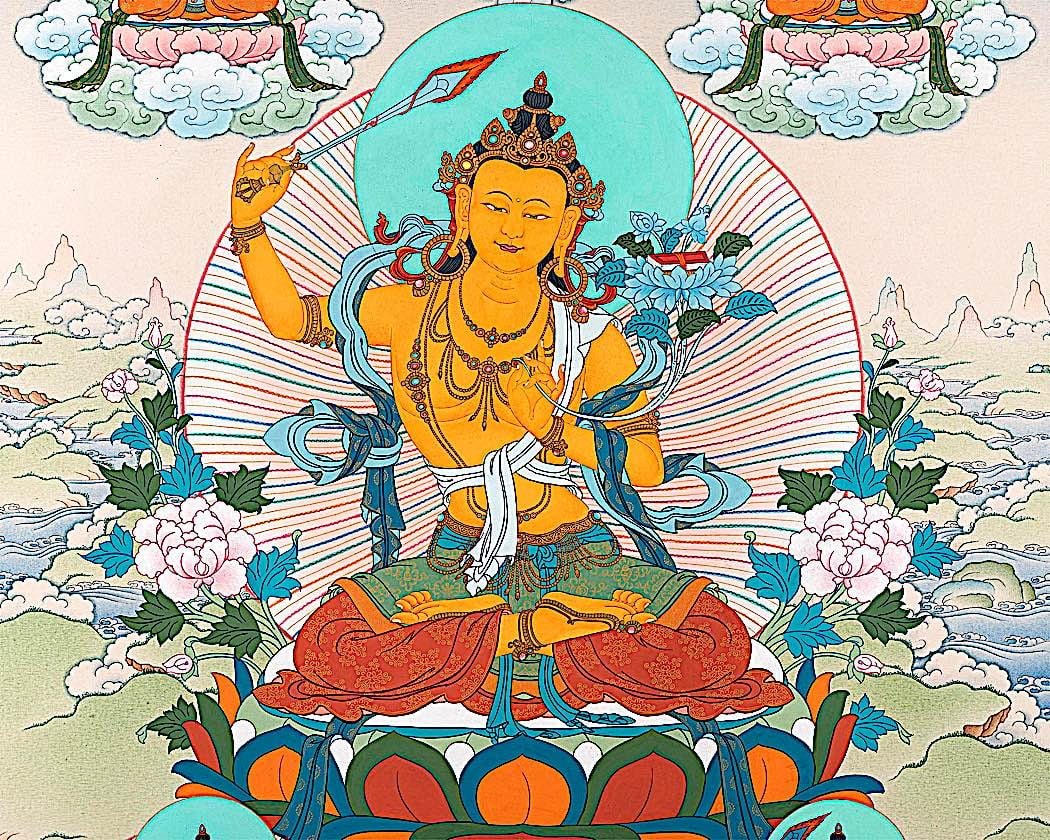
Likewise, the Mañjuśrī of the Padma or Lotus family, although always red, may also have four arms, one with a bow, another with an arrow, a third with a wisdom sword held aloft and a fourth with the Sutra. When just starting this practice, or until your teacher advises otherwise, usually stay with the easy visualization of the five colors with sword. For those without empowerment, you visualize the 5 Mañjuśrī mandala in front of you.
This system beautifully shows us how pure, ultimate wisdom, known as dharmakāya prajñā, refracts into different methods and qualities to counter the five primary mental poisons, called kleśas. These are often manifesting as our inner or outer demons.
The transformative method is to practice the corresponding five enlightened wisdoms, known as jñānas. For instance, Arapachana Manjusri’s wisdom is Mirror-Like Wisdom. With this reflective, contemplative wisdom, we can overcome our anger and hate.
Here, we’ll translate Jamyang Khyentse Chökyi Lodrö’s practice, so that if you listen or chant along or practice the Sanskrit version from @3GemsBand, or the Tibetan version, you’ll understand the meaning of the praise.
Think of each mantra as presented here, as “keys” to the door of wisdom. Imagine your anger, or hate or greed, or envy, or attachments as poisons or demons creating negative situations for you. Think of each mantra as the key that unlocks the door to the secrets that transform those demons and poisons into wisdom and accomplishments.
The Dharmakāya Essence: The Foundation of All Wisdom
Before exploring the five specific emanations, Jamyang Khyentse Chökyi Lodrö’s praise or practice begins with prostrating to the the fundamental, non-dual essence of Mañjuśrī—the wisdom dharmakāya itself.
1. General Invocation / Prajñā-Dharmakāya Mañjuśrī
| Buddha Family | Form of Mañjuśrī | Primary Wisdom |
|---|---|---|
| Dharmakaya (all) | Dharmakāya (ultimate nature) | All Wisdoms |
Mantra Key: oṃ vākyedaṃ namaḥ
The mantra oṃ vākyedaṃ namaḥ serves as a general homage to the very essence of enlightened speech and wisdom. The term vākyedaṃ means “this speech” or “this word,” invoking the Mañjuśrī who is the nature of reality. This is the ultimate, formless wisdom from which all the specific, colorful manifestations arise. It is the wisdom that pervades the entire dharmadhātu (sphere of reality).
The Sasnskrit praise (chanted above by 3GemsBand, from the practice by Jamyang Khyentse Chökyi Lodrö:
To the great body of all Buddhas,
The wisdom body, the sovereign,
To Mañjuśrī of immaculate form,
The vajra-granter of supreme boons, I bow.
The Five Families of Mañjuśrī
The subsequent five forms embody the transformation of the five poisons or demons into the five wisdoms, each anchored in a specific Buddha Family.
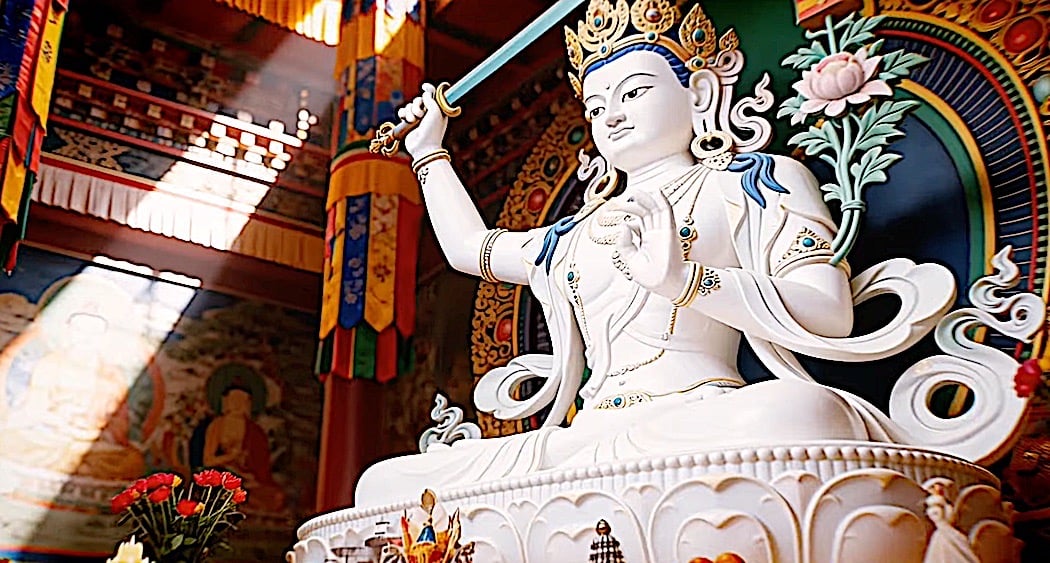
2. Vāgiśvara Mañjuśrī: Lord of Speech and Reality
| Buddha Family | Poison Purified | Transformed Wisdom | Mantra Key | Typical Color |
|---|---|---|---|---|
| Vairocana (Tathāgata Family) | Ignorance | Dharmadhātu Wisdom | vāgiśvara muṃ | Yellow/White |
Form: Vāgiśvara (Lord of Speech) Mañjuśrī
Praise in English:
With the lion’s roar of selflessness,
Striking fear in deer-like heretics,
The revealer of all meanings,
To the Lord of Speech, I bow.
Mantra Key: oṃ vāgiśvara muṃ
Appearance: White with sword and sutra, or can appear also with four faces and four arms and yellow.
In the Vairocana (Tathāgata/Buddha) Family, the poison of delusion or fundamental ignorance is purified into the all-encompassing Dharmadhātu Wisdom.
This wisdom recognizes the reality of all phenomena as uncreated and non-abiding. Vāgiśvara Mañjuśrī, often depicted with a white body – although he can also be represented as the main iconic yellow form), is the quintessential wisdom aspect of this family, representing the enlightened speech that teaches the truth of emptiness. The seed syllable muṃ is his specific hallmark, grounding his wisdom in reality.
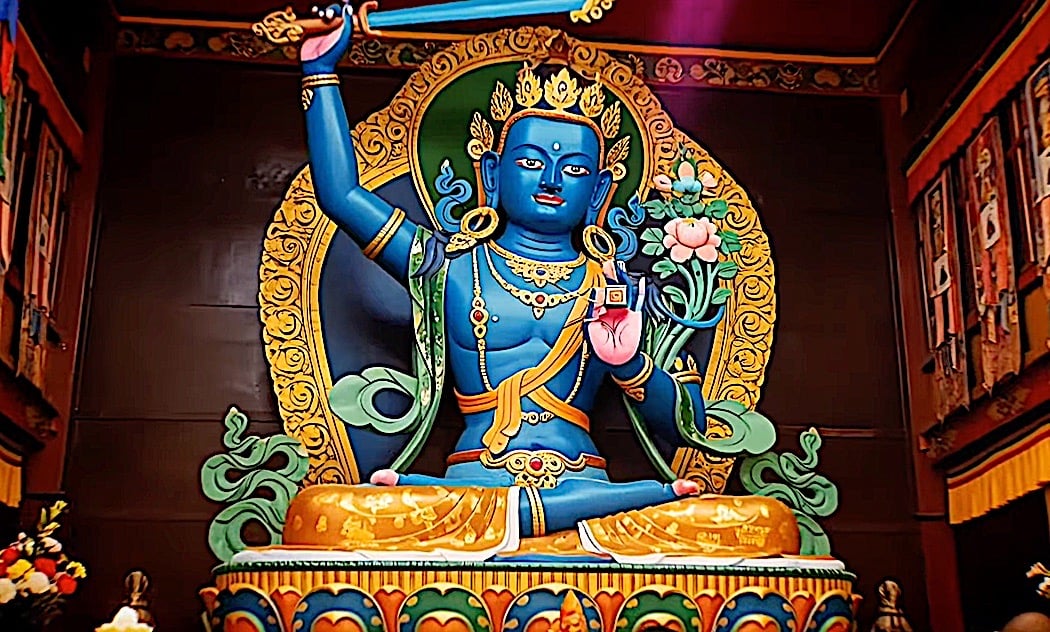
3. Arapacana Mañjuśrī: The Mirror-Like Wisdom, Cutter of Ignorance
| Buddha Family | Poison Purified | Transformed Wisdom | Mantra Key | Typical Color |
|---|---|---|---|---|
| Akṣobhya (Vajra Family) | Aggression/Anger/Hate | Mirror-Like Wisdom | arapacana dhīḥ | Blue |
Form: Arapacana Mañjuśrī
His praise in English is:
A lamp for the world, a torch of wisdom,
Of great splendor, the radiant one,
Completely freed from all conceptual thought,
to Manjusri, I bow.
Mantra Key: oṃ arapacana dhīḥ
Appearance: Blue, or in wrathful form black, or standard yellow form (all five can appear in this form)
In the Akṣobhya (Vajra) Family, the destructive power of anger and aggression is purified into the crystal-clear Mirror-Like Wisdom. This wisdom sees all phenomena exactly as they are, without distortion or projection, like a perfect mirror reflecting everything without judgment.
Arapacana is arguably the most famous form. His syllables A RA PA CA NA are celebrated as the essence of the perfection of wisdom, and his seed syllable dhīḥ is considered the very sound of wisdom itself. He is traditionally blue, symbolizing the immutable, diamond-like quality of this wisdom.
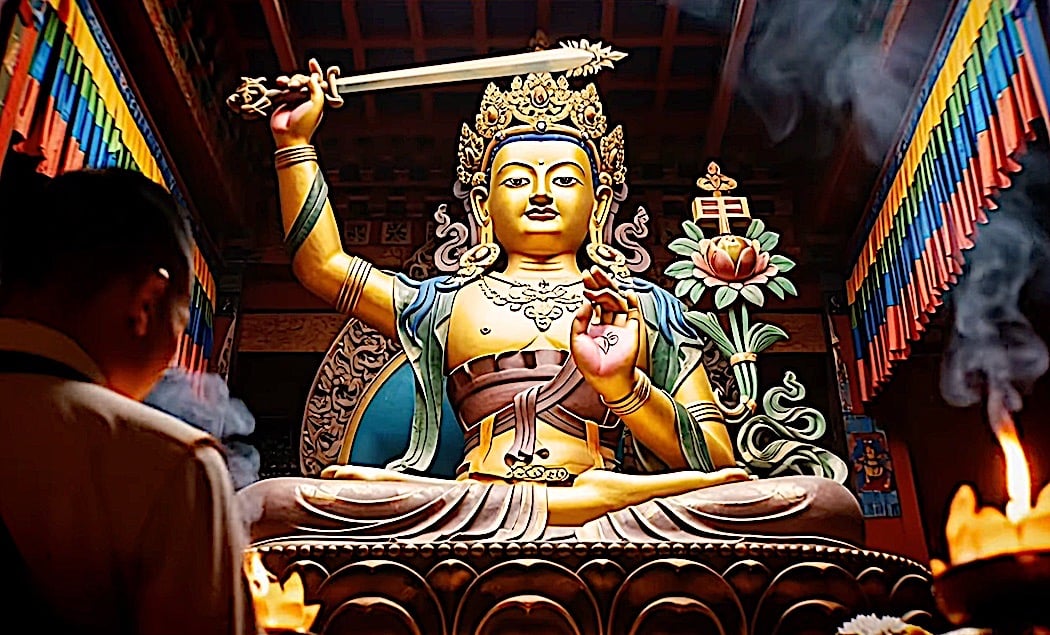
4. Vajratīkṣṇa Mañjuśrī: The Sharp Cutter of Suffering
| Buddha Family | Poison Purified | Transformed Wisdom | Mantra Key | Typical Color |
|---|---|---|---|---|
| Ratnasambhava (Ratna) | Pride/Miserliness | Wisdom of Equality | vajratīkṣṇa | Yellow/Gold |
Form: Vajratīkṣṇa (The Vajra-Sharp One) or Duḥkhachheda (Cutter of Suffering) Mañjuśrī
His praise in English is:
He whose mind severs the threefold doubt,
Whose nature is the three qualities,
Of the Buddha’s unsurpassed awakening,
To the One of Immeasurable Qualities, I bow.
Mantra Key: oṃ vajratīkṣṇa duḥkha chheda prajñā jñāna mūrtaye jñāna-kāya-vāgiśvara arapacanāyate namaḥ
Appearance: Yellow with sword and sutra, or can yellow but with the implements on lotus thrones over his shoulder, or yellow with four arms, but with a vajra in right hand instead of a sword, and sutra in opposite hand, and two lower hands in mudra.
The Ratnasambhava (Ratna/Jewel) Family is concerned with the transformation of spiritual or material pride and miserliness into the Wisdom of Equality. This wisdom recognizes the essential sameness of all beings and phenomena in their ultimate emptiness and potential for Buddhahood. Vajratīkṣṇa, often yellow/golden, embodies the cutting edge of this wisdom, severing the attachment to self-importance and the suffering born of inequality and scarcity. The long mantra describes him as the “embodiment of the vajra-sharp, suffering-cutting wisdom,” underscoring his role as the great provider of ultimate insight.
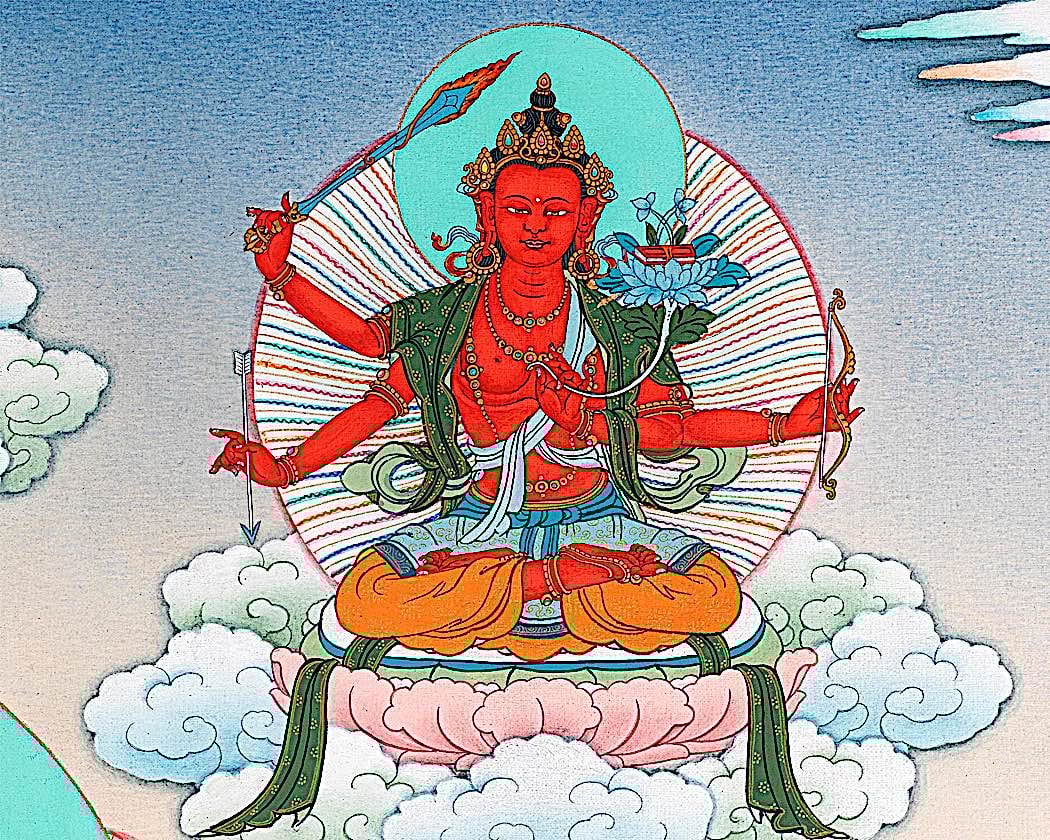
5. Mañjughoṣa / Prajñāvardhani: The Sweet Voice of Discernment
| Buddha Family | Poison Purified | Transformed Wisdom | Mantra Key | Typical Color |
|---|---|---|---|---|
| Amitābha (Padma) | Desire/Attachment | Discriminating Wisdom | hrīḥ … prajñā vardhani | Red |
Form: Mañjughoṣa (Sweet-Voiced One) or Prajñāvardhani (Increaser of Wisdom)
His praise in English is:
In the form of the unassailable lion of speech,
Whose all-seeing vision is supreme bliss,
Adorned with beautiful garlands of flames,
To the Banner of Dharma, I bow.
Mantra Key: oṃ hrīḥ mame dīpaṃ mañjuśrī mūṃ hrīḥ prajñā vardhani hrīḥ dhīḥ svāhā
Appearance: Red with two arms, one with sword and other Sutra, or four arms, red, with a bow in one lower hand, arrow in the other, plus sword and sutra in upper arms.
In the Amitābha (Padma/Lotus) Family, the intense emotion of desire and attachment is transformed into Discriminating Wisdom. This wisdom clearly discerns the unique characteristics of every phenomenon without clinging to them.
Mañjughoṣa, the “Sweet-Voiced One,” is typically red, embodying the captivating yet non-clinging power of compassionate wisdom and speech. His mantra includes the seed syllable hrīḥ, associated with Amitābha, and the phrase prajñā vardhani (increaser of wisdom), emphasizing his ability to enhance the understanding necessary for liberation.
6. Jñānasattva Mañjuśrī: The All-Accomplishing Being
| Buddha Family | Poison Purified | Transformed Wisdom | Mantra Key | Typical Color |
|---|---|---|---|---|
| Amoghasiddhi (Karma) | Jealousy/Envy | All-Accomplishing Wisdom | … jñāna-satva hūṃ | Green |
Form: Mañjuśrī Jñānasattva (Wisdom Being Mañjuśrī)
In English his praise is:
The primordial Buddha, without cause,
With the single eye of stainless wisdom,
The Tathāgata of wisdom body,
To the Lord of the Maṇḍala, I bow.
Mantra Key: oṃ mañjuśrī-jñāna-satva-hūṃ
Appearance: Green with two arms with sword and sutra, or sometimes yellow but with sword and sutra on lotus flowers over his shoulders.
Finally, arguably the most important poison to overcome, that of envy. It is envy of other people’s success, or, in the case of countries, envy of other’s resources, that triggers the other poisons: hate and anger arises from envy, as does attachment, greed and certainly ignorance.
Jñānasattva Mañjuśrī of the Amoghasiddhi and Tara Karma or Action Family transforms the poison of envy into the All-Accomplishing Wisdom. This is the wisdom that ensures all enlightened activities are perfected for the benefit of sentient beings.
Jñānasattva, often green, is the Mañjuśrī of action, embodying the energetic and spontaneous realization of benefit. The seed syllable hūṃ, which signifies powerful, enlightened activity, is central to his mantra, confirming his role as the wisdom that perfectly accomplishes the Buddha’s aims.
The final verse in the practice is the all important dedication of merit.
In English this is:
By the merit accumulated from bowing and praising,
The assembly of deities of Mañjuśrī’s five families
May the darkness of ignorance be utterly destroyed
And may the lamp of twofold knowledge shine forth.
Five Families of Wisdom
Jamyang Khyentse Chökyi Lodrö’s presentation of the Five Families of Mañjuśrī offers a complete Vajrayana mandala of wisdom. It teaches that the path to enlightenment is not merely a single act of intellectual understanding, but a comprehensive transformation that addresses every facet of the confused mind – and also our activities and decisions. By meditating upon these five forms, and the keys of the 5 mantras, the practitioner engages with the ultimate truth, using Mañjuśrī’s multi-faceted wisdom to purify the five poisons and reveal the five perfectly enlightened qualities within.
More articles by this author

Where is Buddha? Where are Purelands? Where is the most Sacred Place? “Your mind” is where you’ll find Buddha, Dharma and Sangha
100-Syllable Yidam Samaya Mantra: Union, Bliss, Bonding, Renewal, Purification, Wish Fulfilment and Wisdom
Celebrating Loving Kindness on Maitreya Day: Significance and Traditional Practices to Start the Lunar New Year Celebrating the Buddha-to-Come

Search
Latest Features



Please support the "Spread the Dharma" mission as one of our heroic Dharma Supporting Members, or with a one-time donation.
Please Help Support the “Spread the Dharma” Mission!
Be a part of the noble mission as a supporting member or a patron, or a volunteer contributor of content.
The power of Dharma to help sentient beings, in part, lies in ensuring access to Buddha’s precious Dharma — the mission of Buddha Weekly. We can’t do it without you!
A non-profit association since 2007, Buddha Weekly published many feature articles, videos, and, podcasts. Please consider supporting the mission to preserve and “Spread the Dharma." Your support as either a patron or a supporting member helps defray the high costs of producing quality Dharma content. Thank you! Learn more here, or become one of our super karma heroes on Patreon.
Lee Kane
Author | Buddha Weekly
Lee Kane is the editor of Buddha Weekly, since 2007. His main focuses as a writer are mindfulness techniques, meditation, Dharma and Sutra commentaries, Buddhist practices, international perspectives and traditions, Vajrayana, Mahayana, Zen. He also covers various events.
Lee also contributes as a writer to various other online magazines and blogs.