



Sadhanas, and the Three Secrets of Vajrayana Buddhism, Like Three Acts of a Movie Script

What are the three secrets in Vajrayana Buddhism that makes it possible to attain enlightenment in only one lifetime? What is the “role-playing secret” of Buddhist Sadhanas and why do they help make us better Dharma practitioners?” Why is the Vajrayana Buddhist Sadhana like a film script or stage play?
Sadhanas are more than just treasured sacred texts passed down from teacher-to-student. In Vajrayana Sadhanas are, metaphorically, the movie scripts, with stage directions, a role-playing performance that can help lead us to actual Buddhist realizations. Within that script are the three secrets of Vajrayana — much like there are three acts in a feature-length movie. And, like a movie, permission is required to enter the set — in this case, a teacher gives us permission to practice the Sadhana and guides us, like a Director in our “performance.

3 Act Structure
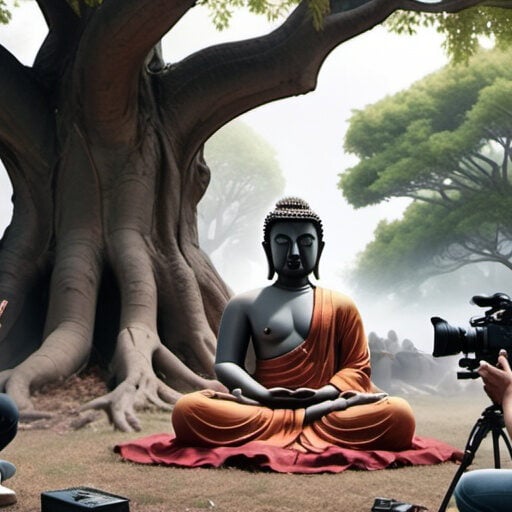
Any movie producer or director will tell you that a blockbuster movie begins with a great script with three acts and at least two turning points. The script only comes alive in front of the camera, or on stage, when supported by really convincing method actors.
The written Sadhana, in Vajrayana Buddhism, is certainly a great script for our meditations, tested and proven by the preceding lineage of accomplished practitioners. This unbroken teaching lineage stretches back to the source of wisdom, the Buddha. Because it is like a script or screenplay, it is spoken aloud. Like a film script, the Sadhana is method acted, after extensive rehearsal and role play.

Method Acting?
The question is, are you a good enough method actor to be convincing in the role? Can you convince even yourself, the actor, that you are the role. Chances are, in the beginnning, the answer is no. But, with rehearsal, over and over, we gradually embed ourselves in the role of our Yidam and accomplish realizations in the process.
Sanskrit Sādhanā literally translates as “a means of accomplishing”. The Sanskrit root “Sadh” means “completion.” These should not be confused with “Pujas.” Pujas are celebratory offerings, merit accumulating practices. Sadhanas are meant to move us on the path of accomplishment. These are methods passed down through hundreds of years of successful accomplished teachers. A Puja, for example, might be the preparatory practices of Bodhichitta found in all Sadhanas.

To finish our metaphor, like an actor, we first sit and read the Sadhana out loud until we have the nuances and the words, and we practice it daily, visualizing until we, ourselves become the role, in our case acting as the Buddha.
Sinking into the “Role”
In the beginning, we read. Later, as we sink into the role, we may even improvise. This metaphorically aligns with the idea of abbreviated versus long practices. The great scholar and teacher Alexander Berzin explained that Sadhanas, come in abreviated form, medium and long form. He taught:
There will be an abbreviated one; there will be a full one; sometimes there’s a medium level as well. And my teacher Serkong Rinpoche said that the abbreviated forms, the short forms, are for advanced practitioners. It’s the long, full forms that are for the beginners.

3 Secrets of Every Sadhana – the 3 Act Structure
Every Sadhana has three secrets, whether abbreviated or long-form. This is just like the three acts of a good movie script.
The three secrets are: Act 1, Bodhichitta; Act 2: Selflessness; and Act 3, Dedication. Without all three, there is no Mahayana Buddhist Sadhana. Without Bodhichitta it is not a Mahayana practice. Without Selflessness, there is no Sadhana. And, without Dedication of Merit it is not a Buddhist practice.

3 Acts to Purify 3 Poisons
What is the purpose of these three steps? It is to purify the Three Poisons, which obscure our own Buddha Nature. The first Act, Bodhichitta practices, purify our attachments and greed, our desires. The second Act, Selflessness, purifies our Delusions and Pride, and our illusory misinterpretation of the nature of reality. The Third, Dedication of Merit, purifies the poisons of Aversion and Hatred.
Stated that way, the secrets seem concise and simple. Yet, when our understanding is limited, we will find that Bodhichitta practices in the beginning of the Sadhana can be quite lengthy — just like Act 1 in a film, that has to bring the audience into the world of the film. Until we have Bodhichitta mastered in our mind to an instinctive level, where we really believe it, it is important to practice, daily.
Lama Tsongkhapa and Manjushri
In teachings on White Tara, Lama Zopa described it this way:
When Lama Tsongkhapa asked Manjushri: “What is the quick way to achieve enlightenment?” Manjushri advised Lama Tsongkhapa to attempt all these together: purifying the obstacles to attainment; collect the necessary condition of merit; make one-pointed request to the guru to receive blessings; and third, train your mind in the actual body of the practice, the stages of the path to enlightenment. This is the answer Manjushri gave to Lama Tsongkhapa’s question.
For this reason, Sadhanas begin with Taking Refuge in the Three Jewels and prostration. We then make a Bodhichitta vow and state the four immeasurables. We then, usually, purify with Vajrasattva mantra. Next, we will likely offer a mandala, although it might be an abbreviated form using our mala. There are usually sensory offerings and guru yoga as well.

Act 1 – the Preliminaries
So, each time we engage in the Sadhana, we are doing our preliminaries. That Sadhana will include these preliminaries, often in the form of the Seven Limbs of Practice, or the aspirational prayer of Samatabhadra.
As we state each limb in our Sadhana, we meditate on the meaning and visualize the practice, like a fast-paced movie montage. The seven preliminaries or limbs are Bodhichitta motivation, prostration to the field of merit, offerings, admitting our mistakes to purify our errors, rejoicing, requesting teachings and requesting our teacher’s remain to teach us.
This is all preliminary. Chanting the 7 limbs praise from the King of Prayers is a beautiful way of accomplishing these seven preliminary practices. See the linked video for a beautiful chanted version of this prayer.
Act 2 – Overcoming Delusions, Attaining Selflessness
The Second Secret of the Sadhana is Selflessness, which helps us overcome our delusions. This one sounds simple, but is the most complicated and difficult to understand for most people. You can explain the notion of Emptiness through recitations of the Heart Sutra and other Sutras, but intellectual understanding isn’t the same as becoming Emptiness.
As a teaching method, Sadhanas coach us to visualize, and “play act” and rehearse what may seem fanciful, incredible, or impossible. We role-play being a fully Enlightened Buddha. We pretend, in the beginning, to train. We keep training, like an actor rehearsing — first reading the script out loud, then, engaging in what actors call immersion acting or method acting. We pretend to be, what we aspire to be.
The “Role” We’re Playing: Fully Enlightened Yidam
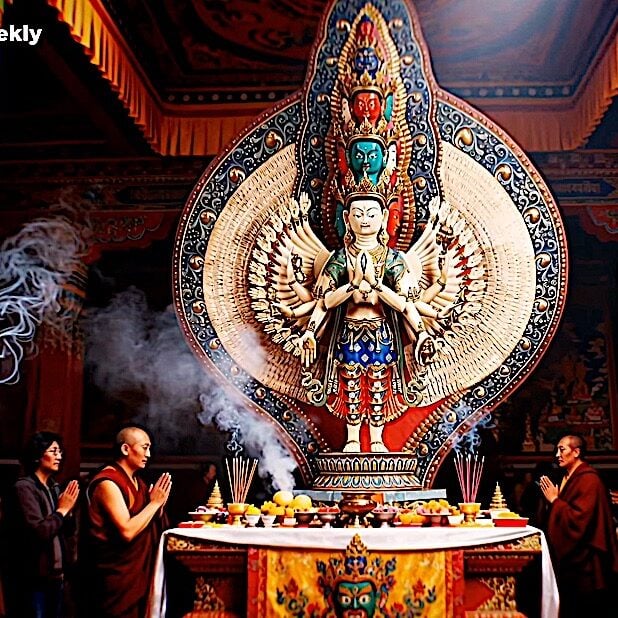
What do we aspire to be? A fully Enlightened Buddha, nothing less, often in the form of a Yidam we personally resonate with — or a form given to us by our teacher based on our own needs. To some of us, this might be a glorious Mother Buddha such as Tara. To others, our practice might be Avalokiteshvara in his thousand-armed compassionate form, reaching out with all those hands to save sentient beings. To others, we might imagine ourselves as a ferocious Buddha who uses wrath to overcome suffering, like the Incredible Hulk transformation in a movie.
Whatever our Yidam form, even if we have empowerment, we are not yet that Buddha. We act like the Buddha. We chant the mantra with the voice of the Buddha. We visualize ourselves as the Buddha helping others. But we are, at this stage, role-playing. We continue role-playing daily, weekly, and annually until we are so good in the role that we convince even ourselves that we are the Buddha.
Why we Must Speak our Sadhanas
This is a skillful method, well grounded in psychology and perfected by Enlightened teachers over thousands of years. This is why, for example, we are taught to “speak” our Sadhanas. Rehearsing “in your head” doesn’t have the same impact as “acting it out.” In the beginning, before we have perfected the practice, we are told to speak Sadhanas outloud.
Script Reading Metaphor
Why? This is like script reading to an actor. They could read the script, over and over, silently, but all actors understand that the real learning and dramatization begins with verbal reading, and extensive repetition.
You might ask, at this point, what does play acting as a powerful Buddha have to do with secret of Selflessness? We begin and end our visualization with the dissolving of the self. In order to become the play-acted Yidam, we have to use method acting to visualize our ordinary selves dissolving away.
Imagine your favorite actor in a heroic adventure film. Chances are, this actor’s real life is ordinary, at least compared to the portrayal of your favorite film hero. Do you imagine, that in real life, your favorite actor jumps off cliffs and lands on a moving trains? Chances are good the actor who plays your hero has to spend some time on set, dissolving away the “ordinary persona.” This allows the actor to get into character. He or she has to act with fearlessness. He or she has to act as if it is possible to jump off a cliff onto a train. When the actor steps in front of the camera, he will be in character, fully immersed.
Imagining the Act — Jumping Off a Cliff
The actor imagines what it would be like to jump off of a cliff. What can’t be realistically acted must be created with digital effects, green screens and stunt people. In the finished product it will look real, and the audience will be convinced. But, the actor, while rehearsing, and in the performance, must actual convey what it feels like to jump of that cliff.
We are like that actor, when we engage in our Sadhanas. Becoming a Buddha is so far beyond our current reality that we have to “dissolve away” our ordinary selves. We imagine our bodies dissolving away into light, and reforming as our Yidam. In our metaphor, the green screens and stunt people are the steps of visualization we build, such as the 1000 arms we have to visualize if we are stepping forth as Avalokiteshvara in his 1000-armed form.
Why Bother?
People who have never engaged in this form or practice, at this stage, will raise an eyebrow and say, why bother? Well, for the “why bother” people they will never see beyond the surface. They’ll see a meditator sitting on a cushion, eyes half closed. They are not ready to be the actor, and the best they can experience is the final product, the movie in the theatre.
For those motivated to this method, over time, through method practice, the self gradually dissolves away and they become their Yidam.
Act 3 – the Dedication is the Secret
The final Act, the final secret, is dedication, which overcomes the poisons of hate and aversion. This is the happy, or at least fulfilling, ending. A film with an unfilling ending is almost never successful. As long as the ending is sound, we come out of the practice with a genuine feeling of accomplishment.
That final act, in Mahayana Buddhist practice, is to dedicate the merit to the benefit of all sentient beings. This aspiration is what fulfils. We aren’t just doing this role-playing and hard work for ourselves. This willingness to dedicate our hard-earned merit for the benefit of others helps us overcome our aversion for others, our prejudices and our hatred. With compassion and metta we embrace all beings as our equals, equally deserving of relief from suffering. This purifies our aversions and hatreds.
1 thought on “Sadhanas, and the Three Secrets of Vajrayana Buddhism, Like Three Acts of a Movie Script”
Leave a Comment
More articles by this author

Where is Buddha? Where are Purelands? Where is the most Sacred Place? “Your mind” is where you’ll find Buddha, Dharma and Sangha

100-Syllable Yidam Samaya Mantra: Union, Bliss, Bonding, Renewal, Purification, Wish Fulfilment and Wisdom

Search
Latest Features




Please support the "Spread the Dharma" mission as one of our heroic Dharma Supporting Members, or with a one-time donation.
Please Help Support the “Spread the Dharma” Mission!
Be a part of the noble mission as a supporting member or a patron, or a volunteer contributor of content.
The power of Dharma to help sentient beings, in part, lies in ensuring access to Buddha’s precious Dharma — the mission of Buddha Weekly. We can’t do it without you!
A non-profit association since 2007, Buddha Weekly published many feature articles, videos, and, podcasts. Please consider supporting the mission to preserve and “Spread the Dharma." Your support as either a patron or a supporting member helps defray the high costs of producing quality Dharma content. Thank you! Learn more here, or become one of our super karma heroes on Patreon.
Lee Kane
Author | Buddha Weekly
Lee Kane is the editor of Buddha Weekly, since 2007. His main focuses as a writer are mindfulness techniques, meditation, Dharma and Sutra commentaries, Buddhist practices, international perspectives and traditions, Vajrayana, Mahayana, Zen. He also covers various events.
Lee also contributes as a writer to various other online magazines and blogs.

Thank you for sharing this insightful and creative explanation of sadhanas and the “three secrets” of Vajrayana Buddhism. The comparison of a sadhana to the three acts of a movie script is a helpful and engaging way to understand how these practices unfold step by step, guiding practitioners through preparation, meditation, and completion.
I especially appreciate how the article explains that a sadhana is a “means of accomplishment,” a structured practice passed down through lineage to help practitioners cultivate wisdom, compassion, and realization. Like a carefully crafted recipe, each part of the practice has a specific purpose and works together to support spiritual transformation.
The explanation of the three secrets is particularly meaningful: the beginning focuses on generating bodhicitta and the altruistic intention to benefit all beings; the middle emphasizes the realization of selflessness through meditation and visualization; and the conclusion involves dedicating the merit of the practice for the welfare of all sentient beings. These stages beautifully reflect the core values of Vajrayana practice.
Thank you for presenting these teachings in such a clear and accessible way. Reflections like this help readers better understand the depth and structure of Vajrayana practices and inspire practitioners to approach their sadhana with greater awareness, devotion, and purpose.
Regards,
Antique Buddhas
https://www.buddhashop.net