



Exploring Shunyata, Emptiness without Nihilism: the Sutra called Flawless Purity, Buddha’s dialogue with laywoman Gangottara
The Flawless Purity Sutra is memorable for more than one reason. In the form of debate with the sharp mind of the an advanced lay woman Gangottara, it explores the important theme of “Emptiness without Nihilism.” It becomes clear, very quickly, that Gangottara is highly intelligent and has a god understanding of Shunyata — but, importantly, she seems to view Emptiness as Nihilistic nothingness. The fine line between Emptiness and Nothingness is always a difficult topic, yet important to progress in “Wisdom understanding Shunyata.” It is vital to not take a nihilistic view of profound Shunyata.
This Short Sutra from one of the oldest collections of Mahayana sutras, “The Heap of Jewels” further explores the meaning of emptiness.
If Phenomena are empty of any essence, than the whole dualistic mind that wants to apprehend them as real so as to possess or shun them, together with the world of apparently real things it creates, has really never come into existence. Fundamentally, it is unborn, yet it appears like a magic display.
Since it is unborn it also never dies. Here, that place beyond the grasp of the conceptual mind is referred to as Nirvana. The setting of this sutra is in the Jeta Grove outside the city of Shravasti, north of the Ganges River in Central India. This is the site of one of the first great monasteries built for The Buddha and his community, donated by the great patron Anathapindika.
The seemingly fearless laywoman Gangottara, who obviously already has a superb grasp of the teachings (though tending towards the nihilistic side), is incisively interrogating the Buddha on his own ground. Though an unflinching debater, she addresses him respectfully as ‘Tathágata’, and ‘World honored one’.
Thus have I heard.
Once the Buddha was dwelling in the garden of Anathapindika, in the Jeta Grove near Shravasti. At that time, a laywoman named Gangottara came from her dwelling in Shravasti to see the Buddha. She prostrated herself with her head at the Buddha’s feet, withdrew to one side, and sat down.
The world honored one asked Gangottara, “Where do you come from?”
The Laywoman asked the Buddha,
“World-Honored One, if someone were to ask a magically produced being where he came from, how should the question be answered?
The World Honored One told her,
“A magically produced being neither comes nor goes, is neither born nor perishes; how can one speak of a place from which he comes?
Then the laywoman asked,
“Is it not true that all things are illusory, like magic?”
The Buddha said,
“Yes indeed, what you say is true”
Gangottara asked,
“If all things are illusory, like magic, why did you ask me where I came from?”
The World Honored One told her,
“A magically produced being does not go to the miserable planes of existence, nor to heaven; nor does he attain nirvana. Gangottara is that also true of you?”
The Laywoman replied,
“As I see it, if my own body were different from a magically produced one, then I could speak of going to the good and miserable planes of existence, or of attaining Nirvana. I see no difference, though, between my body and a magically produced one, so how can I speak of going to the good or miserable planes, or of attaining nirvana?
“Furthermore, World Honored One, nirvana’s very nature is such that it is not reborn in the good or miserable planes, nor does it experience parinirvana. I perceive that the same is true of my own nature.”
The Buddha asked,
“Do you not seek the state of nirvana?”
Gangottara asked in turn,
“If this question were put to one who had never come into being, how should it be answered?”
The Buddha replied,
“That which has never come into being is nirvana itself”
Gangottara asked,
“Are not all things identical with nirvana?
The Buddha replied,
“So they are, so they are.”
“World Honored One, if all things are identical with nirvana why did you ask me ‘Do you not seek the state of nirvana’? Furthermore World Honored One, if a magically produced being asked another magically produced being ‘Do you not seek the state of nirvana?’ what would the answer be?”
The World Honored One told her,
“I raised the question because there are in this assembly good men and good women who can be brought to maturity. I am free of mental attachments. Why? Because the Tathágata knows that even the names of things inapprehensible, let alone the things themselves or those who seek nirvana.”
Gangottara said,
“If so, why all the accumulation of good roots for the attainment of enlightenment?”
[The Buddha replied],
“Neither Bodhisattvas nor their good roots can be apprehended, because in the Bodhisattvas’ minds there is no discriminative thought as to whether they are accumulating good roots or not.”
Gangottara asked,
“What do you mean by ‘no discriminative thought’?”
The World Honored One answered,
“The absence of discriminative thought cannot be understood or grasped by means of thinking. Why? Because in the state of non-discriminative thought even the mind is inapprehensible, let alone the mental functions. This state in which the mind is inappreciable is called inconceivable. It cannot be grasped or realized. It is neither pure nor impure. Why So?
Because, as the Tathágata always teaches, all things are as empty and unimpeded as space.”
Gangottara inquired,
“If all things are like empty space, why does the World Honored One speak of form, feeling conception, impulse and consciousness; the eighteen elements; the twelve entrances; the twelve links of dependent origination; The defiled and the undefiled; the pure and impure things; samsára and nirvana?”
The Buddha told Gangottara,
“When I speak of a ‘self’, for example, although I express the concept by a word, actually the nature of a ‘self’ is inapprehensible. I speak of form but the nature of form is also inapprehensible, and so it is with the other Dharma’s, up to nirvana. Just as we cannot find water in mirages, so we cannot find nature in form, and so it is with the others, up to nirvana.
“Gangottara, only a person who cultivates pure conduct in accordance with the dharma, perceiving that nothing can be apprehended, deserves to be called a real cultivator of pure conduct. Since the arrogant say that they have apprehended something, they cannot be said to be firmly established in genuine pure conduct. Such arrogant people will be terrified and doubtful when they hear this profound Dharma. They will be unable to liberate themselves from birth, old age, sickness, death, worry, sorrow, suffering, and distress.
“Gangottara, after my parinirvana, there will be some people able to spread this profound Dharma, which can stop the rounds of samsára. However, some fools, because of their evil views, will hate those Dharma-Masters, and will contrive to harm them. Such fools will fall to the hells for that.”
Gangottara asked,
“You speak of this profound dharma which can stop the rounds of samsára, what do you mean by ‘stop the rounds of samsára?’
The World Honored One replied,
“To stop the rounds of samsára is to penetrate reality, the realm of the inconceivable. Such a Dharma cannot be damaged ordestroyed. Hence, it is called the dharma that can stop the rounds of samsára.”
Then the World Honored One smiled graciously and emitted from his forehead blue, yellow, red, white, and crystalline lights. The lights illuminated all the numerous lands, reaching as high as the Brahma Heaven, then returned to the Buddha’s and entered the top of the Buddha’s head.
Seeing this, the venerable Ánanda thought to himself,
“The Tathágata, the worthy one, the supremely enlightened one, does not smile without a reason.”
He rose from his seat, uncovered his right shoulder, knelt on his right knee, and joined his palms towards the Buddha, inquiring,
“Why did the Buddha smile?”
The Buddha replied,
“Recall that, in the past, a thousand Tathágatas also taught this dharma here, and each of those assemblies was also led by a laywoman named Gangottara. After hearing this Dharma preached, the laywoman, and all the assembly left the household life. In time, they entered nirvana without residue.”
Ánanda asked the Buddha,
“What name should be given to this Sutra and how should we accept and uphold it?”
The Buddha said,
“This Sutra is called Flawless Purity, and you should accept and uphold it by that name”
During the Preaching of this sutra, seven hundred monks and four hundred nuns were liberated from defilements forever and their minds were set free.
At that time, the gods of the realm of desire magically produce various kinds of wonderful celestial flowers and scattered them on the Buddha, saying,
“Rare indeed is this laywoman, who can converse fearlessly with the Tathágata on equal terms. She must have served and made offerings to countless Buddhas, and planted good roots in their presence.”
After the Buddha had finished speaking this sutra, the Laywoman Gangottara and all the other gods, humans, asuras, gandharvas, and so forth were jubilant over the Buddha’s teaching. They accepted it with faith, and begun to follow it with veneration”
1 thought on “Exploring Shunyata, Emptiness without Nihilism: the Sutra called Flawless Purity, Buddha’s dialogue with laywoman Gangottara”
Leave a Comment
More articles by this author
Seven Mantras of the Seven Successive Buddhas: Removes All Obstacles, Negative Karma, Illness, Posession with FULL SUTRA and Mantra Commentary
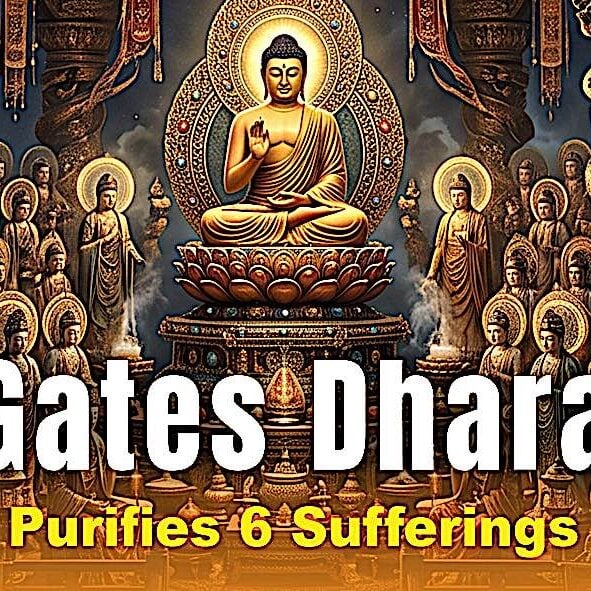
The Noble Dhāraṇī of the Six Gates: Background, Dharani in Sanskrit, Translation and Full Sutra with Benefits

SUBSCRIBING MEMBERS VIDEO: Śūraṅgama Heart Mantra 楞嚴咒心 The King of Mantras Sung by 3 Gems Band in Chinese Temple Chanting Style
Daśacakra Kiṣitigarbha Dhāraṇī: Rescuing All Beings: The Sanskrit Dharani that Saves Beings on Hearing or Seeing or Chanting
Search
Latest Features



Please support the "Spread the Dharma" mission as one of our heroic Dharma Supporting Members, or with a one-time donation.
Please Help Support the “Spread the Dharma” Mission!
Be a part of the noble mission as a supporting member or a patron, or a volunteer contributor of content.
The power of Dharma to help sentient beings, in part, lies in ensuring access to Buddha’s precious Dharma — the mission of Buddha Weekly. We can’t do it without you!
A non-profit association since 2007, Buddha Weekly published many feature articles, videos, and, podcasts. Please consider supporting the mission to preserve and “Spread the Dharma." Your support as either a patron or a supporting member helps defray the high costs of producing quality Dharma content. Thank you! Learn more here, or become one of our super karma heroes on Patreon.
Lee Kane
Author | Buddha Weekly
Lee Kane is the editor of Buddha Weekly, since 2007. His main focuses as a writer are mindfulness techniques, meditation, Dharma and Sutra commentaries, Buddhist practices, international perspectives and traditions, Vajrayana, Mahayana, Zen. He also covers various events.
Lee also contributes as a writer to various other online magazines and blogs.
Thank you for this blog post. I find emptiness to be a confusing topic and one that a lot of Dharma teachers are unable to get across to beginners and lay practitioners. I appreciate this breakdown and simplifying of a complex teaching.