


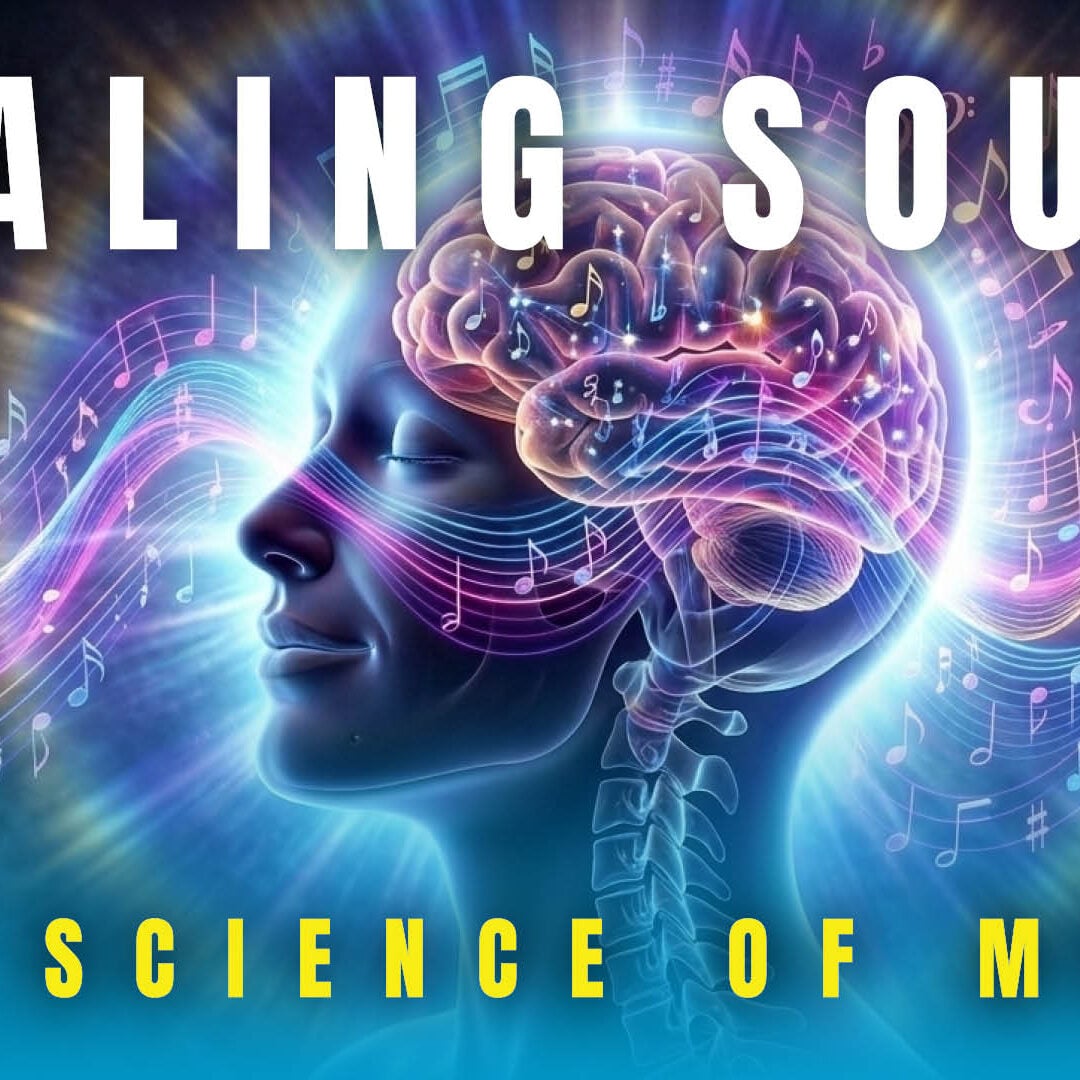
DOCUMENTARY VIDEO: Music is Medicine: The Science of Healing Frequencies – 3 acoustic meditation secrets, 5 Studies
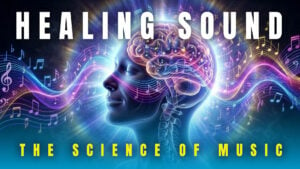
One of the most popular topics in internet searches is healing music. But here’s the real question: Is it just a placebo, or is there actual science behind why these sounds make us feel better?
From ancient chanting traditions to modern meditation playlists, humans have used sound for healing across every culture. But only recently has neuroscience begun to reveal what’s actually happening in our brains and bodies when we listen.
In this special feature and video, we’re going to explore the science behind healing music. And don’t worry—you don’t have to be Buddhist to benefit from these healing sounds.
So what happens when you press play on one of our healing mantra playlists? Quite a lot, actually, at least according to the science behind healing music.
First, music affects your brainwaves through a process called ‘entrainment’—where rhythmic sounds literally synchronize your neural activity . A paper called the Brainwave Synchronization Study in 2025 used EEG brain scans to reveal that healing music induces the strongest synchronization of brain activity across groups of people—even stronger than meditation alone . For citations for these studies see the details of this video and the information icons.
But here’s where it gets interesting. Researchers have identified three specific acoustic features that make music ‘healing’—and these features transcend musical genres .
If we think about it: whether it’s a Buddhist mantra, a classical music performance, or ambient electronic music, healing music shares universal properties. One key feature is how it uses ‘roughness’—varying levels of sonic harshness that create tension and release, similar to how a good story has ups and downs .
And here’s the best part: these acoustic features have been found to significantly predict how music makes us feel—whether it evokes calmness or happiness, or an energetic healing response, or a pristine state of concentration. That means science can now identify what makes music therapeutic, regardless of the culture it comes from. Of course, these benefits are enhanced by faith and other factors, but the healing can work even if the song is purely notes, humming, or in a language you do not understand.
There are additional benefits to mantra, which we’ve covered in separate videos, but here we’re just focused on the healing response in body and mind to music itself.
Let’s go beyond the EEG and talk chemistry—because healing music doesn’t just change your brainwaves. According to some studies it also changes your body chemistry over time.
In a 2024 study titled Chanting, Cortisol and Anxiety Reduction, they found that just 12 minutes of group chanting significantly decreased cortisol levels—that’s your body’s primary stress hormone . And here’s the key: whether you chant out loud or silently, both reduce cortisol. But vocal chanting was even more effective at reducing self-reported anxiety.
When you’re listening to a mantra or chanting along, you’re literally lowering your stress hormones. But there’s more to it than simply reducing stress in you.
Music also triggers the release of dopamine and endogenous opioids—your body’s natural painkillers . In fact, recent neurochemical mapping in a 2025 study, titled “Music and Pain Modulation”, the data revealed that structured music activates the brain’s reward system in ways that actually reshape how we remember pain .
This is why music is so effective for chronic pain management. It’s not just a distraction—it’s actively changing how your brain processes pain signals .
Research using brain imaging has shown that healing music can reduce pain ratings by altering brain activity in the cingulate gyrus—a region involved in pain processing . Even more fascinating: music has been found to modulate gamma-band activity in the somatosensory cortex, the part of your brain that processes touch and pain sensations .
So if any music can be healing, why do traditions like Buddhism emphasize mantra chanting?
Here at Buddha Weekly, our healing mantra series—including the Medicine Buddha Dharani and other powerful chants—draws on practices that have been used for thousands of years. But the science shows there’s something uniquely powerful about the repetitive, rhythmic nature of chanting .
Remember those three universal acoustic features we mentioned earlier? Mantras often incorporate them naturally—with rhythmic patterns, harmonic richness, and that balance between tension and release that the research identified .
Here’s what’s crucial: these benefits are universal. You don’t need to be Buddhist or subscribe to any particular belief system to benefit. The acoustic properties work regardless of your background . The science is clear—the sentient brain responds to certain sound patterns in predictable ways . You also don’t need to be human. If your beloved animal or bird or fish companion is not feeling well, play healing music so they can hear it and benefit. Other studies have even shown the benefit of playing music for plants.
And the research on chanting specifically found that group vocalization creates a sense of social connection and altruism, which has its own powerful healing effects .
So the next time you press play on a Buddha Weekly or 3GemsBand meditation or healing music track, you can know the benefits are not just in your head. You’re literally, according to these research studies: synchronizing your brainwaves and lowering your stress hormones. You are also activating your brain’s natural painkillers . And in the case of mantras, you are tapping into acoustic patterns that have been healing humans, and even animals, for millennia, regardless of your faith or spiritual path.
If you enjoyed this deep dive into the science of sound, be sure to check out our healing mantra series here at Buddha Weekly. And whether you’re Buddhist, spiritual, or just curious—these ancient sounds have modern science on their side.
Let us know in the comments: what music or sounds help you feel centered and calm? We’d love to hear your experiences.
Thank you for watching, and may your journey be filled with peace and healing sounds. May all beings benefit.
STUDIES CITED :
Reference List for Video Popups
1. Brainwave Synchronization Study (Section 1)
Citation: Gao, J., Leung, H. K., Lee, K. C. G., Poon, C. C., Huang, G., Liao, J., Wu, B. W. Y., Thach, T. Q., Ho, R. T. H., & Sik, H. H. (2025). Interbrain synchronization in classroom during high-entropy music listening and meditation: a hyperscanning EEG study. Frontiers in Neuroscience, 19, 1557904.
Link: https://www.frontiersin.org/journals/neuroscience/articles/10.3389/fnins.2025.1557904/full
Key Finding: 6 Hz high-entropy music induced the strongest brain synchronization compared to meditation and rest.
2. Acoustic Features of Healing Music (Section 1)
Citation: Uncovering potential distinctive acoustic features of healing music. (2023). General Psychiatry. BMJ Group.
Link: https://gpsych.bmj.com/content/gpsych/suppl/2023/12/20/gpsych-2023-101145.DC2/Press_release.pdf
Key Finding: Three universal acoustic features of healing music were identified: standard deviation of roughness, mean MFCC3, and period entropy of MFCC3.
3. Chanting, Cortisol & Anxiety Reduction (Section 2)
Citation: Perry, G., Polito, V., & Thompson, W. F. (2024). Exploring the Physiological and Psychological Effects of Group Chanting in Australia: Reduced Stress, Cortisol and Enhanced Social Connection. Journal of Religion and Health, 63(6), 4793-4816.
Link: https://pubmed.ncbi.nlm.nih.gov/38091206/
Key Finding: 12 minutes of group chanting significantly decreased cortisol levels and self-reported anxiety.
4. Music & Pain Modulation (Section 2)
Citation: Hauck, M., Metzner, S., Rohlffs, F., Lorenz, J., & Engel, A. K. (2013). The influence of music and music therapy on pain-induced neuronal oscillations measured by magnetencephalography. Pain, 154(4), 539-547.
Link: https://www.sciencedirect.com/science/article/abs/pii/S030439591200677X
Key Finding: Preferred music reduced pain ratings via delta-band activity in the cingulate gyrus; healing music modulated gamma-band activity in somatosensory cortices.
5. Music as Universal Language (Section 2)
Citation: (Referenced in the General Psychiatry study, citing traditional music forms across cultures).
Link: https://gpsych.bmj.com/content/gpsych/suppl/2023/12/20/gpsych-2023-101145.DC2/Press_release.pdf
Key Finding: Music is a universal language that transcends culture and genre, including pilgrimage songs in Nigeria, high-life drumming in Ghana, singing bowl music in India, and five-element music in China.
🎧 FEATURED THIS VIDEO:
Buddha Weekly’s Healing Mantra Series – including the Medicine Buddha Dharani and other powerful chants. Drawing on thousands of years of tradition, now backed by modern science.
RESOURCES / More Information:
📖 BUDDHAWEEKLY.com (1400+ in-depth Dharma features): https://buddhaweekly.com/📅 Dharma Calendar (covering the next 3 years): https://buddhaweekly.com/dharma-calendar/📄 Practice Text PDF Downloads: https://buddhaweekly.com/downloads/🖼️ Dharma Art Gallery Downloads: https://buddhaweekly.com/dharma-art-gallery/🎵 BUDDHAWEEKLY Music (YouTube): https://music.youtube.com/@BuddhaWeekly🎵 3 GEMS BAND (YouTube): https://music.youtube.com/@3GemsBand🎵 BUDDHA WEEKLY (Apple Music): https://music.apple.com/us/artist/buddha-weekly/1691780466🎵 3GEMS (Apple Music): https://music.apple.com/us/artist/3gems/1831580194🎵 BUDDHAWEEKLY (Spotify): https://open.spotify.com/artist/1Rk3pOFGwxJFhjnOhZyHWx🎵 3GEMS (Spotify): https://open.spotify.com/artist/0F5bWufjymJEwYQKHkM507🎬 3GEMS YouTube Channel: https://www.youtube.com/@3GemsBand
💬 JOIN THE CONVERSATION:
What music or sounds help you feel centered and calm? Drop a comment below—we’d love to hear your experiences.
🔔 SUBSCRIBE FOR MORE:
If you enjoyed this deep dive into the science of sound, subscribe and hit the bell for more content exploring music, mindfulness, and healing.
🌿 MAY ALL BEINGS BENEFIT
Thank you for watching. May your journey be filled with peace and healing sounds.
#HealingMusic #MeditationMusic #SoundHealing #MusicTherapy #BuddhaWeekly #Mantra #ScienceOfSound #BrainwaveEntrainment #StressRelief #PainRelief
📌 DISCLAIMER:This content is for informational and educational purposes only. It is not intended as medical advice. Always consult a qualified healthcare professional for health concerns.
🔬 STUDIES CITED:
Brainwave Synchronization Study (2025) – Gao et al., Frontiers in Neuroscience→ 6 Hz high-entropy music induced the strongest brain synchronization compared to meditation alone.🔗 https://www.frontiersin.org/journals/neuroscience/articles/10.3389/fnins.2025.1557904/full
Acoustic Features of Healing Music (2023) – General Psychiatry, BMJ Group→ Three universal acoustic features identified: roughness variation, frequency patterns, and harmonic consistency.🔗 https://gpsych.bmj.com/content/gpsych/suppl/2023/12/20/gpsych-2023-101145.DC2/Press_release.pdf
Chanting, Cortisol & Anxiety Reduction (2024) – Perry et al., Journal of Religion and Health→ Just 12 minutes of group chanting significantly decreased cortisol and self-reported anxiety.🔗 https://pubmed.ncbi.nlm.nih.gov/38091206/
Music & Pain Modulation (2013) – Hauck et al., Pain→ Healing music modulates gamma-band activity in somatosensory cortices, reducing pain perception.🔗 https://www.sciencedirect.com/science/article/abs/pii/S030439591200677X
Music as Universal Language (2023) – General Psychiatry (cross-cultural reference)→ Music transcends culture and genre—from Nigerian pilgrimage songs to Indian singing bowls.🔗 https://gpsych.bmj.com/content/gpsych/suppl/2023/12/20/gpsych-2023-101145.DC2/Press_release.pdf
More articles by this author
“Surviving the Grief Wave”: BuddhaCast 5: Buddhist Anchors for Sudden Grief Attacks, a Podcast with Josephine Nolan and Dave Lang
Video: Under Attack? Instantly Banish Black Magic, External Obstacles & Curses | Black Tara Protection Mantra
Buddhist Mantra Time Out: Sadness Quick Fix – Vasudhara Happiness Dharani Instant Pick-Me-Up Guided Visualization and Dharani Chanting

Search
Latest Features


Please support the "Spread the Dharma" mission as one of our heroic Dharma Supporting Members, or with a one-time donation.
Please Help Support the “Spread the Dharma” Mission!

Be a part of the noble mission as a supporting member or a patron, or a volunteer contributor of content.
The power of Dharma to help sentient beings, in part, lies in ensuring access to Buddha’s precious Dharma — the mission of Buddha Weekly. We can’t do it without you!
A non-profit association since 2007, Buddha Weekly published many feature articles, videos, and, podcasts. Please consider supporting the mission to preserve and “Spread the Dharma." Your support as either a patron or a supporting member helps defray the high costs of producing quality Dharma content. Thank you! Learn more here, or become one of our super karma heroes on Patreon.
Lee Kane
Author | Buddha Weekly
Lee Kane is the editor of Buddha Weekly, since 2007. His main focuses as a writer are mindfulness techniques, meditation, Dharma and Sutra commentaries, Buddhist practices, international perspectives and traditions, Vajrayana, Mahayana, Zen. He also covers various events.
Lee also contributes as a writer to various other online magazines and blogs.