


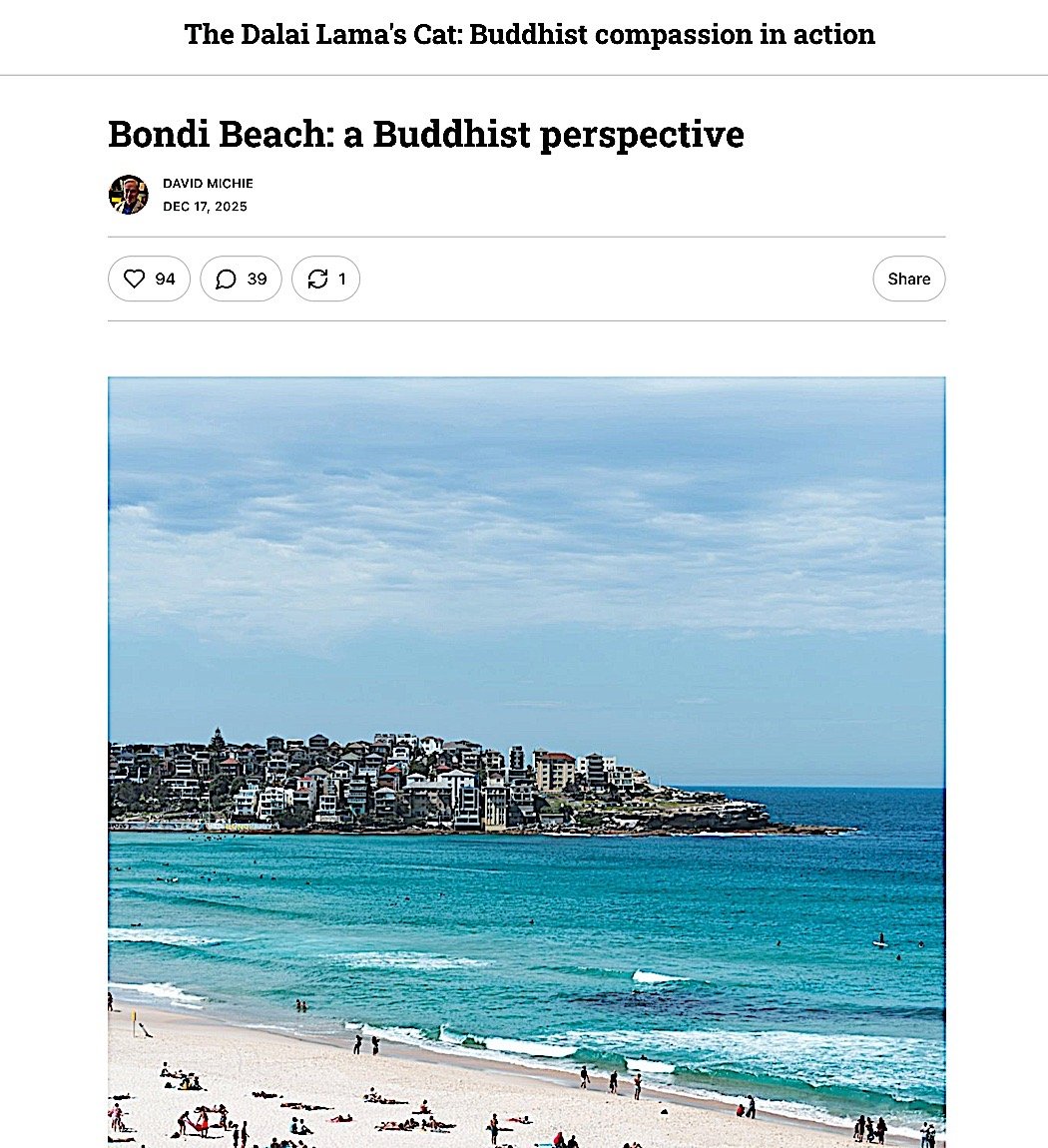
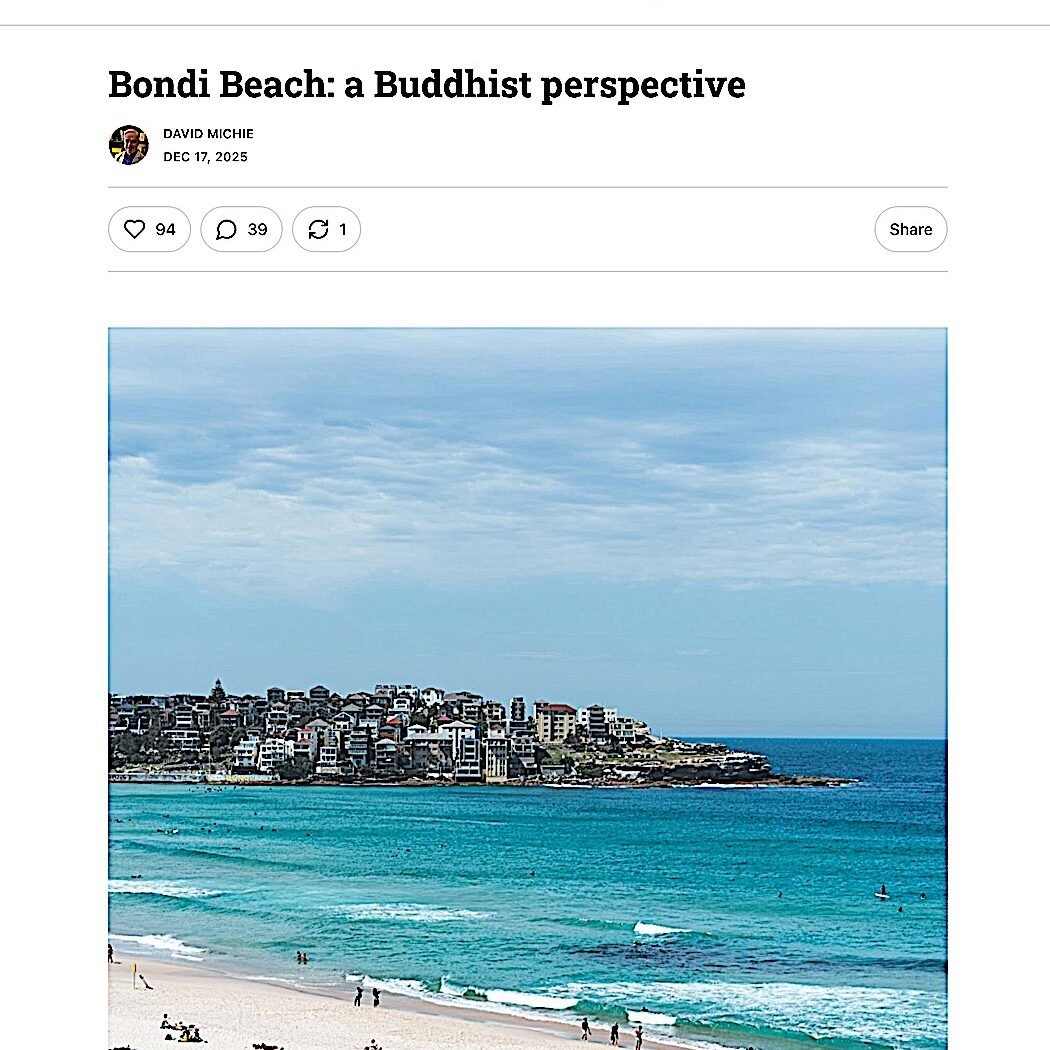
Bondi Beach: a Buddhist perspective from David Michie, author of The Dalai Lama’s Cat
With permission from David Michie, we’re re-publishing his “Bondi Beach: A Buddhist Perspective” from his David Michie Substack:
By David Michie
Author, The Dalai Lama’s Cat and many books
(Originally published Dec 17, 2025 on David Michie’s Substack)
Like most people, I am both horrified and saddened by Sunday’s terrorist attack at Bondi Beach. My heart goes out to those whose loved ones were killed or injured in the violence.
Many of you know that I live in Australia. I thought I should write a few words in case you’re wondering about my response to what happened.
After the last mass shooting in Port Arthur in 1996, Australia implemented one of the strictest sets of gun-control laws in the world, and there hasn’t been another attack since – until last Sunday. Mass shootings don’t happen here. We are a free, open and tolerant society. What happened has shocked our country and our sense of who we are. I expect it will take some time for us collectively to process it.
Seeking a uniquely Buddhist perspective on the events, what comes to mind immediately is how the attack, and the responses to it, offer a striking validation of one of Buddha’s main teachings: that reality arises from mind itself.
How could anyone perceive an elderly stranger in his late eighties, enjoying a picnic on the beach, as such a hateful figure that he deserved to be shot dead? That 87-year-old Alexander Kleytman survived the Holocaust as a young child in Europe, only to be killed by a different expression of antisemitism on the other side of the world eighty years later, adds a tragic poignancy to what happened.
And how could a ten-year-old child, Matilda, be regarded as so threatening, so contemptible, that her life too should be taken?
Yet in the minds of the attackers, these two — along with everyone else gathered to celebrate Hanukkah — were perceived only as members of a group, stripped of their humanity and recast as oppressors who, in that distorted frame of mind, deserved to die.
In the days since the attack, we have seen a familiar pattern of responses unfold. There has been grief and compassion, but also blame, identity politics, opportunism and argument.
Some insist that gun laws were not tight enough, questioning how two non-citizens were able to obtain firearms at all.
Others, wading in from the United States, argue the opposite — that if guns were more readily available in Australia, someone might have shot the attackers before they were able to kill so many others.
People have been adamant that the gun debate itself is a distraction. The real failure, they say, lies with governments that have signalled tolerance for antisemitism, allowing hatred to take root and grow.
Others focus on intelligence and security: how could a man reportedly connected to jihadist training abroad be known to authorities and yet still carry out such an attack?
Meanwhile, some campaigners argue that facial-recognition cameras at popular places like Bondi are the only way to ensure that events like this never happen again. Others object just as strongly, saying it is neither effective nor acceptable to treat everyone as a potential suspect.
Setting aside the substance of these arguments, what becomes striking is how clearly people’s inner landscapes shape the reality they experience. We like to imagine ourselves as independent, impartial observers of events unfolding ‘out there’. Yet from a Buddhist perspective, ‘out there’ is more like a cinema screen onto which we project what is happening ‘in here’.
One person sees a world defined by dangerous others; another sees a world constrained by unjust authority. Some are convinced that one group is inherently threatening, others that a different group is. Some believe there are too many guns, others that there are not enough.
The great sadness is that we can do nothing to change what happened at Bondi Beach last Sunday. But we do have agency over our own minds — and therefore over what we project into the world. No one else can do this for us.
What kind of reality do we wish to inhabit? Most of us, I expect, long for one shaped by equanimity, tolerance and kindness. One in which we are deeply grateful for the life we have and are mindful of its preciousness. A reality where we understand the extraordinary paradox, taught by all the great inner traditions, the Golden Rule that as we give, so we receive.
So, if there is an effective, compassionate and sane response to last Sunday’s tragedy, it may be this: to use the shock of what happened as a reminder to review the mental causes we ourselves are cultivating. Often we struggle to see how different minds give rise to different realities. In moments like this, the process is laid bare.
If we are to find something meaningful from this truly awful event, let’s use it as a motivator to cultivate the mental causes for the reality we wish to experience. To be the loving kindness we wish to see in the world.
More articles by this author
Search
Latest Features




Please support the "Spread the Dharma" mission as one of our heroic Dharma Supporting Members, or with a one-time donation.
Please Help Support the “Spread the Dharma” Mission!

Be a part of the noble mission as a supporting member or a patron, or a volunteer contributor of content.
The power of Dharma to help sentient beings, in part, lies in ensuring access to Buddha’s precious Dharma — the mission of Buddha Weekly. We can’t do it without you!
A non-profit association since 2007, Buddha Weekly published many feature articles, videos, and, podcasts. Please consider supporting the mission to preserve and “Spread the Dharma." Your support as either a patron or a supporting member helps defray the high costs of producing quality Dharma content. Thank you! Learn more here, or become one of our super karma heroes on Patreon.
David Michie
Author | Buddha Weekly
David Michie (from his website): "I am a Buddhist, writer and mindful safari guide. I feel grateful to share the wisdom of my lamas with like-minded people around the world."
David Michie is the author of The Dalai Lama's Cat series, The Queen's Corgi: On Purpose, The Magician of Lhasa, The Astral Traveller's Handbook & Other Tales, as well as several works of non fiction including Buddhism for Busy People, Buddhism for Pet Lovers and Why Mindfulness is Better than Chocolate.