





Mindful Weight Loss: A Buddhist Approach to Body, Habit, and Healing

The media often portrays weight loss as a war against cravings, urges, and even the kingdom of fast food. The Buddhist perspective is different; its goal is more about caring for oneself, fulfilling one’s needs, and loving oneself. As stated by the Buddha in the Dhammapada 159,
“If one holds oneself dear, one should guard oneself with care.”
Elsewhere, in the Maha-Saccaka Sutta (MN36), it is stated that calming and disciplining the body cannot be achieved by starving it. These ideas, and many others found in Buddhist literature, point to the vital role that Buddhism and one of its central tenets—mindfulness—can play in healthy weight loss.
Health Note: Always seek advice of your health care practitioners for any health concerns.
Feature by Karoline Gore
Embodied Awareness and Mindful Eating
The Satipaṭṭhāna Sutta instructs practitioners to contemplate the body “in the body”, to see it as it is, without judgment. This idea can be beneficial in the context of weight loss, as many people who are overweight or obese feel shame or aversion. Buddhist practice encourages us to tune in to our bodies rather than judge them. For instance, through mindfulness practices such as body scanning and mindfulness meditation, we can recognize tension and relaxation, hunger and fullness, and the thought and emotional patterns that accompany eating.

Mindful eating, meanwhile, invites us to flavor food with all our senses. In doing so, we can be more grateful for our food and more aware of satiety or hunger. As mindfulness writer Thich Nhat Hanh states, “When we eat with full awareness, we recognize the food as a gift of the whole universe.

Right View in Buddhism
When it comes to weight loss, many people can become obsessed with the numbers on a scale. By consuming healthy foods and embracing regular exercise, they can, in fact, reach their goals, even if the scale doesn’t show it to the extent they would like. This phenomenon can arise because there is a difference between losing fat and weight.
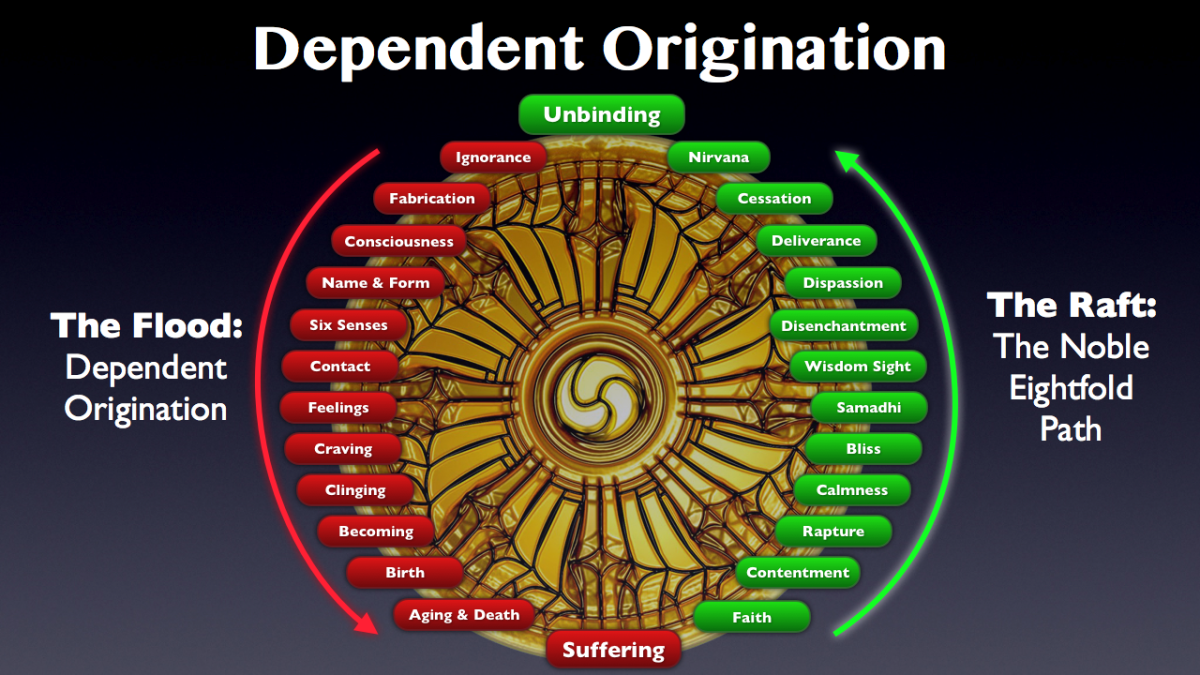
One can reduce fat levels while building muscle, resulting in stable weight loss. This way of thinking aligns with the Buddhist teaching of Right View—understanding core causes and conditions. In Buddha’s teaching on dependent origination, he says, “Whoever sees dependent origination sees the Dhamma” (MN28). Weight is just an effect; fat storage is the process. Transformation arises from mindful understanding of the body and the mind. That is, weight gain sometimes has deeper causes, including stress, anxiety, and depression—and these issues must be dealt with for lasting weight loss.
Mindfulness and Craving
Because mindfulness is grounded in acceptance, it is a powerful tool for managing cravings. In the Dhammapada, the Buddha states, “From craving springs grief; from craving springs fear.” In many ways, it works the other way around as well. That is, grief and fear can cause us to crave foods our bodies do not actually need to thrive. Instead of battling cravings, mindfulness encourages us to ask ourselves questions such as where in our bodies we feel urges, what emotions accompany our cravings, and whether our cravings result from real hunger or, rather, a wish to escape.

The goal isn’t to reject our cravings but rather to observe them mindfully. This simple act diminishes their power and allows us to find healthier ways to channel challenging emotions.
Embracing Right Effort and Loving-Kindness
In the Noble Eightfold Path, Right Effort is defined as exerting yourself and committing to your goals by distinguishing skillful from unskillful actions and by making yourself want to do so. When it comes to weight loss, commitment and effort are essential, but it is vital to avoid “unskillful actions” that can lead to cravings for unhealthy foods, overeating, or emotional eating. As such, it is advisable to avoid rigid diets that feel like punishment and to replace self-criticism with self-compassion. This idea is closely related to mettā, or loving-kindness, which is an antidote to self-hatred and self-punishment. As you pursue your weight loss goals, aim to recite affirming phrases such as “May I be healthy,” “May I care for my body with kindness,” and “May I treat myself with compassion.”
Losing weight is a positive goal that can be pursued through a mindful approach. Mindfulness practices and meditation can help us better understand our bodies, so we can keep cravings at bay. Mindfulness can also keep us on the right path by encouraging us to view our weight loss journey as self-care rather than a punishment.
3 thoughts on “Mindful Weight Loss: A Buddhist Approach to Body, Habit, and Healing”
Leave a Comment
More articles by this author

Making LUNAR NEW YEAR 2026 Your Most Auspicious and Blessed Year: Feb 17, 2026 Chinese New Year; Feb 18,2026 LOSAR Tibetan New Year



A Bee’s View of Buddha Dharma: “caring for bees” is a noble karmic act of the Pāramitā (Perfection) of Metta (loving kindness)


Search
Latest Features





Please support the "Spread the Dharma" mission as one of our heroic Dharma Supporting Members, or with a one-time donation.
Please Help Support the “Spread the Dharma” Mission!

Be a part of the noble mission as a supporting member or a patron, or a volunteer contributor of content.
The power of Dharma to help sentient beings, in part, lies in ensuring access to Buddha’s precious Dharma — the mission of Buddha Weekly. We can’t do it without you!
A non-profit association since 2007, Buddha Weekly published many feature articles, videos, and, podcasts. Please consider supporting the mission to preserve and “Spread the Dharma." Your support as either a patron or a supporting member helps defray the high costs of producing quality Dharma content. Thank you! Learn more here, or become one of our super karma heroes on Patreon.
Lee Kane
Author | Buddha Weekly
Lee Kane is the editor of Buddha Weekly, since 2007. His main focuses as a writer are mindfulness techniques, meditation, Dharma and Sutra commentaries, Buddhist practices, international perspectives and traditions, Vajrayana, Mahayana, Zen. He also covers various events.
Lee also contributes as a writer to various other online magazines and blogs.

I am overweight from eating too much cheese, I can’t seem to loose the weight. This article helped. I don’t overeat.
Very glad it was helpful
Thank you for this thoughtful and compassionate article. I really appreciated how you explained weight loss from a Buddhist perspective—not as a struggle against the body, but as an act of care, mindfulness, and understanding. That message is both gentle and encouraging.
The reflections on mindful eating, awareness of hunger and emotions, and observing cravings rather than fighting them were especially meaningful. They remind us that real change often comes from understanding our habits and causes, not from harsh discipline or self-criticism.
I was also touched by the emphasis on self-compassion, loving-kindness, and Right Effort. Seeing health as part of a balanced and mindful life, rather than a punishment or obsession, is a wise and refreshing perspective.
I’m grateful for the clarity and kindness in this piece. Articles like this help readers approach their bodies and minds with patience, awareness, and care. Thank you for sharing these reflections for the benefit of others.
Regards,
Antique Buddhas
https://www.antique-buddhas.com