



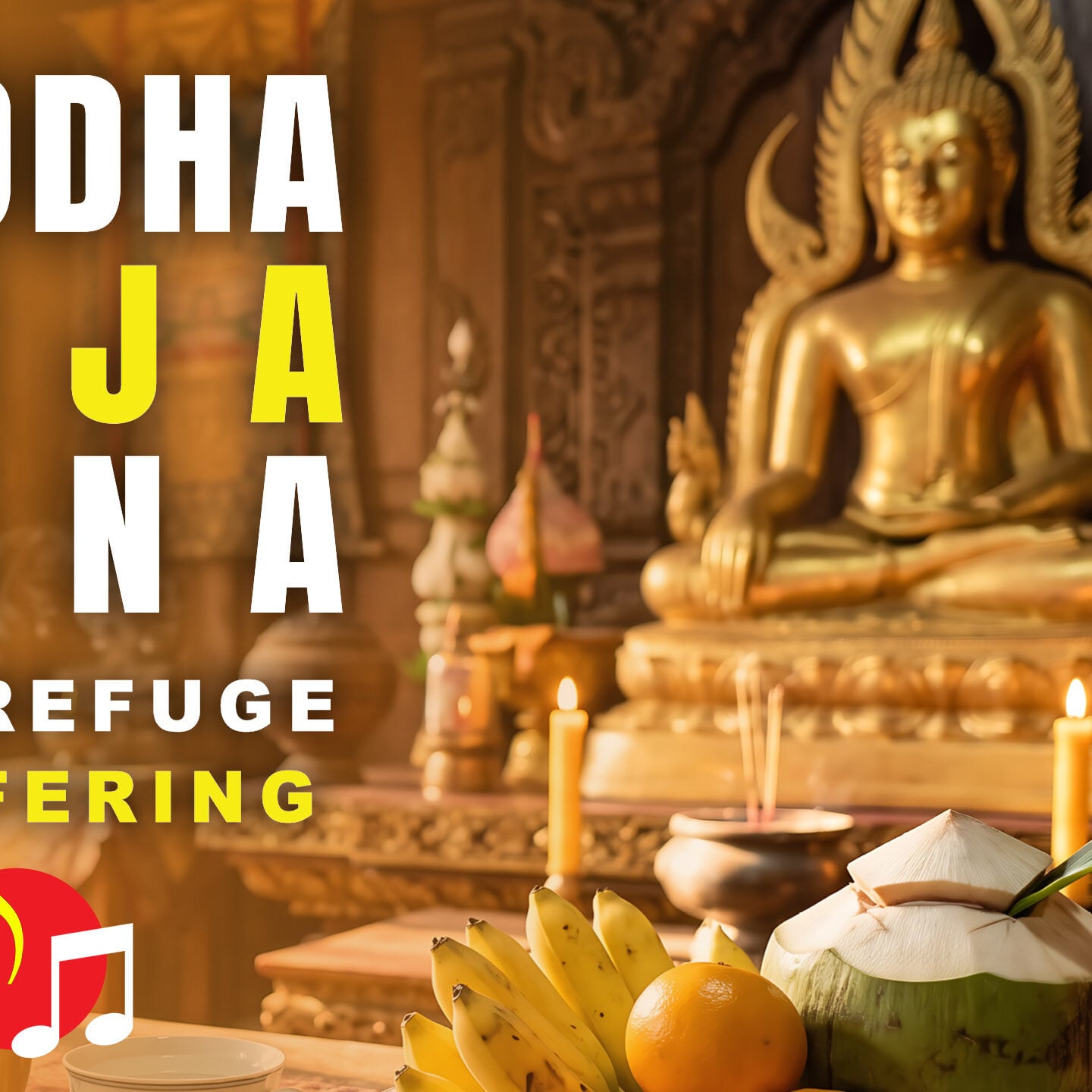
MUSIC VIDEO and PRACTICE: Śaraṇaṃ Gacchāmi Sanskrit Refuge and Offering Chanted Beautifully for Daily Practice

BENEFITS: Daily Refuge and Offering accumulates vast merit and positive karma and purifies past negative karma, removing obstacles and obstructions and taming the 5 Poisons.
VIDEO (Captioned for chant along):
FROM THE @3GemsBand – NEW RELEASE FOR OUR FIRST YEAR ANNIVERSARY on YOUTUBE! Śaraṇaṃ Gacchāmi: Sanskrit Refuge & Offering by @3GemsBand This is the SECOND in our series of foundational practices. Here we sing the Refuge in the Three Jewels, Offerings, Four Immeasurables, Aspiration and Dedications in SANSKRIT (yesterday’s release in this series was in PALI) — @3GemsBand sings the daily refuge and offerings to the Three Jewels, a crucially important practice.
(AVAILABLE on your favorite Music Streamer under 3Gems Band., title “Saranam Gacchami Sanskrit Refuge and Offering 🌟 🌟 🌟
FOR THE RELEASE, for sing along. Here are the SANSKRIT lyrics (with Devanagari, IAST (and English Translation in brackets):
Saranam Gacchami Sanskrit Refuge and Offering
(Śaraṇaṃ Gacchāmi: Sanskrit Refuge & Offering)
SECTION 1: Homage to the Buddha
Line 1
नमो तस्स भगवतो अरहतो सम्मा–सम्बुद्धस्स
Namo tasya bhagavataḥ arhataḥ sammā-sambuddhasya
(Homage to the Blessed One, the Worthy One, the Fully Enlightened Buddha)
Line 2
नमो तस्स भगवतो अरहतो सम्मा–सम्बुद्धस्स
Namo tasya bhagavataḥ arhataḥ sammā-sambuddhasya
(Homage to the Blessed One, the Worthy One, the Fully Enlightened Buddha)
Line 3
नमो तस्स भगवतो अरहतो सम्मा–सम्बुद्धस्स
Namo tasya bhagavataḥ arhataḥ sammā-sambuddhasya
(Homage to the Blessed One, the Worthy One, the Fully Enlightened Buddha)
SECTION 2: Three Refuges – First Repetition
Line 4
बुद्धं शरणं गच्छामि
Buddhaṃ śaraṇaṃ gacchāmi
(I take refuge in the Buddha)
Line 5
धर्मं शरणं गच्छामि
Dharmaṃ śaraṇaṃ gacchāmi
(I take refuge in the Dharma)
Line 6
सङ्घं शरणं गच्छामि
Saṅghaṃ śaraṇaṃ gacchāmi
(I take refuge in the Saṅgha)
SECTION 3: Three Refuges – Second Repetition
Line 7
द्वितीयम्पि बुद्धं शरणं गच्छामि
Dvitīyampi buddhaṃ śaraṇaṃ gacchāmi
(For the second time, I take refuge in the Buddha)
Line 8
द्वितीयम्पि धर्मं शरणं गच्छामि
Dvitīyampi dharmaṃ śaraṇaṃ gacchāmi
(For the second time, I take refuge in the Dharma)
Line 9
द्वितीयम्पि सङ्घं शरणं गच्छामि
Dvitīyampi saṅghaṃ śaraṇaṃ gacchāmi
(For the second time, I take refuge in the Saṅgha)
SECTION 4: Three Refuges – Third Repetition
Line 10
तृतीयम्पि बुद्धं शरणं गच्छामि
Tṛtīyampi buddhaṃ śaraṇaṃ gacchāmi
(For the third time, I take refuge in the Buddha)
Line 11
तृतीयम्पि धर्मं शरणं गच्छामि
Tṛtīyampi dharmaṃ śaraṇaṃ gacchāmi
(For the third time, I take refuge in the Dharma)
Line 12
तृतीयम्पि सङ्घं शरणं गच्छामि
Tṛtīyampi saṅghaṃ śaraṇaṃ gacchāmi
(For the third time, I take refuge in the Saṅgha)
SECTION 5: Confession of Faults – to the Buddha
Line 13
कायेन वाचा चित्तेन प्रमादेन मया कृतम्
Kāyena vācā cittena pramādena mayā kṛtam
(Whatever wrong I have done through body, speech, or mind, through negligence)
Line 14
अत्ययं क्षम मे भोः भूरिप्रज्ञ तथागत
Atyayaṃ kṣama me bhoḥ bhūriprajña tathāgata
(Forgive me that transgression, O Venerable One of great wisdom, the Tathāgata)
SECTION 6: Confession of Faults – to the Dharma
Line 15
कायेन वाचा चित्तेन प्रमादेन मया कृतम्
Kāyena vācā cittena pramādena mayā kṛtam
(Whatever wrong I have done through body, speech, or mind, through negligence)
Line 16
अत्ययं क्षम मे धर्म दृष्टधर्मिक अकालिक
Atyayaṃ kṣama me dharma dṛṣṭadharmika akālika
(Forgive me that transgression, O Dharma that is visible here-and-now and timeless)
SECTION 7: Confession of Faults – to the Saṅgha
Line 17
कायेन वाचा चित्तेन प्रमादेन मया कृतम्
Kāyena vācā cittena pramādena mayā kṛtam
(Whatever wrong I have done through body, speech, or mind, through negligence)
Line 18
अत्ययं क्षम मे सङ्घ सुप्रतिपन्न अनुत्तर
Atyayaṃ kṣama me saṅgha supratipanna anuttara
(Forgive me that transgression, O Saṅgha that has practiced well and supremely)
SECTION 8: Offering of Light – Praise to the Buddha
Line 19
गन्धसारप्रदीपेन दीपेन तमोहत
Gandhasārapradīpena dīpena tamohata
(By this fragrant, essential lamp that dispels darkness)
Line 20
त्रिलोकदीपं सम्बुद्धं पूजयामि तमोनुदम्
Trilokadīpaṃ sambuddhaṃ pūjayāmi tamonudam
(I honour the Fully Enlightened One, the light of the three worlds, the dispeller of darkness)
SECTION 9: Offering of Flowers
Line 21
वर्णगन्धगुणोपेतमेतत्कुसुमसन्तति
Varṇagandhaguṇopetam etat kusumasantatim
(This garland of flowers, endowed with colour, fragrance, and virtue)
Line 22
पूजयामि मुनीन्द्रस्य श्रीपदासरोरुहे
Pūjayāmi munīndrasya śrīpadāsaroruhe
(I offer at the lotus feet of the supreme sage)
Line 23
पूजयामि बुद्धं कुसुमेन अनेन पुण्येन एतेन च भोतु मोक्षम्
Pūjayāmi buddhaṃ kusumena anena puṇyena etena ca bhotu mokṣam
(I honour the Buddha with these flowers; may this merit bring liberation)
Line 24
पुष्पं म्लायति यथा इदं मे कायः तथा याति विनाशभावम्
Puṣpaṃ mlāyati yathā idaṃ me kāyaḥ tathā yāti vināśabhāvam
(Just as these flowers wither, so too my body will reach destruction)
SECTION 10: Offering of Food – First Request
Line 25
अधिवासयतु नो भोः भोजनं परिकल्पितम्
Adhivāsayatu no bhoḥ bhojanaṃ parikalpitam
(May the Venerable One kindly accept this prepared meal)
Line 26
अनुकम्पामुपादाय प्रतिगृह्णातु उत्तम
Anukampāmupādāya pratigṛhṇātu uttama
(Out of compassion, may the Supreme One receive it)
SECTION 11: Offering of Drink – Second Request
Line 27
अधिवासयतु नो भोः पानीयं परिकल्पितम्
Adhivāsayatu no bhoḥ pānīyaṃ parikalpitam
(May the Venerable One kindly accept this prepared drink)
Line 28
अनुकम्पामुपादाय प्रतिगृह्णातु उत्तम
Anukampāmupādāya pratigṛhṇātu uttama
(Out of compassion, may the Supreme One receive it)
SECTION 12: Offering of Everything – Third Request
Line 29
अधिवासयतु नो भोः सर्वं श्रद्धया पूजितम्
Adhivāsayatu no bhoḥ sarvaṃ śraddhayā pūjitam
(May the Venerable One kindly accept all that is offered in faith)
Line 30
अनुकम्पामुपादाय प्रतिगृह्णातु उत्तम
Anukampāmupādāya pratigṛhṇātu uttama
(Out of compassion, may the Supreme One receive it)
SECTION 13: Aspirations, Blessings & The Four Immeasurables
Line 31
इष्टं प्रार्थितं युष्माकं क्षिप्रमेव समृध्यताम्
Iṣṭaṃ prārthitaṃ yuṣmākaṃ kṣiprameva samṛdhyatām
(May all your wishes and desires quickly be fulfilled)
Line 32
सर्वे पूर्यन्तु सङ्कल्पाः चन्द्रः पूर्णरसो यथा मणिज्योतिरसो यथा
Sarve pūryantu saṅkalpāḥ candraḥ pūrṇaraso yathā maṇijyotiraso yathā
(May all your aspirations be fulfilled, like the full-moon light, like the radiant jewel)
FOUR IMMEASURABLES (BRAHMAVIHĀRĀḤ)
Line 33
मैत्रीं भावयामि सर्वेषां भूतानां सुखचेतसा
Maitrīṃ bhāvayāmi sarveṣāṃ bhūtānāṃ sukhacetasā
(I cultivate loving-kindness toward all beings with a happy mind)
Line 34
करुणां भावयामि सर्वेषां दुःखमोचनीम्
Karuṇāṃ bhāvayāmi sarveṣāṃ duḥkhamocanīm
(I cultivate compassion that frees all beings from suffering)
Line 35
मुदितां भावयामि सर्वेषां हर्षवर्धिनीम्
Muditāṃ bhāvayāmi sarveṣāṃ harṣavardhinīm
(I cultivate sympathetic joy that increases the happiness of all beings)
Line 36
उपेक्षां भावयामि सर्वेषां समचेतसा
Upekṣāṃ bhāvayāmi sarveṣāṃ samacetasā
(I cultivate equanimity toward all beings with a balanced mind)
SECTION 14: Final Homage
Line 37
बुद्धं भगवन्तमभिवादयामि
Buddhaṃ bhagavantam abhivādayāmi
(I bow down to the Buddha, the Blessed One)
Line 38
धर्मं नमस्यामि
Dharmaṃ namasyāmi
(I honour the Dharma)
Line 39
सङ्घं नमामि
Saṅghaṃ namāmi
(I bow to the Saṅgha)
More articles by this author



Search
Latest Features





Please support the "Spread the Dharma" mission as one of our heroic Dharma Supporting Members, or with a one-time donation.
Please Help Support the “Spread the Dharma” Mission!
Be a part of the noble mission as a supporting member or a patron, or a volunteer contributor of content.
The power of Dharma to help sentient beings, in part, lies in ensuring access to Buddha’s precious Dharma — the mission of Buddha Weekly. We can’t do it without you!
A non-profit association since 2007, Buddha Weekly published many feature articles, videos, and, podcasts. Please consider supporting the mission to preserve and “Spread the Dharma." Your support as either a patron or a supporting member helps defray the high costs of producing quality Dharma content. Thank you! Learn more here, or become one of our super karma heroes on Patreon.
Lee Kane
Author | Buddha Weekly
Lee Kane is the editor of Buddha Weekly, since 2007. His main focuses as a writer are mindfulness techniques, meditation, Dharma and Sutra commentaries, Buddhist practices, international perspectives and traditions, Vajrayana, Mahayana, Zen. He also covers various events.
Lee also contributes as a writer to various other online magazines and blogs.